Federalists vs Anti-Federalists
Interactive passage with audio narration, comprehension questions, and printable PDF.
By completing this purchase you agree to our Terms of Use and Privacy Policy. Your subscription renews automatically until you cancel. You can cancel anytime from your account settings. All sales are final and non-refundable. Digital content is available for download in your account immediately upon purchase.
What's included
Federalists vs Anti-Federalists preview and details
About this printable Federalists vs Anti-Federalists reading passage (Grades 6-8)
Sample passage and quiz from Federalists vs Anti-Federalists
Reading passage and comprehension quiz preview
Federalists vs Anti-Federalists
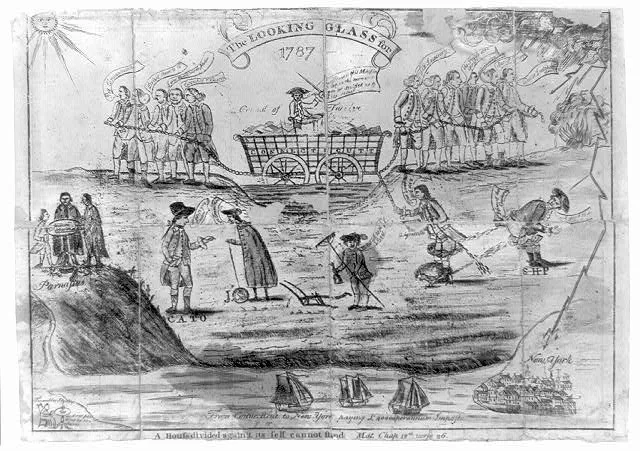
"The looking glass for 1787. A house divided against itself cannot stand. Mat. chap. 13th verse 26" by Doolittle, Amos, 1754-1832 / Library of Congress.
The debate between Federalists and Anti-Federalists was one of the most important moments in early American history. After the American Revolution, the United States needed a new government that would be stronger than the old Articles of Confederation. Some leaders believed that a powerful central government was necessary to maintain order and unity. Others feared that too much power in one place would threaten the rights people had fought for.
The Federalists, including Alexander Hamilton, James Madison, and John Jay, supported the new Constitution. They argued that only a strong central authority could solve the problems facing the nation, such as economic instability and internal conflict between the states. In their view, a national government could regulate trade, collect taxes, and provide security. The Federalists used newspapers and essays to make their case. In The Federalist Papers, Alexander Hamilton wrote, “A nation without a national government is, in my view, an awful spectacle.” This quote shows the Federalists’ belief that unity and strength depended on a strong government.
On the other hand, the Anti-Federalists were deeply concerned about the possibility of tyranny. Leaders like Patrick Henry and George Mason argued that the Constitution gave too much power to the federal government and did not protect individual rights. The Anti-Federalists wanted a Bill of Rights to guarantee freedoms such as speech, religion, and trial by jury. They believed that only strong state governments could protect the people from oppression.
This conflict was not just about government structure—it was about trust, experience, and the lessons of history. The Federalists trusted that a balanced system with checks and balances would prevent abuses. The Anti-Federalists remembered the dangers of British rule and wanted clear limits on power. Despite their differences, both sides cared deeply about liberty and justice. Their arguments show the contradiction at the heart of the debate: how to balance freedom with the need for effective government.
After months of heated debate, a compromise was reached. The Federalists agreed to add a Bill of Rights to the Constitution, satisfying many Anti-Federalist concerns. This solution allowed the Constitution to be ratified and created a foundation for American democracy. The debate highlighted the importance of civic participation, as regular citizens read, discussed, and voted on the new plan for government.
In conclusion, the Federalists and Anti-Federalists shaped the nation by challenging each other’s ideas and forcing Americans to consider what kind of country they wanted to build. Their debate remains relevant today because it raises questions about power, rights, and the responsibilities of government that citizens still discuss.
Interesting Fact: The Bill of Rights, demanded by the Anti-Federalists, was added to the Constitution in 1791, just four years after the original document was signed.
Comprehension quiz (8 questions)
1. Who supported the new Constitution?
2. Who wanted a Bill of Rights?
3. When was the Bill of Rights added?
4. Why did Federalists want a strong government?
5. What worried Anti-Federalists most?
6. What was the result of the debate?
7. The Constitution was ratified in 1788. True or false?
8. What does 'contradiction' mean?
Common Core standards for Federalists vs Anti-Federalists
Explain events, procedures, ideas, or concepts in a historical, scientific, or technical text, including what happened and why, based on specific information in the text.
Determine the meaning of general academic and domain-specific words or phrases in a text relevant to a grade 4 topic or subject area.
Write informative/explanatory texts to examine a topic and convey ideas and information clearly.
Perfect for the way you teach
- Build comprehension skills
- Auto-graded quiz
- Differentiated reading
- Read together at home
- Improve fluency
- Quiet reading time
- Reading curriculum support
- Independent practice
- Track Lexile growth