Fixing the Land After the Dust Bowl
Interactive passage with audio narration, comprehension questions, and printable PDF.
By completing this purchase you agree to our Terms of Use and Privacy Policy. Your subscription renews automatically until you cancel. You can cancel anytime from your account settings. All sales are final and non-refundable. Digital content is available for download in your account immediately upon purchase.
What's included
Fixing the Land After the Dust Bowl preview and details
About this printable Fixing the Land After the Dust Bowl reading passage (Grades 3-5)
Sample passage and quiz from Fixing the Land After the Dust Bowl
Reading passage and comprehension quiz preview
Dust Bowl Recovery
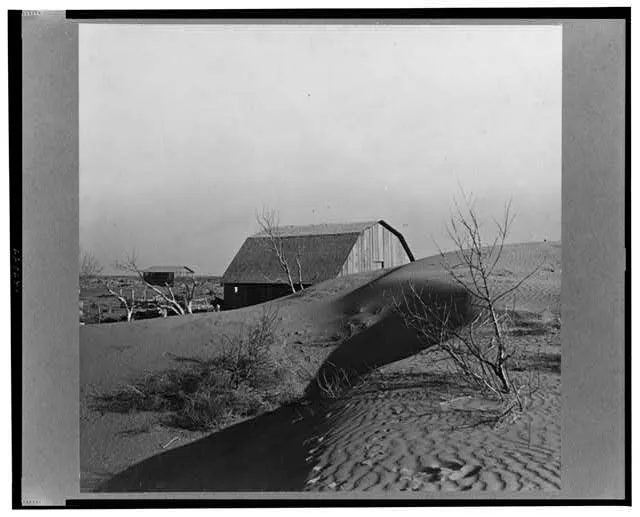
Source: Library of Congress - Rothstein, Arthur, 1915-1985
The Dust Bowl was a time in the 1930s when huge dust storms swept across the Great Plains. Wind blew away the topsoil because the land was very dry. This happened after years of drought and bad farming practices. Crops could not grow, and many families lost their farms.
Farmers and the government knew they had to make a change. The United States government started new recovery programs to help farmers. One important group was the Soil Conservation Service. This group taught farmers better ways to care for the land. Farmers learned to plant trees in rows called windbreaks. These trees stopped the wind from blowing away the soil.
People also learned new ways to plow the land. Instead of leaving fields bare, they planted cover crops to protect the soil. Farmers built terraces, which are small steps on hillsides. Terraces slowed down rainwater and kept soil from washing away.
Many farmers joined together to share ideas and help each other. They worked as a team. The government gave them new seeds and tools. Recovery programs paid some farmers to plant grass instead of crops. Grass roots held the soil in place. These changes helped the land heal.
After several years of hard work, the Great Plains started to recover. Rain finally returned, and crops began to grow again. Because of new farming practices and government programs, dust storms became less common.
The Dust Bowl taught Americans the importance of soil conservation. By caring for the land, farmers made sure that people could grow food and live in the Great Plains for many years to come.
Interesting Fact: After the Dust Bowl, more than 200 million trees were planted in the Great Plains to protect the soil from wind.
Comprehension quiz (8 questions)
1. What caused the Dust Bowl?
2. What is a windbreak?
3. Which group helped farmers recover?
4. Why did farmers plant cover crops?
5. How did terraces help the land?
6. What happened after rain returned?
7. The Dust Bowl recovery used new farming methods.
8. What does 'soil conservation' mean?
Common Core standards for Fixing the Land After the Dust Bowl
Explain events, procedures, ideas, or concepts in a historical, scientific, or technical text, including what happened and why, based on specific information in the text.
Determine the meaning of general academic and domain-specific words or phrases in a text relevant to a grade 4 topic or subject area.
Paraphrase portions of a text read aloud or information presented in diverse media and formats, including visually, quantitatively, and orally.
Write informative/explanatory texts to examine a topic and convey ideas and information clearly.
Perfect for the way you teach
- Build comprehension skills
- Auto-graded quiz
- Differentiated reading
- Read together at home
- Improve fluency
- Quiet reading time
- Reading curriculum support
- Independent practice
- Track Lexile growth