This learning resource is available in interactive and printable formats. The interactive worksheet can be played online and assigned to students. The Printable PDF version can be downloaded and printed for completion by hand.
This passage explores the complex causes and lasting effects of the French and Indian War, a pivotal conflict in colonial North America. Students will analyze the motivations of British, French, and Native American groups and examine how competition for territory, resources, and power led to alliances and conflict. The text addresses the consequences for colonists and Indigenous peoples, including changes in territory, economic impacts, and growing tensions that contributed to the American Revolution. Featuring a primary source quote, a glossary of key terms, and a detailed timeline, the passage models historical reasoning and evidence use. The resource aligns with D2.His.2.3-5, D2.His.3.3-5, RI.4.3, RI.4.4, W.4.2, and includes read aloud audio and a full Spanish translation. Activities include a multiple-choice quiz, writing prompts, and a graphic organizer to help students master the topic and develop their historical thinking skills.
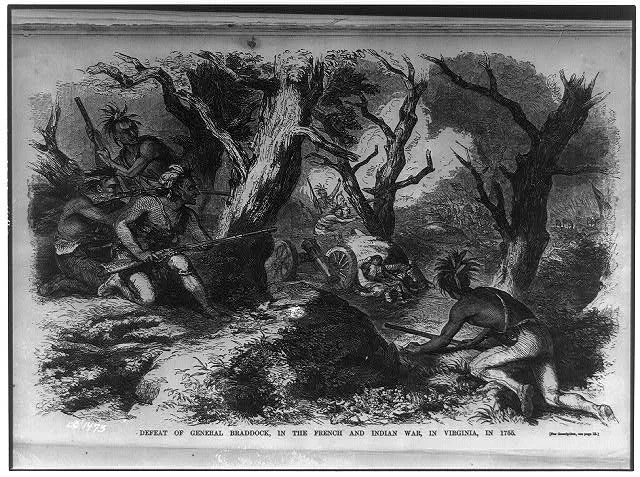
Defeat of General Braddock, in the French and Indian War, in Virginia in 1755 Source: Library of Congress - Andrew, John, 1815-1870
The French and Indian War began in 1754 as a struggle between Britain and France for control of land and resources in North America. Both nations claimed the vast Ohio River Valley, an area rich in fur trade and valuable land for settlers. This competition created tension not only between the two European powers but also among the many Native American nations living in the region. The war is called the French and Indian War because many Native American groups allied with the French against the British and their colonial settlers.
One major cause of the conflict was the desire for economic and territorial expansion. British colonists wanted to move westward and establish farms on land controlled by Native Americans and claimed by France. The French, meanwhile, built forts to protect their trade networks and block British movement. Native American groups, such as the Iroquois Confederacy, often chose sides based on who would best protect their own interests. As one Mohawk leader said in a council speech, “We are unwilling to see our lands made a scene of blood.” This quote shows that Native Americans were deeply concerned about the violence and the loss of their homelands.
The war’s beginning was marked by a series of small clashes. In 1754, a young George Washington led Virginia troops against a French force at Fort Duquesne. The British government soon sent more soldiers from Europe, turning the conflict into a large-scale war. Both the British and the French relied on alliances with Native Americans, but their approaches were different. The French often built trading partnerships and respected Native customs. The British, on the other hand, tended to push for settlement and control, causing mistrust among some Indigenous groups. This difference in strategy had important consequences for the war’s outcome and for relationships after the war.
The effects of the French and Indian War were far-reaching. The British eventually defeated the French in 1763, gaining control of Canada and all French lands east of the Mississippi River. However, this victory came with problems. Britain had spent huge sums on the war and expected the American colonists to help pay the debt through new taxes. This sparked anger and resentment among the colonists, who felt they had not been fairly represented in these decisions. At the same time, Native American nations lost land and power as British settlers moved westward. The British government tried to stop further conflict with the 1763 Proclamation Line, forbidding colonists from settling west of the Appalachian Mountains, but many settlers ignored it.
Different groups experienced the war in unique ways. British colonists gained new territory but faced greater control from the British government. Native Americans lost land and autonomy, and their alliances with the French no longer offered protection. The French, having lost their North American empire, withdrew from most of the continent. The war’s conclusion set the stage for new conflicts. The resentment over taxes and restrictions helped spark the American Revolution just over a decade later.
In summary, the French and Indian War was not simply a battle between two European powers. It was a complex struggle involving economic ambitions, fragile alliances, and competing claims to land. By considering the perspectives of British, French, and Native American peoples, we see that the war’s causes and effects were deeply rooted in larger issues of power and territory. The decisions made during and after the war shaped the future of North America.
Interesting Fact: Benjamin Franklin proposed the Albany Plan of Union during the war, suggesting the colonies unite for defense. Although it was not adopted, it was an early idea of American unity.
When did the French and Indian War begin?
1754177617831607
Which area was fought over in the war?
Ohio River ValleyRocky MountainsGreat PlainsGulf Coast
Who allied with the French?
Many Native AmericansSpanish settlersBritish colonistsDutch traders
Why did Britain tax colonists after the war?
To repay war debtTo pay Native AmericansTo build more fortsTo reward the French
What was the Proclamation Line of 1763?
Banned colonists from moving westLet French settle anywhereGave Canada to FranceAllied with the Iroquois
What did some Native Americans fear most?
Loss of homelandsBritish languageFrench soldiersSpanish ships
True or False: The war ended in 1763.
TrueFalse
What does 'autonomy' mean in the passage?
Self-governmentA type of fortA battleA trade route
Perfect For:
👩🏫 Teachers
• Reading comprehension practice
• Auto-graded assessments
• Literacy skill development
👨👩👧👦 Parents
• Reading practice at home
• Comprehension improvement
• Educational reading time
🏠 Homeschoolers
• Reading curriculum support
• Independent reading practice
• Progress monitoring
Reading Features:
📖
Reading Passage
Engaging fiction or nonfiction text
❓
Comprehension Quiz
Auto-graded questions
📊
Instant Feedback
Immediate results and scoring
📄
Printable Version
Download for offline reading
🔊
Read Aloud
Voice-over with word highlighting
Related Content
Informational Text —Healthy Teeth and Gums
RI.4.10RI.4.3RF.4.4RF.4.4.A
Natural Disasters and Urban flooding
This reading comprehension worksheet focuses on the topic of natural disasters, specifically urban flooding. Following t...
RI.4.44-ESS3ESS3.B4-ESS3-1
The Formation of Fossils
L.4.2.DL.4.6RI.4.4
Climate and Water Cycle
W.4.2.ARI.4.4RI.4.1
Ocean Acidification
Download this reading comprehension worksheet about ocean acidification. The worksheet includes an informational text ab...
RI.4.4
Informational Text —The History of Toothpaste
RI.4.4RI.4.4
Informational Text —Migratory Birds
Engage young minds with this worksheet that delves into the wonders of migratory birds. Learn about their extraordinary ...
RI.4.10RI.4.3RF.4.4RF.4.4.A
Informational Text —All About Dentists
Students read an informational text explaining what dentists do and how they are trained. Aligned to RI.4.3-2
RI.4.10RI.4.3RF.4.4RF.4.4.A
Understanding Climate Action Context Clues
Understanding Climate Action" worksheet, aligned with CCS L.4.4.A and NGSS. This resource introduces key concepts such a...
L.4.4.ARI.4.1RI.4.4
Pollination: A Crucial Ecosystem Service
Explore the vital role of pollination beyond plant reproduction, as it sustains ecosystems by ensuring food security, pr...
RI.4.2RI.4.3RI.4.4RI.5.1
The States of Matter: Solid
Discover the differences between solids, liquids and gases by exploring how their particles are arranged and move. This ...
RI.4.2RI.4.3RI.4.4RI.5.1
What is a Simple Machine
Discover the power of simple machines! This informational text explores how basic tools like levers, pulleys and incline...
RI.4.2RI.4.3RI.4.4RI.5.1
The Role of Pollinators in Nature
Learn about the fascinating world of pollinators and discover their crucial role in the reproductive process of flowerin...
RI.4.2RI.4.3RI.4.4RI.5.1
Seed Dispersal: How Plants Travel
Plants may seem stationary, but their seeds have amazing ways to travel! Explore the fascinating world of seed dispersal...
RI.4.2RI.4.3RI.4.4RI.5.1
Sunspots and Solar Flares
This quiz is designed to test your understanding of the fascinating phenomena of sunspots and solar flares, as described...
RI.4.1RI.4.4RI.5.1ESS1.A
Learn about the Inner Planets
The inner planets of our solar system—Mercury, Venus, Earth, and Mars—are fascinating worlds made of rock and metal. Clo...
RI.4.4RI.4.2
The Sun: Our Nearest Star
The Sun is the heart of our solar system and the closest star to Earth. Composed of hot plasma, the Sun generates energy...
RI.4.4RI.4.2
Exploring Space: Rockets and Spacecraft
Space exploration has been one of humanity's greatest achievements, made possible by rockets and spacecraft. Rockets act...
RI.4.4RI.4.2
Understanding the Inner Planets
The inner planets of the solar system—Mercury, Venus, Earth, and Mars—are known for their solid, rocky surfaces. Mercury...
RI.4.4RI.4.2
The Sun: Our Special Star
The Sun is the closest star to Earth and the center of our solar system.