French Revolution and America
Interactive passage with audio narration, comprehension questions, and printable PDF.
By completing this purchase you agree to our Terms of Use and Privacy Policy. Your subscription renews automatically until you cancel. You can cancel anytime from your account settings. All sales are final and non-refundable. Digital content is available for download in your account immediately upon purchase.
What's included
French Revolution and America preview and details
About this printable French Revolution and America reading passage (Grades 6-8)
Sample passage and quiz from French Revolution and America
Reading passage and comprehension quiz preview
French Revolution and America
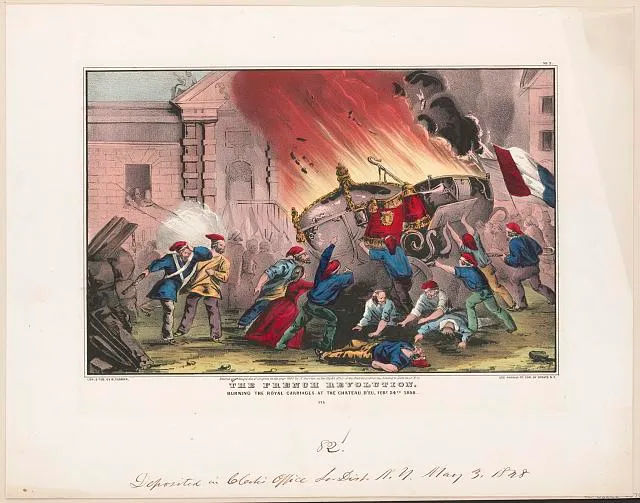
"The French revolution: burning the royal carriages at the Chateau d'Eu, Feby. 24, 1848" by N. Currier (Firm) / Library of Congress.
The French Revolution began in 1789 and quickly caught the attention of people around the world, including the citizens of the new United States. The revolution promised liberty and equality, ideals that had inspired Americans during their own struggle for independence. However, the French Revolution also became known for its violent phase, including the execution of King Louis XVI and thousands of others. These events forced Americans to consider their own position in global affairs and led to heated debates about the country’s foreign policy.
Americans were divided over how to respond. Many, like Thomas Jefferson, believed the United States should support France. They argued that France had helped America during the Revolutionary War, and that it was only right to help them in their fight for freedom. For Jefferson and his supporters, the French Revolution represented the same ideals of democracy and self-government that Americans valued. These Americans feared that refusing to support France would be a betrayal of both an ally and the cause of liberty worldwide.
Others, including Alexander Hamilton and President George Washington, were deeply concerned about the violence and instability in France. They worried that supporting the revolution could drag the United States into dangerous conflicts. These leaders believed that the United States should remain neutral, avoiding alliances that could lead to war. Washington’s Proclamation of Neutrality in 1793 declared that the U.S. would not take sides in the conflict between France and its enemies. This decision became an important example of American neutrality in world affairs.
The debate over the French Revolution revealed deeper division in American society. Supporters of France, known as Democratic-Republicans, and supporters of neutrality, often called Federalists, disagreed about what path the new nation should follow. Should America take an active role in supporting revolutions abroad, or should it protect itself by staying out of foreign conflicts? This debate shaped the early years of American politics and led to the formation of the country’s first political parties.
These divisions were not just about foreign events. They reflected different visions for America’s future. Some Americans wanted a strong connection to revolutionary ideas and believed the U.S. should help other countries gain freedom. Others thought the young nation should focus on stability and avoid foreign entanglements. This contrast influenced debates about the Constitution, the strength of the federal government, and the identity of the United States as a nation.
In the end, Washington’s policy of neutrality set a precedent for future American foreign policy. The fierce debates over the French Revolution showed that the United States was still defining its values and place in the world. These early arguments helped shape the political system and the nation’s approach to international relations.
Interesting Fact: The phrase "entangling alliances," often used to describe Washington’s approach, became a guiding principle for U.S. foreign policy for many years, influencing decisions long after the French Revolution ended.
Comprehension quiz (8 questions)
1. When did the French Revolution begin?
2. Who was President during the Neutrality Proclamation?
3. What did supporters of France value most?
4. Why did some Americans fear supporting France?
5. What was one main result of these debates?
6. How did neutrality affect U.S. foreign policy?
7. The U.S. took France’s side in the war. True or false?
8. What does 'neutral' mean in this passage?
Common Core standards for French Revolution and America
Explain events, procedures, ideas, or concepts in a historical, scientific, or technical text, including what happened and why, based on specific information in the text.
Determine the meaning of general academic and domain-specific words or phrases in a text relevant to a grade 4 topic or subject area.
Write informative/explanatory texts to examine a topic and convey ideas and information clearly.
Perfect for the way you teach
- Build comprehension skills
- Auto-graded quiz
- Differentiated reading
- Read together at home
- Improve fluency
- Quiet reading time
- Reading curriculum support
- Independent practice
- Track Lexile growth