Fugitive Slave Act Opposition — Reading Comprehension
Rate this
Premium Resource
Present
Present in classroom. No work saved
Assign
Classroom with student accounts, Track progress
Quick Play
No student accounts, assign with a link
Grades
6
7
8
Standards
D2.HIS.2.3-5
D2.HIS.3.3-5
RI.4.3
RI.4.4
W.4.2
PRINT+DIGITAL RESOURCE
This learning resource is available in interactive and printable formats. The interactive worksheet can be played online and assigned to students. The Printable PDF version can be downloaded and printed for completion by hand.
This passage examines the Fugitive Slave Act of 1850 and the complex challenges of its enforcement in the Northern United States. Students will analyze the causes behind the law, the motivations of both supporters and opponents, and the consequences for individuals and society. The text incorporates multiple perspectives, including those of abolitionists, free Black communities, and law enforcement officials. It includes a primary source quote, encourages historical reasoning, and models vocabulary such as 'jurisdiction,' 'abolitionist,' and 'compromise.' The lesson aligns with C3 Framework (D2.His.2.3-5, D2.His.3.3-5) and Common Core standards (RI.4.3, RI.4.4, W.4.2). Activities include a detailed glossary, comprehension quiz, writing prompts, a T-Chart graphic organizer, and a timeline of key events. The passage offers both English and Spanish versions and includes read aloud audio for accessibility.
CONTENT PREVIEW
Expand content preview
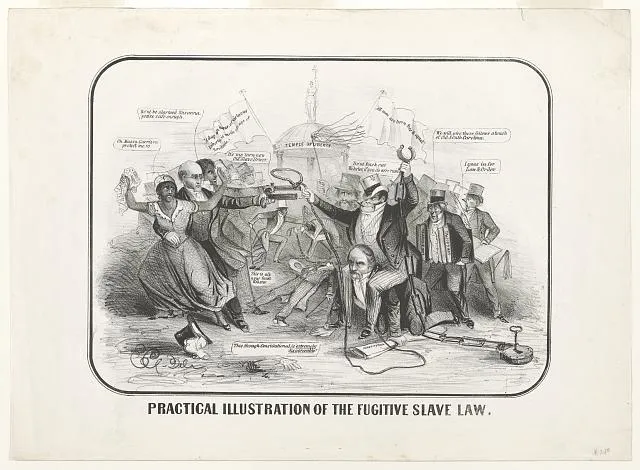
"Practical illustration of the Fugitive Slave Law" / Library of Congress.
The Fugitive Slave Act of 1850 was a federal law that required citizens in free states to help capture and return people who had escaped slavery in the South. This law was passed as part of the Compromise of 1850, an agreement intended to settle disputes over the expansion of slavery into new territories. The act increased penalties for anyone who aided a fugitive, or escaped enslaved person, and gave government agents the power to enforce the law across the North.
The enforcement of the Fugitive Slave Act caused significant opposition in Northern communities. Many Northerners who had previously ignored the issue of slavery were forced to confront its injustice directly. Some individuals became actively involved in resistance efforts, supporting abolitionist groups and helping fugitives escape through networks like the Underground Railroad. The law made it dangerous for both fugitives and those offering assistance, as even free Black citizens could be falsely accused and captured.
This opposition was not limited to a few activists. Towns, churches, and even local governments sometimes refused to cooperate with federal authorities. Some states passed so-called “personal liberty laws,” which tried to block or limit the Act’s enforcement. These laws provided legal protections for accused fugitives and prevented state officials from helping federal marshals.
The conflict over the Fugitive Slave Act highlighted the deep divisions in the United States regarding slavery. While Southern states demanded strict enforcement to protect their economic interests, many Northerners viewed the Act as a violation of their own moral and legal principles. The law forced people to choose between following federal rules and obeying their conscience.
Key events, such as the 1851 rescue of Shadrach Minkins in Boston and the 1854 Anthony Burns case, showed how public protests and legal battles were used to challenge the Act. Newspapers reported widely on these incidents, spreading awareness and fueling more organized resistance. These confrontations increased tensions between North and South and contributed to the growing national debate over slavery.
In summary, the opposition to the Fugitive Slave Act played a major role in shaping political and social attitudes before the Civil War. It forced Americans to question the meaning of justice, freedom, and obedience to law. The growing resistance in the North made clear that the issue of slavery could no longer be ignored or easily compromised.
Interesting Fact: In some towns, citizens formed “vigilance committees” to warn fugitives and help protect them from slave catchers, showing organized community action against the law.
What year was the Fugitive Slave Act passed?
1850186517761820
Who did the law require to help capture fugitives?
NorthernersOnly SouthernersOnly policeJudges
Which city saw the rescue of Shadrach Minkins?
BostonNew YorkPhiladelphiaChicago
Why did many Northerners oppose the Act?
It felt unjustIt was popularIt helped all peopleIt was easy to ignore
What was the Underground Railroad?
A secret escape networkA real railroadA Southern lawA church group
What did personal liberty laws do?
Protected accused fugitivesHelped slave catchersSupported slaveryMade new states
True or False: Vigilance committees helped fugitives.
TrueFalse
What does 'resistance' mean?
Fighting against somethingHelping a lawMoving to a new placeVoting in elections
Perfect For:
👩🏫 Teachers
• Reading comprehension practice
• Auto-graded assessments
• Literacy skill development
👨👩👧👦 Parents
• Reading practice at home
• Comprehension improvement
• Educational reading time
🏠 Homeschoolers
• Reading curriculum support
• Independent reading practice
• Progress monitoring
Reading Features:
📖
Reading Passage
Engaging fiction or nonfiction text
❓
Comprehension Quiz
Auto-graded questions
📊
Instant Feedback
Immediate results and scoring
📄
Printable Version
Download for offline reading
🔊
Read Aloud
Voice-over with word highlighting
Reviews & Ratings
No reviews yet. Be the first to share your experience!
Related Content
Native American Tribes Across America
This engaging history reading passage introduces students to Native American tribes across America, focusing on their da...
D2.HIS.1.3-5D2.HIS.2.3-5RI.4.1RI.4.2
Teepees: Homes on the Great Plains
This engaging history reading passage introduces students to teepees, the unique homes of Native American tribes on the ...
D2.HIS.2.3-5D2.HIS.14.3-5RI.4.1RI.4.2RI.4.4
Traditional Native American Clothing
This engaging history passage explores traditional Native American clothing and how it reflected the environment, values...
D2.HIS.2.3-5D2.HIS.3.3-5RI.4.3RI.4.4
The Iroquois Confederacy: A System of Peace
This engaging U.S. History reading passage introduces students to the Iroquois Confederacy, a powerful alliance of Nativ...
D2.HIS.2.3-5D2.HIS.3.3-5RI.4.3RI.4.4
The Cherokee Nation: History and Culture
This reading passage explores the rich history and culture of the Cherokee Nation, one of the largest Native American tr...
D2.HIS.2.3-5D2.HIS.14.3-5RI.4.3RI.4.4RI.4.10
The Sioux: Warriors and Tribal Leaders
This history reading passage explores the Sioux Nation, focusing on their roles as warriors and tribal leaders. Students...
D2.HIS.1.3-5D2.HIS.2.3-5RI.4.1RI.4.3
Native American Respect for Nature
This engaging history reading passage explores Native American respect for nature, emphasizing the close relationship be...
D2.HIS.2.3-5D2.HIS.3.3-5RI.4.3RI.4.4
Jamestown: The First Permanent English Colony
This engaging history passage explores the founding of Jamestown, the first permanent English colony in America. Aligned...
D2.HIS.1.3-5D2.HIS.2.3-5RI.4.3RI.4.4
Pocahontas and the Powhatan People
This engaging reading passage explores the life of Pocahontas and the Powhatan people and their important role in early ...
D2.HIS.1.3-5D2.HIS.2.3-5RI.4.1RI.4.3
Colonial Children: School and Chores
This reading passage explores the daily lives of colonial children, focusing on their experiences at school and their ma...
D2.HIS.2.3-5D2.HIS.3.3-5RI.4.1RI.4.2RI.4.4
Colonial Clothing and Homemade Goods
This engaging U.S. history passage explores the daily life of early American colonists with a focus on colonial clothing...
D2.HIS.2.3-5RI.4.3RI.4.4
Colonial Jobs: Blacksmiths, Bakers, and Craftsmen
This engaging history reading passage explores the vital roles of blacksmiths, bakers, and craftsmen in colonial America...
D2.HIS.2.3-5D2.HIS.3.3-5RI.4.3RI.4.4
Colonial Towns and Village Life
This engaging history reading passage explores the daily life, work, and unity found in colonial towns and villages. Ali...
D2.HIS.1.3-5D2.HIS.2.3-5RI.4.3RI.4.4
Colonial Trade with England and Africa
This history reading passage explores colonial trade between the American colonies, England, and Africa, focusing on the...
D2.HIS.2.3-5D2.HIS.14.3-5RI.4.3RI.4.4
Benjamin Franklin: Printer, Inventor, and Leader
This history reading passage explores the life and achievements of Benjamin Franklin, one of America's most important ea...
D2.HIS.2.3-5D2.HIS.3.3-5RI.4.1RI.4.3
George Washington Leads the Army
This engaging history reading passage explores how George Washington bravely led the Continental Army during the America...
D2.HIS.1.3-5D2.HIS.2.3-5RI.4.3RI.4.4
Women and Children During the Revolutionary War
This reading passage explores the important roles women and children played during the Revolutionary War. Students will ...
D2.HIS.2.3-5RI.4.3RI.5.3
African Americans Fight for Freedom
This educational passage explores the brave and inspiring story of how African Americans fought for freedom in the Unite...
D2.HIS.2.3-5D2.HIS.3.3-5RI.4.3RI.4.4
The Battle of Yorktown Ends War
This engaging U.S. history reading passage explores the Battle of Yorktown, a key event that ended the American Revoluti...
D2.HIS.1.3-5D2.HIS.2.3-5RI.4.1RI.4.3
Loyalists vs. Patriots: Divided Families
This engaging U.S. history reading passage explores the division between Loyalists and Patriots during the American Revo...