Gettysburg Address
Interactive passage with audio narration, comprehension questions, and printable PDF.
By completing this purchase you agree to our Terms of Use and Privacy Policy. Your subscription renews automatically until you cancel. You can cancel anytime from your account settings. All sales are final and non-refundable. Digital content is available for download in your account immediately upon purchase.
What's included
Gettysburg Address preview and details
About this printable Gettysburg Address reading passage (Grades 6-8)
Sample passage and quiz from Gettysburg Address
Reading passage and comprehension quiz preview
Gettysburg Address
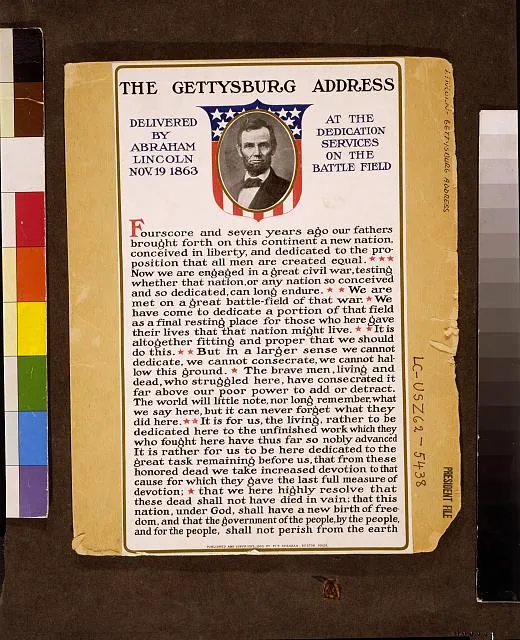
Source: Library of Congress
On November 19, 1863, President Abraham Lincoln delivered the Gettysburg Address during a ceremony to dedicate the new national cemetery at Gettysburg, Pennsylvania. This location was the site of one of the bloodiest battles of the American Civil War. The address was brief, lasting just over two minutes, but its impact has lasted for generations. Lincoln’s words honored the soldiers who died and challenged Americans to understand the true purpose of the war.
The Civil War was a conflict between the Northern and Southern states over issues such as slavery and states’ rights. The Battle of Gettysburg, fought in July 1863, was a turning point. Thousands of Union and Confederate soldiers lost their lives in this fierce struggle. The cemetery dedication gave the nation a moment to mourn, but also to reflect on why the battle—and the war—mattered.
In his speech, Lincoln reminded listeners that the United States was founded on the idea of equality, as stated in the Declaration of Independence. He said the war was not just about preserving the Union, but about whether a nation "conceived in liberty, and dedicated to the proposition that all men are created equal," could survive. This was a powerful call, linking the sacrifices at Gettysburg to the nation’s founding principles.
Lincoln used the occasion to redefine the Civil War as a test of democracy itself. He said the fallen soldiers had given their "last full measure of devotion," and it was up to the living to continue their work. The President urged Americans to dedicate themselves to a "new birth of freedom" that would ensure government "of the people, by the people, for the people, shall not perish from the earth."
This message was especially important because many people at the time were divided over the war’s purpose. By focusing on democracy and equality, Lincoln encouraged unity and gave the North a moral reason to continue fighting. The legacy of the Gettysburg Address is seen in how it shaped American values and the nation’s identity.
Over time, the Gettysburg Address has become one of the most famous speeches in American history. Schoolchildren recite its words, and historians study its meaning. Lincoln’s message continues to inspire those who believe in freedom and justice.
Interesting Fact: Lincoln was not the main speaker at the ceremony. Many newspapers did not mention his speech at first, but today it is considered one of the greatest speeches ever given.
Comprehension quiz (8 questions)
1. When was the Gettysburg Address delivered?
2. Where did Lincoln give his famous speech?
3. What was being dedicated at the ceremony?
4. Why was the Battle of Gettysburg important?
5. What idea did Lincoln connect to the war?
6. How did Lincoln redefine the war's purpose?
7. The Gettysburg Address lasted over ten minutes. (True/False)
8. What does 'legacy' mean in the passage?
Common Core standards for Gettysburg Address
Explain events, procedures, ideas, or concepts in a historical, scientific, or technical text, including what happened and why, based on specific information in the text.
Determine the meaning of general academic and domain-specific words or phrases in a text relevant to a grade 4 topic or subject area.
Write informative/explanatory texts to examine a topic and convey ideas and information clearly.
Perfect for the way you teach
- Build comprehension skills
- Auto-graded quiz
- Differentiated reading
- Read together at home
- Improve fluency
- Quiet reading time
- Reading curriculum support
- Independent practice
- Track Lexile growth