This learning resource is available in interactive and printable formats. The interactive worksheet can be played online and assigned to students. The Printable PDF version can be downloaded and printed for completion by hand.
This middle school science reading passage introduces students to the science of temperature records and how direct measurements have revealed global warming trends since the late 1800s. Aligned with NGSS standard MS-ESS3-5, the passage explains the mechanisms behind temperature measurement, the use of thermometers, satellites, ships, and buoys, and the significance of the data they collect. Students will understand that Earth's global average temperature has risen by about 1.1°C (2°F) since pre-industrial times, with most of the warming occurring since 1980. The passage explores why the oceans absorb most of this excess heat, how scientists account for the urban heat island effect, and why multiple independent datasets reinforce the same warming trend. Activities include comprehension questions, vocabulary, writing prompts, and graphic organizers to deepen understanding. Audio integration supports diverse learners. This resource is ideal for grades 6-8 science classes examining human impact on Earth's systems.
CONTENT PREVIEW
Expand content preview
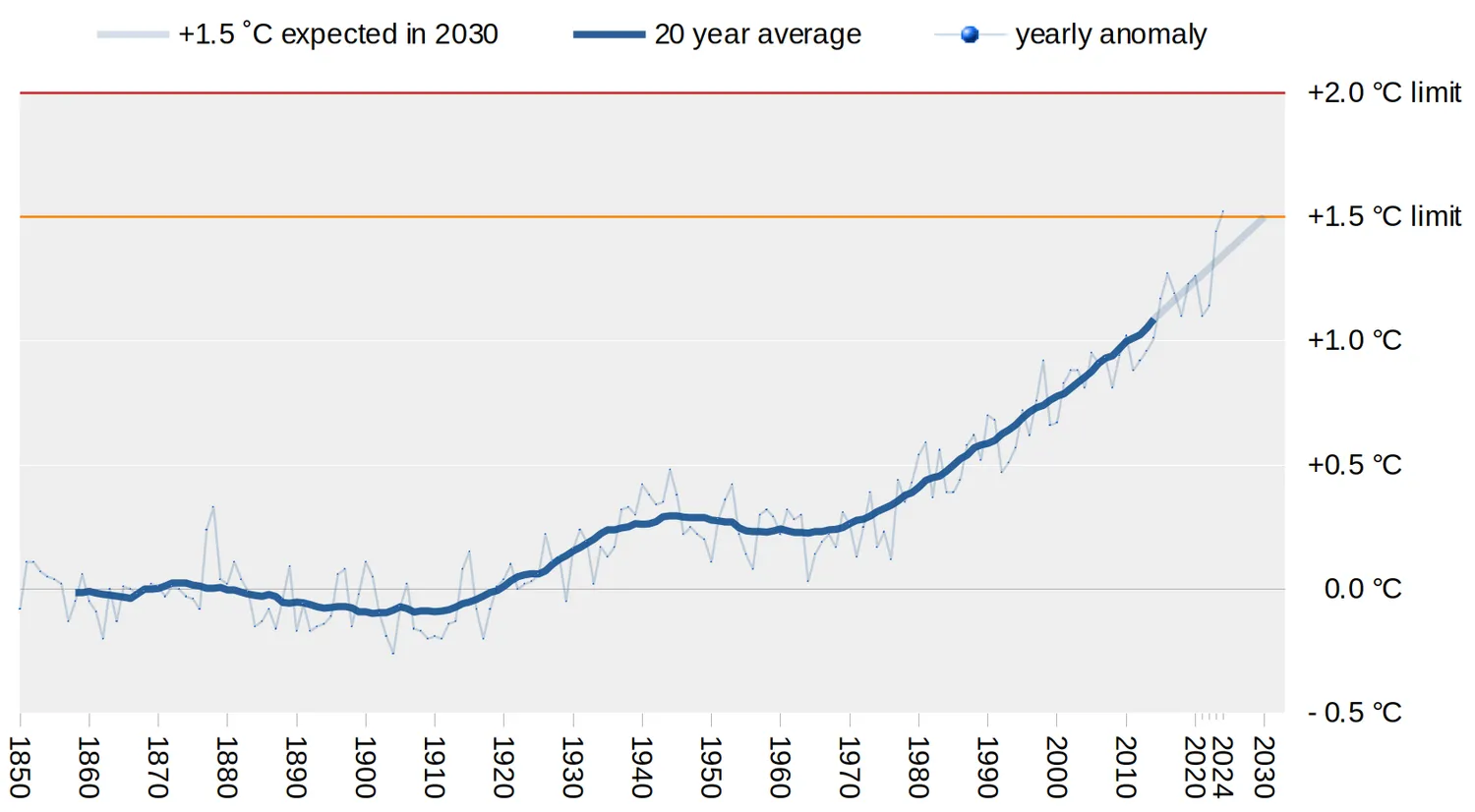
Global average temperature anomaly 1850 - 2016, World Meteorological Organization, Press Release 04/2017, 2017-03-21 by World Meteorological Organization / Wikimedia Commons
Earth’s average temperature is not constant. Over the past 140 years, scientists have noticed a clear trend: the planet is getting warmer. This is not just a guess or a feeling—it is measured and recorded. Careful observations show that, since the late 1800s, global average temperature has risen by about 1.1°C (2°F). Most of this warming has taken place since 1980, making the last two decades the warmest years on record. Understanding this trend is important for predicting future climate and preparing for its impacts.
How Scientists Measure Temperature
Scientists use many methods to track changes in Earth’s temperature. The most direct way is with thermometers at weather stations around the world. These thermometers have been collecting daily measurements since the late 1800s, providing a long-term record. However, thermometers only measure the air at specific locations. To get a global picture, scientists also use satellites that measure temperatures from space and buoys that float in the oceans. Ships also collect data as they travel. By combining all these sources—thousands of weather stations, satellites, ships, and buoys—scientists can calculate Earth’s average temperature with a high degree of accuracy. Multiple independent scientific groups analyze the data separately, but they all find the same warming trend. This agreement increases confidence in the results.
Not Just Air: Oceans and Urban Effects
About 90% of the extra heat trapped by the planet goes into the oceans. This is because water absorbs heat more effectively than air. Ocean temperatures have risen alongside air temperatures, which scientists confirm with thermometer and buoy data. As a result, marine heatwaves have become more common. Scientists also account for the urban heat island effect, which means cities are often warmer than surrounding areas due to concrete and asphalt. To avoid bias, they adjust their data to make sure warming trends are not just due to cities. This careful process ensures that the measured warming reflects changes across the entire planet, not just urban areas.
Effects and Implications of Rising Temperatures
Rising global temperatures have many consequences. Heatwaves are becoming more frequent and intense, while cold snaps are less common. These changes affect ecosystems, weather patterns, and human health. The warming of the oceans can harm coral reefs and disrupt marine life. Understanding temperature records allows scientists to predict future climate changes and helps societies prepare for extreme weather events. Reliable temperature data is essential for developing policies to reduce greenhouse gas emissions and protect the environment.
Temperature records show the importance of scientific observation, careful measurement, and global cooperation. By understanding how and why the planet is warming, people can make informed choices about the future.
Interesting Fact: The ten warmest years ever recorded have all occurred since 2010, showing how rapidly the planet is changing.
What is the main trend shown by temperature records since the late 1800s?
Earth’s average temperature is rising.Earth’s average temperature is falling.Temperatures have stayed the same.There is no clear trend.
About how much has Earth’s average temperature increased since pre-industrial times?
About 1.1°C (2°F)About 5°C (9°F)About 0.1°C (0.2°F)About 10°C (18°F)
Which tool is NOT used to measure Earth’s temperature?
ThermometerBuoySatelliteTelescope
What is the urban heat island effect?
Cities are often warmer than rural areas.Oceans are warmer than lakes.Mountains are colder than valleys.Satellites heat up in space.
What is a marine heatwave?
A time when ocean temperatures are unusually high.A strong wind over the land.A period of cold ocean water.A storm in a city.
What does the passage suggest is the main cause of the recent warming trend?
Increased greenhouse gas emissions.The sun getting hotter.More cities being built.Less rainfall worldwide.
Why do scientists use multiple sources of temperature data?
To get a more accurate global picture.To make the data look bigger.Because thermometers don’t work.So they can travel the world.
True or False: Most of Earth's extra heat is absorbed by the oceans.
TrueFalse
True or False: Only one group of scientists studies temperature records.
TrueFalse
Which of these is a consequence of rising global temperatures, according to the passage?
More heatwaves and fewer cold snaps.Longer winters everywhere.Colder oceans.Less need for scientific data.
Perfect For:
👩🏫 Teachers
• Reading comprehension practice
• Auto-graded assessments
• Literacy skill development
👨👩👧👦 Parents
• Reading practice at home
• Comprehension improvement
• Educational reading time
🏠 Homeschoolers
• Reading curriculum support
• Independent reading practice
• Progress monitoring
Reading Features:
📖
Reading Passage
Engaging fiction or nonfiction text
❓
Comprehension Quiz
Auto-graded questions
📊
Instant Feedback
Immediate results and scoring
📄
Printable Version
Download for offline reading
🔊
Read Aloud
Voice-over with word highlighting
Reviews & Ratings
No reviews yet. Be the first to share your experience!
Related Content
Natural Disaster: Hurricanes
Hurricanes are massive storms with strong winds and rain. Tracking and preparing for them helps protect people in their ...
RI.3.1RI.4.4RI.4.2RI.5.2
How Climate Change Affects Animal Migration
This NGSS-aligned science reading passage explains how climate change affects animal migration by altering seasonal cues...
MS-LS2-6MS-ESS3-5
What Is Global Warming?
This NGSS-aligned reading passage explains global warming, the greenhouse effect, and how human activities like burning ...
MS-ESS3-5
What Causes Global Warming?
This NGSS-aligned reading passage explains what causes global warming, focusing on how human activities like burning fos...
MS-ESS3-5
How to Stop Global Warming
This NGSS-aligned reading passage helps students understand how to stop global warming by reducing greenhouse gases. It ...
MS-ESS3-5
Human Impacts: Climate Change
This standards-aligned science reading passage for grades 6-8 explains the mechanisms and effects of human-driven climat...
MS-LS2-4MS-ESS3-5
Climate Change: Vulnerable Ecosystems
This middle school science passage, aligned with NGSS standards MS-ESS3-5 and MS-LS2-4, helps students understand how cl...
MS-ESS3-5MS-LS2-4
Climate Change: Solutions and Mitigation
This passage explores scientific solutions and mitigation strategies for climate change, designed for middle school scie...
MS-ESS3-4MS-ESS3-5
Scientific Inquiry in Earth Science
This passage explores scientific inquiry in Earth science for grades 6-8, aligned with NGSS standards MS-ESS1-4, MS-ESS2...
MS-ESS1-4MS-ESS2-1MS-ESS3-5SEP
Great Barrier Reef
This passage introduces middle school students to the Great Barrier Reef, the world's largest coral reef system, located...
MS-LS2-1MS-LS2-4MS-ESS3-5
Siberian Taiga
This engaging middle school science passage explores the Siberian Taiga, the world’s largest forest ecosystem, stretchin...
MS-LS2-1MS-ESS3-5
The Greenhouse Effect
This comprehensive middle school science passage explores the greenhouse effect, a process essential to maintaining Eart...
MS-ESS2-6MS-ESS3-5
Melting Ice and Snow
This passage, designed for grades 6-8 and aligned with NGSS MS-ESS3-5, explores the mechanisms and impacts of melting ic...
MS-ESS3-5
Rising Sea Levels
This science passage, written for grades 6-8, explores the phenomenon of rising sea levels, a key topic aligned with NGS...
MS-ESS3-5
Ice Cores
This passage, aligned with NGSS standards MS-ESS3-5 and MS-ESS1-4, explores the scientific process of extracting and ana...
MS-ESS3-5MS-ESS1-4
How Climate Change Affects Weather
This middle school science passage explores how and why weather patterns are changing globally. Students will learn abou...
MS-ESS3-5
How Climate Change Affects Oceans
This NGSS-aligned passage explores major changes occurring in Earth’s oceans, focusing on the mechanisms and impacts of ...
MS-ESS3-5
Carbon Footprint
This NGSS-aligned passage for grades 6-8 explores the concept of a carbon footprint, focusing on how personal activities...
MS-ESS3-4MS-ESS3-5
El Niño
This middle school science passage provides an in-depth exploration of El Niño, the warm phase of the El Niño-Southern O...
MS-ESS2-6MS-ESS3-5
ENSO and Global Climate
This comprehensive passage explores the El Niño-Southern Oscillation (ENSO), a crucial driver of global climate variabil...