Going to School in New England
Interactive passage with audio narration, comprehension questions, and printable PDF.
By completing this purchase you agree to our Terms of Use and Privacy Policy. Your subscription renews automatically until you cancel. You can cancel anytime from your account settings. All sales are final and non-refundable. Digital content is available for download in your account immediately upon purchase.
What's included
Part of this bundle

Going to School in New England preview and details
About this printable Going to School in New England reading passage (Grades 3-5)
Sample passage and quiz from Going to School in New England
Reading passage and comprehension quiz preview
New England Colonial Schools
Source: Wikimedia Commons - Internet Archive Book Images
New England colonial schools were among the first in America. These schools began in the early 1600s. They were built so children could learn to read the Bible. Unlike other colonies, New England towns believed every child should read and write. Because of this, they created many small schools.
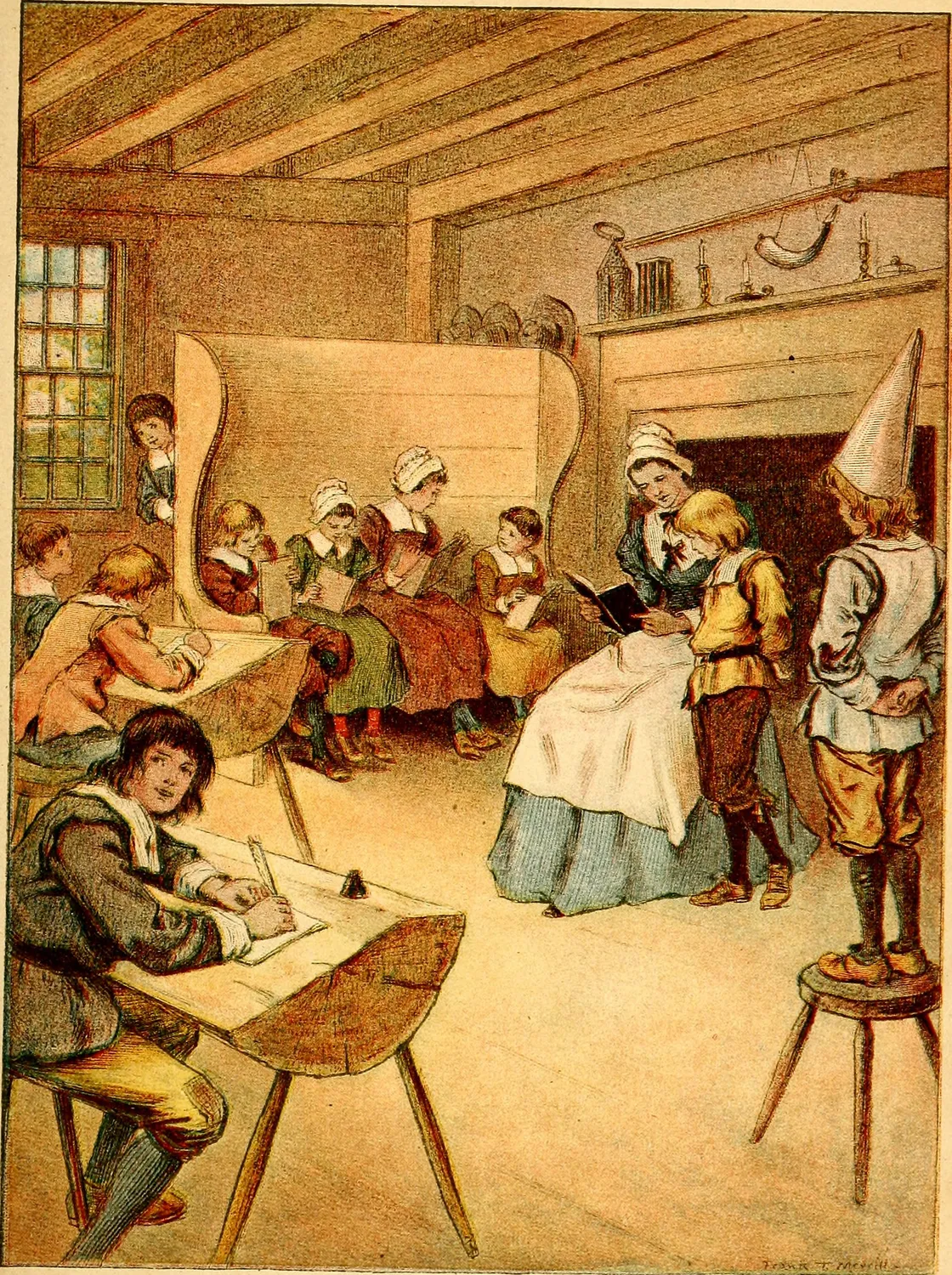
Most schools were one-room buildings. Boys and girls of different ages sat on wooden benches. There were very few supplies. The main tool for learning was a hornbook. A hornbook was a wooden paddle with a sheet of paper. The paper showed the alphabet and prayers. It was covered with a thin piece of animal horn to protect it. Children used hornbooks to practice their letters and read simple words.
Teachers were strict. Some teachers were men, but many were women called dame school teachers. Dame schools were often held in a woman's home. Boys and girls learned to read, but they also learned about religion and good behavior. Teachers used the Bible for lessons and expected children to memorize prayers.
Discipline was very important in these schools. If students talked out of turn or made mistakes, teachers punished them. Punishments included standing in the corner, wearing a dunce cap, or even being hit with a stick. These rules taught children to respect their teachers and try their best. Parents supported strict discipline because they wanted their children to be good citizens.
New England had more schools than other colonies. This happened because towns were close together. The law required every town with 50 or more families to have a school. This law helped many children learn to read, unlike in the Southern colonies, where schools were rare.
By learning to read and understand the Bible, students became good members of their communities. Many went on to teach others or help in their churches. These early schools helped shape America by teaching the values of reading, religion, and hard work.
Interesting Fact: Some colonial schools used birch rods as punishment. Even small children could be punished for not doing their lessons correctly!
Comprehension quiz (8 questions)
1. Why did New England build many schools?
2. What is a hornbook?
3. Who taught in dame schools?
4. Why did teachers punish students?
5. How did hornbooks help students?
6. What law did towns have?
7. Colonial schools used birch rods for punishment. True or false?
8. What is discipline?
Common Core standards for Going to School in New England
Explain events, procedures, ideas, or concepts in a historical, scientific, or technical text, including what happened and why, based on specific information in the text.
Determine the meaning of general academic and domain-specific words or phrases in a text relevant to a grade 4 topic or subject area.
Write informative/explanatory texts to examine a topic and convey ideas and information clearly.
Perfect for the way you teach
- Build comprehension skills
- Auto-graded quiz
- Differentiated reading
- Read together at home
- Improve fluency
- Quiet reading time
- Reading curriculum support
- Independent practice
- Track Lexile growth