This learning resource is available in interactive and printable formats. The interactive worksheet can be played online and assigned to students. The Printable PDF version can be downloaded and printed for completion by hand.
This passage examines the Haudenosaunee (Iroquois) longhouse as a key invention and cultural symbol, exploring its role in Native American history and world history. Students will learn about the communal and matrilineal aspects of Haudenosaunee society, the construction techniques of longhouses, and how these structures reflected the confederacy’s values. The passage integrates evidence from archaeological sources, demonstrates cause-and-effect relationships, and highlights the social hierarchy and daily life inside longhouses. Activities include a glossary, quiz, writing prompts, graphic organizers, and a timeline. Spanish translations and read aloud audio are included. The content aligns with CA HSS 6.2, 7.1, and CCSS.RI.6.1, CCSS.RI.7.3, and CCSS.WHST.6-8.2, supporting literacy and historical inquiry skills.
CONTENT PREVIEW
Expand content preview
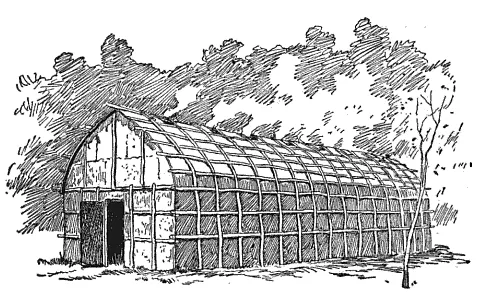
"Iroquois Longhouse" by Wilbur F. Gordy / Wikimedia Commons (Public domain).
The Haudenosaunee, also known as the Iroquois Confederacy, constructed large longhouses in the woodlands of what is now New York State and southern Canada. These wooden structures were central to the daily lives of the Haudenosaunee and reflected their unique social organization. Longhouses, often stretching over 100 feet and sometimes as long as 200 feet, could house up to twenty families from the same clan. The word "Haudenosaunee" itself means "People of the Longhouse," highlighting the importance of these buildings in their culture.
Each longhouse was built with a sturdy wooden frame, covered with sheets of elm bark. Archaeological findings, such as the remains of posts and bark impressions in the soil at sites like the Onondaga and Seneca villages, provide evidence of their size and structure. Inside, the space was divided by wooden partitions, creating private family areas along the walls, while a central aisle ran down the length of the building. Fires placed along this aisle provided warmth and a place for cooking. Openings in the roof above each fire acted as vents, allowing smoke to escape. This design demonstrated advanced engineering skills and a deep understanding of the local environment.
The Haudenosaunee practiced a matrilineal system, meaning that family lineage and property were passed down through the mother’s line. Women owned the longhouses and decided which families could live there. Grandmothers, known as clan mothers, held significant power and often selected the male leaders, or sachems, for the Confederacy. This matrilineal structure shaped daily life, from the way children were raised to how decisions were made within the community. The communal living arrangement inside longhouses encouraged cooperation, shared responsibilities, and strong social bonds among clan members.
European explorers, such as Jacques Cartier in the 1530s, described visiting Iroquoian villages with rows of longhouses and fields of corn, beans, and squash. These "Three Sisters" crops were grown together and stored inside the longhouses during winter. The longhouse system remained relatively unchanged for centuries, showing the continuity of Haudenosaunee traditions until the arrival of settlers began to disrupt their way of life in the 1600s. Today, reconstructed longhouses at museums and historic sites help historians learn more about Haudenosaunee society and its innovations.
The Haudenosaunee longhouse is significant because it represents both an architectural achievement and a symbol of unity and organization. Longhouses allowed the Iroquois Confederacy to thrive in a challenging environment, fostering cooperation and resilience. The structure’s design and the matrilineal society it sheltered influenced the development of the Confederacy and left a lasting impact on Native American history.
This study of Haudenosaunee longhouses connects to broader themes in world history, such as the relationship between environment, technology, and social organization.
Interesting Fact: Some Haudenosaunee longhouses were so large they could be over half the length of a football field and housed up to 80 people!
What does Haudenosaunee mean?
People of the LonghousePeople of the PlainsPeople of the RiverPeople of the Mountain
What material covered longhouses?
Elm barkAnimal skinsBricksClay tiles
Who chose the male leaders (sachems)?
Clan mothersWarriorsChildrenEuropean settlers
Why did longhouses have roof vents?
Let smoke escapeLet rain inFor decorationFor animals
How did communal living affect Haudenosaunee society?
Encouraged cooperationCreated lonelinessMade people move awayStopped farming
What was the role of women in longhouses?
Owned property and chose familiesBuilt the housesTraveled for tradeFought wars
The longhouse is a symbol of unity.
TrueFalse
What does matrilineal mean?
Lineage through mothersLineage through fathersLineage through leadersLineage through children
Perfect For:
👩🏫 Teachers
• Reading comprehension practice
• Auto-graded assessments
• Literacy skill development
👨👩👧👦 Parents
• Reading practice at home
• Comprehension improvement
• Educational reading time
🏠 Homeschoolers
• Reading curriculum support
• Independent reading practice
• Progress monitoring
Reading Features:
📖
Reading Passage
Engaging fiction or nonfiction text
❓
Comprehension Quiz
Auto-graded questions
📊
Instant Feedback
Immediate results and scoring
📄
Printable Version
Download for offline reading
🔊
Read Aloud
Voice-over with word highlighting
Reviews & Ratings
No reviews yet. Be the first to share your experience!
Related Content
Native American Respect for Nature
This engaging history reading passage explores Native American respect for nature, emphasizing the close relationship be...
D2.HIS.2.3-5D2.HIS.3.3-5RI.4.3RI.4.4
Native Americans and Slavery in Early America
This comprehensive U.S. history reading passage explores the complex relationship between Native Americans and slavery d...
D2.HIS.2.3-5D2.HIS.3.3-5RI.4.3RI.4.4
Native American Tribes Across America
This engaging history reading passage introduces students to Native American tribes across America, focusing on their da...
D2.HIS.1.3-5D2.HIS.2.3-5RI.4.1RI.4.2
Traditional Native American Clothing
This engaging history passage explores traditional Native American clothing and how it reflected the environment, values...
D2.HIS.2.3-5D2.HIS.3.3-5RI.4.3RI.4.4
Native American Basket Weaving
This passage examines the historical importance of basket weaving among Indigenous Americans, highlighting how different...
Native American Treaties
This passage examines early Native American treaties, agreements that were meant to establish peace and boundaries betwe...
D2.HIS.2.3-5D2.HIS.3.3-5RI.4.3RI.4.4
Native American Land Sales
This comprehensive history reading passage examines Native American land sales in U.S. history and asks students to cons...
D2.HIS.2.3-5D2.HIS.3.3-5RI.4.3RI.4.4
Disease and Native Americans
This engaging U.S. history reading passage explores the dramatic impact of European diseases on Native American populati...
D2.HIS.2.3-5D2.HIS.3.3-5RI.4.3RI.4.4
The Cherokee Nation: History and Culture
This reading passage explores the rich history and culture of the Cherokee Nation, one of the largest Native American tr...
D2.HIS.2.3-5D2.HIS.14.3-5RI.4.3RI.4.4RI.4.10
Columbian Exchange Impact on Native Americans
This passage examines the complex effects of the Columbian Exchange on Native Americans, analyzing the causes, consequen...
D2.HIS.2.3-5D2.HIS.3.3-5RI.4.3RI.4.4
Native American Allies in Colonial Wars
This passage examines the complex role of Native American nations as allies and adversaries during the colonial wars of ...
D2.HIS.2.3-5D2.HIS.3.3-5RI.4.3RI.4.4
Spanish Missions Impact on Native American
This reading passage explores the complex impact of Spanish missions on Native American culture in what is now the south...
D2.HIS.2.3-5D2.HIS.3.3-5RI.4.3RI.4.4
Native American Civilizations Before European Contact
This engaging U.S. History reading passage explores Native American civilizations before European contact, focusing on t...
D2.HIS.2.3-5D2.HIS.3.3-5RI.4.3RI.4.4
Moccasins: Soft Leather Footwear
This passage explores the history and significance of moccasins—a soft leather footwear invented by Native American nati...
Native vs European Land Views
This passage examines the contrasting beliefs about land between Native American societies and European settlers, highli...
D2.HIS.2.3-5D2.HIS.3.3-5RI.4.3RI.4.4
Native Americans in Revolutionary War
This engaging U.S. history reading passage explores how Native American nations made difficult decisions during the Amer...
D2.HIS.2.3-5D2.HIS.3.3-5RI.4.3RI.4.4
Pemmican: High-Energy Preserved Food
This engaging history reading passage explores the invention and significance of pemmican, a high-energy preserved food ...
Black History Month Word Search
RF.4.3RF.5.3L.4.4L.5.4
The Inuit Kayak
This passage examines the history and significance of the Inuit kayak, an advanced invention developed by Arctic peoples...
American History Word Search
Word search on American History Word Search! Vocabulary practice aligned to Common Core standards!