How Carbon Moves Through Food Chains — Reading Comprehension
Rate this
Premium Resource
Present
Present in classroom. No work saved
Assign
Classroom with student accounts, Track progress
Quick Play
No student accounts, assign with a link
Grades
6
7
8
Standards
MS-ESS2-1
PRINT+DIGITAL RESOURCE
This learning resource is available in interactive and printable formats. The interactive worksheet can be played online and assigned to students. The Printable PDF version can be downloaded and printed for completion by hand.
This comprehensive reading passage explores how carbon moves through life on Earth, aligning with NGSS standard MS-ESS2-1. Students will trace the carbon cycle from its capture by plants during photosynthesis through feeding relationships involving herbivores and carnivores. The passage explains how cellular respiration releases carbon dioxide back to the atmosphere at each step of the food chain. Through clear explanations and relatable examples, middle school students will understand the continuous movement of carbon atoms through living organisms and the atmosphere. The passage includes audio integration for enhanced accessibility, a simplified version for struggling readers, Spanish translations, comprehensive glossary terms, and engaging activities including multiple-choice questions, writing prompts, and graphic organizers. This resource helps students develop a deep understanding of matter cycling in ecosystems and the interconnected nature of Earth's systems, making it perfect for grades 6-8 science curriculum.
CONTENT PREVIEW
Expand content preview
Carbon is an essential element that makes up all living things on Earth. Every organism contains carbon atoms in its body structures, from the smallest bacteria to the largest whale. Understanding how carbon moves through ecosystems helps scientists track matter and energy flow in nature.
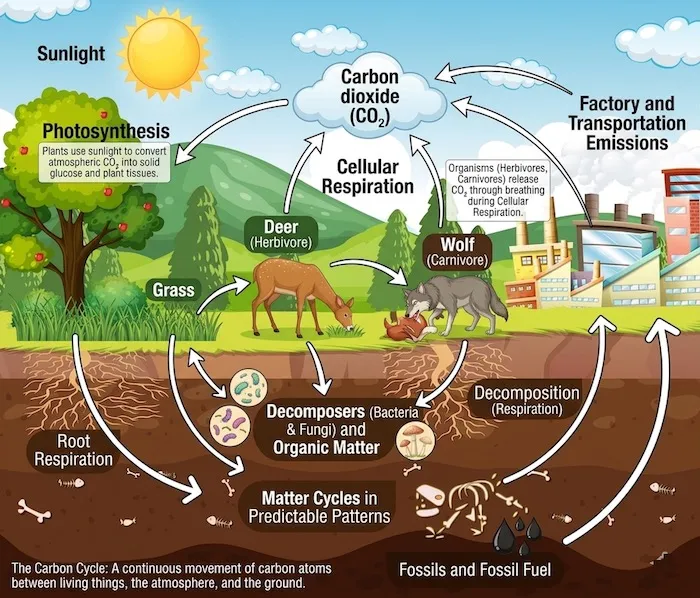
The carbon cycle begins when plants capture carbon dioxide (CO₂) from the atmosphere during photosynthesis. Plants use energy from sunlight to convert CO₂ and water into glucose, a sugar molecule that stores energy. This process transforms carbon from a gas in the air into solid plant tissue. The carbon becomes part of the plant's leaves, stems, roots, and fruits. When a deer eats grass or a rabbit munches on lettuce, these herbivores consume the carbon stored in plant tissues.
Inside the herbivore's body, the plant material gets broken down during digestion. The carbon atoms from the plants become part of the animal's cells, building muscles, bones, and other body structures. However, not all the carbon stays in the herbivore's body. The animal needs energy to move, grow, and stay warm. To release this energy, cells perform cellular respiration, a process that breaks down glucose using oxygen. During cellular respiration, carbon atoms combine with oxygen to form CO₂, which the animal exhales back into the atmosphere. This means herbivores constantly release some carbon while keeping some to build their bodies.
The carbon cycle continues when carnivores eat herbivores. A fox eating a rabbit or a hawk catching a mouse transfers carbon up the food chain. The carnivore digests the herbivore's tissues and uses the carbon to build its own body structures. Just like herbivores, carnivores also perform cellular respiration to release energy from food. Their cells break down carbon-containing molecules and release CO₂ through breathing. Even top predators like wolves or eagles return carbon to the atmosphere every time they exhale.
At each step in the food chain, organisms use cellular respiration to power their life processes. A single carbon atom might travel from the atmosphere into a corn plant, then into a cow that eats the corn, then into a human who drinks milk from that cow. At each step, some carbon returns to the atmosphere through respiration while some remains in the organism's body. This continuous movement creates a cycle where carbon atoms move between living things and the atmosphere repeatedly over time.
The carbon cycle demonstrates that matter cycles through ecosystems in predictable patterns. Carbon atoms are not created or destroyed but constantly recycled. When organisms die, decomposers like bacteria and fungi break down their remains, releasing even more CO₂ through their own cellular respiration. This ensures that carbon returns to the atmosphere, where plants can capture it again through photosynthesis, continuing the cycle.
Interesting Fact: A single carbon atom in your body might have once been part of a dinosaur millions of years ago, then cycled through the atmosphere, plants, and other animals before becoming part of you.
How do plants capture carbon from the atmosphere?
Through photosynthesis using sunlight, CO₂, and waterThrough cellular respiration using oxygenBy eating other organismsBy absorbing it through their roots from soil
What happens to carbon when an herbivore eats a plant?
All the carbon immediately returns to the atmosphereThe carbon is destroyed during digestionSome carbon becomes part of the animal's body and some is released as CO₂The carbon stays in the herbivore forever
What is cellular respiration?
The process plants use to make food from sunlightThe process cells use to break down glucose and release energy, producing CO₂The process of breathing in oxygen through lungsThe process of digesting food in the stomach
Which statement best describes how carbon moves through a food chain?
Carbon only moves from plants to herbivoresCarbon moves from atmosphere to plants to herbivores to carnivores, with CO₂ released at each stepCarbon moves only in one direction and never returns to the atmosphereCarbon is created by plants and destroyed by animals
What role do decomposers play in the carbon cycle?
They create new carbon atomsThey prevent carbon from returning to the atmosphereThey break down dead organisms and release CO₂ through cellular respirationThey only consume carbon without releasing it
When a fox eats a rabbit, what happens to the carbon in the rabbit's body?
It disappears completelyIt becomes part of the fox's body structuresIt immediately turns into oxygenIt stays in the rabbit
Why do all organisms release CO₂ during cellular respiration?
To help plants growBecause carbon combines with oxygen when cells break down glucose for energyTo cool down their bodiesBecause they eat too much food
A carbon atom moves from a corn plant to a cow to a human. This example shows that:
Carbon atoms are created at each stepCarbon atoms are destroyed at each stepCarbon atoms cycle through different organisms over timeCarbon atoms only exist in plants
True or False: Carbon atoms are destroyed when organisms perform cellular respiration.
TrueFalse
True or False: Both herbivores and carnivores release carbon dioxide back to the atmosphere through cellular respiration.
TrueFalse
Perfect For:
👩🏫 Teachers
• Reading comprehension practice
• Auto-graded assessments
• Literacy skill development
👨👩👧👦 Parents
• Reading practice at home
• Comprehension improvement
• Educational reading time
🏠 Homeschoolers
• Reading curriculum support
• Independent reading practice
• Progress monitoring
Reading Features:
📖
Reading Passage
Engaging fiction or nonfiction text
❓
Comprehension Quiz
Auto-graded questions
📊
Instant Feedback
Immediate results and scoring
📄
Printable Version
Download for offline reading
🔊
Read Aloud
Voice-over with word highlighting
Reviews & Ratings
No reviews yet. Be the first to share your experience!
Related Content
Frost Wedging: How Ice Splits Rock
This passage explains frost wedging as a mechanical weathering process. Aligned with NGSS MS-ESS2-1 (Earth’s systems) a...
MS-ESS2-1MS-ESS2-2RST.6-8.3
Limestone Caves: Nature’s Underground Wonders
This passage explains limestone cave formation through carbonation, aligned with NGSS MS-ESS2-1 (Earth’s systems) and L...
MS-ESS2-1LS2.CRST.6-8.7
Chemical Weathering: The Breakdown of Rocks Through Chemical Reactions
This passage explains chemical weathering processes, aligned with NGSS MS-ESS2-1 (Earth’s systems) and ESS2-2 (surface ...
MS-ESS2-1MS-ESS2-2RST.6-8.4
Talus Slopes: Formation and Features
This earth science passage explains talus slope formation through mechanical weathering processes, aligning with NGSS MS...
MS-ESS2-1MS-ESS2-2RST.6-8.4
Biological Weathering: Types and Examples
This passage details biological weathering processes, connecting to NGSS MS-ESS2-1 (Earth's systems) and LS2.B (ecosyste...
MS-ESS2-1MS-PS1-2RST.6-8.3
The Coldest City in the World: Yakutsk
This NGSS-aligned science passage introduces middle school readers to Yakutsk, the coldest city on Earth. Students will ...
MS-ESS2-1
Igneous Rocks
This comprehensive passage introduces middle school students to igneous rocks, focusing on how these rocks form from mol...
MS-ESS2-1MS-ESS3-1
Sedimentary Rocks
This comprehensive middle school science passage introduces students to sedimentary rocks, detailing their step-by-step ...
MS-ESS2-1MS-ESS2-3MS-ESS3-1
Metamorphic Rocks
This engaging middle school science passage introduces students to the fascinating world of metamorphic rocks. Aligned w...
MS-ESS2-1MS-ESS3-1
Scientific Inquiry in Earth Science
This passage explores scientific inquiry in Earth science for grades 6-8, aligned with NGSS standards MS-ESS1-4, MS-ESS2...
MS-ESS1-4MS-ESS2-1MS-ESS3-5SEP
Contour Lines and Elevation
This passage, designed for grades 6-8 and aligned with NGSS standards MS-ESS2-2 and MS-ESS2-1, introduces students to th...
MS-ESS2-2MS-ESS2-1SEP.4SEP.8
Weathering
This comprehensive science reading passage for grades 6-8 focuses on the concept of weathering, aligning with NGSS stand...
MS-ESS2-1
Erosion
This comprehensive middle school science passage explains erosion—the process that transports weathered rock and soil fr...
MS-ESS2-1
Stream Erosion and Deposition
This middle school science passage, aligned to NGSS MS-ESS2-1, introduces students to the dynamic processes of stream er...
MS-ESS2-1
Wind Erosion and Deposition
This comprehensive science reading passage for grades 6-8 explores the processes of wind erosion and deposition, alignin...
MS-ESS2-1
Glacial Erosion and Deposition
This middle school science passage explores glacial erosion and deposition, focusing on the mechanisms by which glaciers...
MS-ESS2-1
Mass Movements
This NGSS-aligned passage introduces middle school students to the science of mass movements—gravity-driven motions of r...
MS-ESS2-1MS-ESS3-2
Soil Formation and Composition
This comprehensive middle school science passage explores soil formation and composition, perfectly aligned to NGSS stan...
MS-ESS2-1
Constructive and Destructive Forces
This middle school science passage explores how Earth's surface is constantly shaped by the interplay of constructive an...
MS-ESS2-1
Mountains and Mountain Building
This NGSS-aligned passage for grades 6-8 covers the fascinating processes that create Earth's highest landforms—mountain...