How Decomposers Return Carbon to the Soil — Reading Comprehension
Rate this
Premium Resource
Present
Present in classroom. No work saved
Assign
Classroom with student accounts, Track progress
Quick Play
No student accounts, assign with a link
Grades
6
7
8
Standards
MS-ESS2-1
PRINT+DIGITAL RESOURCE
This learning resource is available in interactive and printable formats. The interactive worksheet can be played online and assigned to students. The Printable PDF version can be downloaded and printed for completion by hand.
This comprehensive 600-word reading passage explores how decomposers return carbon to the environment, aligned with NGSS standard MS-ESS2-1. Middle school students in grades 6-8 will learn how bacteria and fungi break down dead organisms and organic waste through the process of decomposition. The passage explains cellular respiration in decomposers, how carbon stored in tissues is released as carbon dioxide to the atmosphere, and how organic matter enriches the soil. Students explore real-world examples including forest floors and compost piles. The audio-integrated lesson includes a simplified differentiated version for struggling readers and English Language Learners, Spanish translations of both passages, a comprehensive glossary of key scientific terms, ten multiple-choice questions assessing various cognitive levels, three scaffolded writing prompts with model answers, and engaging graphic organizers. This complete curriculum resource helps students understand the critical role of decomposers in Earth's carbon cycle and matter cycling in ecosystems.
CONTENT PREVIEW
Expand content preview
Decomposers are organisms that break down dead plants, animals, and organic waste into simpler substances. Bacteria and fungi are the most important decomposers in ecosystems. These organisms play a critical role in the carbon cycle by returning carbon that was stored in living tissues back to the environment. Without decomposers, dead organisms would pile up, and essential nutrients would remain locked away instead of being recycled through ecosystems.
When plants and animals die, their bodies contain large amounts of carbon in the form of complex molecules like proteins, fats, and carbohydrates. Decomposers use special enzymes to break down these complex molecules into simpler forms they can absorb. Bacteria work on a microscopic level, while fungi send out thread-like structures called hyphae that spread through dead material. Both types of decomposers secrete enzymes outside their bodies, which break down the organic matter before absorbing the nutrients.
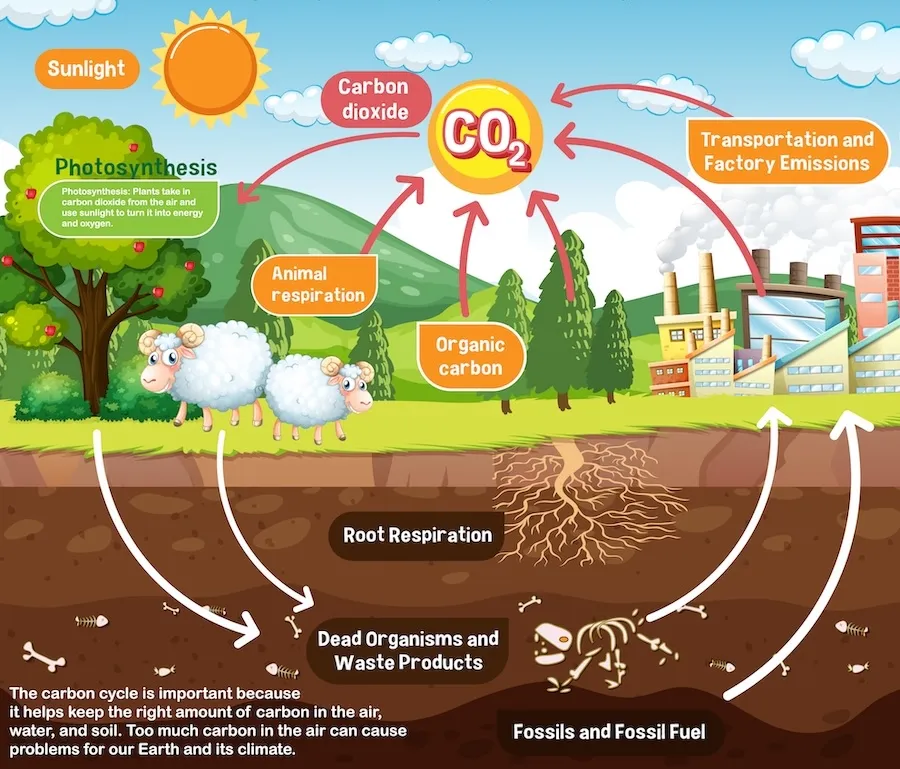
As decomposers break down dead organisms, they use a process called cellular respiration to extract energy from the carbon-containing molecules. During cellular respiration, decomposers combine the carbon from dead tissues with oxygen from the air. This chemical reaction releases energy that the decomposers use to grow and reproduce. An important byproduct of this process is carbon dioxide (CO₂), which is released into the atmosphere. This is the same gas that animals exhale when they breathe and that plants use during photosynthesis.
Not all carbon from dead organisms returns to the atmosphere immediately. Some carbon becomes part of humus, a dark, nutrient-rich material that forms in soil. Humus is made of partially decomposed organic matter that breaks down very slowly. This organic matter improves soil quality by helping it hold water and nutrients that plants need to grow. Over time, decomposers continue working on humus, gradually releasing more carbon dioxide. In a forest, you can see this process on the forest floor, where fallen leaves slowly disappear as fungi and bacteria break them down.
The rate of decomposition depends on several environmental factors. Temperature affects how quickly decomposers work—warmer conditions speed up decomposition, while cold temperatures slow it down. Moisture is also essential because decomposers need water to survive and carry out their life processes. Oxygen availability matters too, since many decomposers require oxygen for cellular respiration. In a compost pile, people create ideal conditions for decomposers by maintaining proper temperature, moisture, and oxygen levels, which speeds up the breakdown of food scraps and yard waste.
The carbon released by decomposers completes an important cycle in nature. Plants absorb carbon dioxide from the atmosphere during photosynthesis and use it to build their tissues. Animals eat plants and incorporate that carbon into their own bodies. When plants and animals die, decomposers break down their remains and release the carbon back to the atmosphere as carbon dioxide. This continuous movement of carbon between living organisms, the atmosphere, and the soil is essential for maintaining life on Earth.
Interesting Fact: A single teaspoon of healthy soil contains more bacteria than there are people on Earth—over 8 billion individual bacterial cells working to decompose organic matter and cycle nutrients.
What are the two main types of decomposers mentioned in the passage?
Plants and animalsBacteria and fungiInsects and wormsAlgae and moss
What do decomposers use to break down complex molecules in dead organisms?
SunlightWaterEnzymesOxygen only
Based on the passage, what is the main gas released into the atmosphere during cellular respiration by decomposers?
OxygenNitrogenCarbon dioxideMethane
What does the term 'humus' refer to in the passage?
A type of decomposerA gas released during decompositionDark, nutrient-rich material made of partially decomposed organic matterThread-like structures in fungi
According to the passage, why do warmer temperatures speed up decomposition?
Warm temperatures kill decomposersDecomposers work faster in warmer conditionsWarm temperatures prevent decompositionTemperature has no effect on decomposition
What can you infer about what would happen if there were no decomposers in an ecosystem?
Plants would grow fasterDead organisms would pile up and nutrients would not be recycledAnimals would become largerThe carbon cycle would speed up
How do fungi spread through dead material to decompose it?
They fly through the airThey send out thread-like structures called hyphaeThey dissolve in waterThey use roots like plants
If you wanted to speed up decomposition in a compost pile, which conditions would be most important to maintain?
Cold temperature, dry conditions, and no oxygenProper temperature, moisture, and oxygen levelsVery hot temperature and complete darknessFreezing temperature and lots of water
True or False: All carbon from dead organisms immediately returns to the atmosphere as carbon dioxide.
TrueFalse
True or False: Decomposers play an essential role in completing the carbon cycle by returning carbon to the atmosphere and soil.
TrueFalse
Perfect For:
👩🏫 Teachers
• Reading comprehension practice
• Auto-graded assessments
• Literacy skill development
👨👩👧👦 Parents
• Reading practice at home
• Comprehension improvement
• Educational reading time
🏠 Homeschoolers
• Reading curriculum support
• Independent reading practice
• Progress monitoring
Reading Features:
📖
Reading Passage
Engaging fiction or nonfiction text
❓
Comprehension Quiz
Auto-graded questions
📊
Instant Feedback
Immediate results and scoring
📄
Printable Version
Download for offline reading
🔊
Read Aloud
Voice-over with word highlighting
Reviews & Ratings
No reviews yet. Be the first to share your experience!
Related Content
Frost Wedging: How Ice Splits Rock
This passage explains frost wedging as a mechanical weathering process. Aligned with NGSS MS-ESS2-1 (Earth’s systems) a...
MS-ESS2-1MS-ESS2-2RST.6-8.3
Limestone Caves: Nature’s Underground Wonders
This passage explains limestone cave formation through carbonation, aligned with NGSS MS-ESS2-1 (Earth’s systems) and L...
MS-ESS2-1LS2.CRST.6-8.7
Chemical Weathering: The Breakdown of Rocks Through Chemical Reactions
This passage explains chemical weathering processes, aligned with NGSS MS-ESS2-1 (Earth’s systems) and ESS2-2 (surface ...
MS-ESS2-1MS-ESS2-2RST.6-8.4
Talus Slopes: Formation and Features
This earth science passage explains talus slope formation through mechanical weathering processes, aligning with NGSS MS...
MS-ESS2-1MS-ESS2-2RST.6-8.4
Biological Weathering: Types and Examples
This passage details biological weathering processes, connecting to NGSS MS-ESS2-1 (Earth's systems) and LS2.B (ecosyste...
MS-ESS2-1MS-PS1-2RST.6-8.3
The Coldest City in the World: Yakutsk
This NGSS-aligned science passage introduces middle school readers to Yakutsk, the coldest city on Earth. Students will ...
MS-ESS2-1
Igneous Rocks
This comprehensive passage introduces middle school students to igneous rocks, focusing on how these rocks form from mol...
MS-ESS2-1MS-ESS3-1
Sedimentary Rocks
This comprehensive middle school science passage introduces students to sedimentary rocks, detailing their step-by-step ...
MS-ESS2-1MS-ESS2-3MS-ESS3-1
Metamorphic Rocks
This engaging middle school science passage introduces students to the fascinating world of metamorphic rocks. Aligned w...
MS-ESS2-1MS-ESS3-1
Scientific Inquiry in Earth Science
This passage explores scientific inquiry in Earth science for grades 6-8, aligned with NGSS standards MS-ESS1-4, MS-ESS2...
MS-ESS1-4MS-ESS2-1MS-ESS3-5SEP
Contour Lines and Elevation
This passage, designed for grades 6-8 and aligned with NGSS standards MS-ESS2-2 and MS-ESS2-1, introduces students to th...
MS-ESS2-2MS-ESS2-1SEP.4SEP.8
Weathering
This comprehensive science reading passage for grades 6-8 focuses on the concept of weathering, aligning with NGSS stand...
MS-ESS2-1
Erosion
This comprehensive middle school science passage explains erosion—the process that transports weathered rock and soil fr...
MS-ESS2-1
Stream Erosion and Deposition
This middle school science passage, aligned to NGSS MS-ESS2-1, introduces students to the dynamic processes of stream er...
MS-ESS2-1
Wind Erosion and Deposition
This comprehensive science reading passage for grades 6-8 explores the processes of wind erosion and deposition, alignin...
MS-ESS2-1
Glacial Erosion and Deposition
This middle school science passage explores glacial erosion and deposition, focusing on the mechanisms by which glaciers...
MS-ESS2-1
Mass Movements
This NGSS-aligned passage introduces middle school students to the science of mass movements—gravity-driven motions of r...
MS-ESS2-1MS-ESS3-2
Soil Formation and Composition
This comprehensive middle school science passage explores soil formation and composition, perfectly aligned to NGSS stan...
MS-ESS2-1
Constructive and Destructive Forces
This middle school science passage explores how Earth's surface is constantly shaped by the interplay of constructive an...
MS-ESS2-1
Mountains and Mountain Building
This NGSS-aligned passage for grades 6-8 covers the fascinating processes that create Earth's highest landforms—mountain...