Reading PassagePremium

How Do Coastlines Change Over Time

Interactive passage with audio narration, comprehension questions, and printable PDF.

No ratings yet
Grades 6–8ScienceElaEnglish · SpanishInteractive · Printable
Aligned toMS-ESS2-1
Just this resource
$1.50
One-time purchase
Best value
Unlock everything
$49.99$29.99/yr
40% off until Aug 1 — 10,000+ resources
Renews at $49.99/year.
Unlock above to use these actions

What's included

Reading passage
Audio narration
Comprehension quiz
Writing activity
Glossary & flashcards
Differentiated version
Spanish translation

How Do Coastlines Change Over Time preview and details

About this printable How Do Coastlines Change Over Time science reading passage, NGSS-aligned (Grades 6-8)

This comprehensive 600-word reading passage explores how coastlines are shaped through natural processes for middle school students in grades 6-8. Students discover how wave action erodes rocky shores, how tidal forces move sediment, and how deposition creates beaches and sandbars. The passage aligns with NGSS standard MS-ESS2-1, helping students understand Earth's systems and geoscience processes. Key vocabulary includes erosion, deposition, sediment, longshore drift, and headlands. The content features audio integration for enhanced accessibility and includes real-world examples of coastal features. Accompanied by differentiated versions for English Language Learners, Spanish translations, comprehension questions, writing activities, and graphic organizers, this resource provides complete curriculum support for teaching about dynamic coastal processes and landform development in Earth science classrooms.
Written by Workybooks TeamPublished by Workybooks
Preview

Sample passage and quiz from How Do Coastlines Change Over Time

Reading passage and comprehension quiz preview

How Do Coastlines Change Over Time
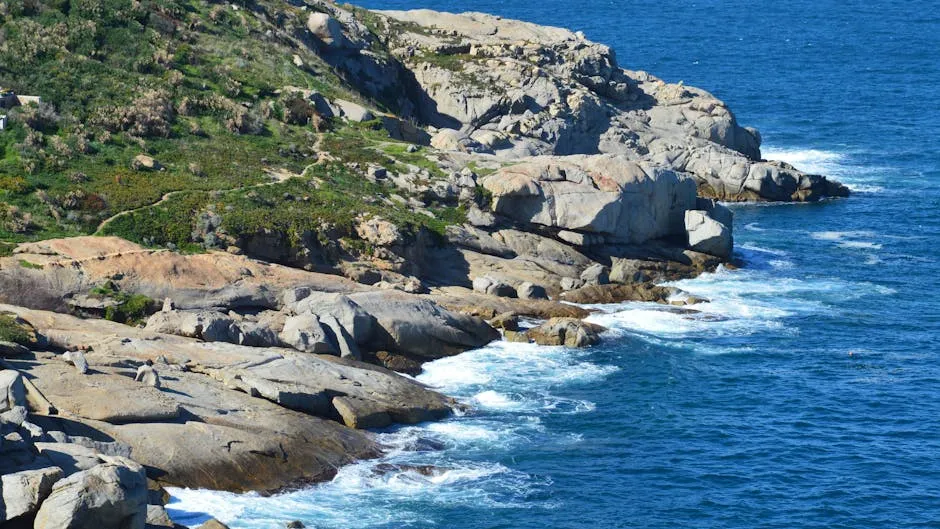
Capture of the rugged rocky coastline meeting the blue sea in Calvi, Corse, France.
Rugged rocky coastline meeting the blue sea in Calvi, Corse, France." by SlimMars 13 / Pexels.

Coastlines are the boundaries where land meets the ocean, and they are constantly changing. Three main forces shape coastlines: wave action, tidal forces, and sediment deposition. Wave action occurs when ocean waves crash against the shore, carrying energy that can break down rocks and move sand. Tidal forces are the rise and fall of ocean water levels caused by the gravitational pull of the moon and sun. Sediment deposition happens when waves and currents drop particles of sand, mud, and rock in new locations. Together, these processes create the diverse coastal features we see today.

Wave action is a powerful force that causes erosion, which is the wearing away of rock and soil. When waves repeatedly strike rocky coastlines, they compress air in cracks and crevices. This pressure breaks the rock apart over time. Waves also carry sand and pebbles that act like sandpaper, grinding down coastal rocks. This process creates dramatic features such as sea cliffs, which are steep rock faces along the shore. In some places, erosion forms headlands, which are points of land that jut out into the ocean. Waves hit headlands from multiple directions, causing them to erode faster than surrounding areas.

While erosion breaks down coastlines in some places, deposition builds them up in others. Waves carry sediment along the coast in a process called longshore drift. This occurs when waves approach the shore at an angle, pushing sand and sediment sideways along the beach. Over time, longshore drift can transport millions of tons of sediment. When waves lose energy, they drop their sediment load. This creates sandy beaches, which are gently sloping accumulations of sand deposited by waves. In protected areas like bays, where wave energy is lower, fine sediment settles to form mudflats.

Tidal forces also play an important role in shaping coastlines. Tides cause water levels to rise and fall twice each day in most locations. During high tide, waves reach higher on the shore and can erode areas that are dry during low tide. During low tide, the retreating water exposes the intertidal zone, the area between high and low tide marks. Strong tidal currents can move large amounts of sediment, creating channels and depositing sand in new locations. In areas with large tidal ranges, such as the Bay of Fundy in Canada, tidal forces can reshape coastlines dramatically.

The combination of erosion and deposition creates various coastal landforms. Sandbars are long, narrow deposits of sand that form parallel to the shore, often just underwater. Barrier islands are larger sand deposits that create protective barriers between the open ocean and the mainland. Spits are narrow ridges of sand that extend from the coast into open water, formed when longshore drift deposits sediment in one direction. These features are temporary on geological timescales, constantly being reshaped by waves and tides.

Understanding how coastlines are shaped is important because millions of people live in coastal areas. Coastal erosion can threaten homes, roads, and infrastructure. Scientists study these processes to predict how coastlines will change and to develop strategies for protecting coastal communities. Climate change and rising sea levels are accelerating coastal changes in many areas, making this knowledge even more critical for future planning.

Interesting Fact: The longest beach in the world is Praia do Cassino in Brazil, stretching over 150 miles. It was formed by millions of years of sediment deposition from ocean currents and waves.

Comprehension quiz (10 questions)

1. What are the three main forces that shape coastlines?

Wave action, tidal forces, and sediment deposition
Wind, rain, and temperature changes
Earthquakes, volcanoes, and landslides
Rivers, glaciers, and ocean currents

2. How do waves cause erosion on rocky coastlines?

By freezing water in the rocks
By compressing air in cracks and carrying sand that grinds down rocks
By heating the rocks until they crack
By dissolving the rocks in salt water

3. What is longshore drift?

The movement of waves straight onto the beach
The sinking of sand to the ocean floor
The process where waves push sediment sideways along the beach
The formation of underwater caves

4. What is the intertidal zone?

The deepest part of the ocean
The area between high tide and low tide marks
The zone where rivers meet the ocean
The area under a barrier island

5. Based on the passage, why do headlands erode faster than surrounding areas?

They are made of softer rock
They receive less sunlight
Waves hit them from multiple directions
They are closer to the ocean floor

6. What happens when waves lose energy as they approach the shore?

They create larger waves
They drop their sediment load, creating beaches
They turn into tidal currents
They cause underwater earthquakes

7. If a coastline has a large tidal range, what effect would this likely have?

No change to the coastline
Only erosion would occur
Dramatic reshaping of the coastline through sediment movement
The formation of mountains

8. How might rising sea levels due to climate change affect coastal erosion?

It would stop coastal erosion completely
It would accelerate coastal changes and erosion
It would only affect beaches, not cliffs
It would have no effect on coastlines

9. Sandbars are permanent features that never change position.

True
False

10. Barrier islands protect the mainland from the open ocean.

True
False
Who it's for

Perfect for the way you teach

Teachers
  • Build comprehension skills
  • Auto-graded quiz
  • Differentiated reading
Parents
  • Read together at home
  • Improve fluency
  • Quiet reading time
Homeschoolers
  • Reading curriculum support
  • Independent practice
  • Track Lexile growth
Topics

Reviews & Ratings

No reviews yet. Be the first to share your experience!

More reading you might love

20 more
Passage
Talus Slopes: Formation and Features - reading educational content
Grades 5–8

Talus Slopes: Formation and Features

science · MS-ESS2-1

Free
Passage
Biological Weathering: Types and Examples - reading educational content
Grades 5–8

Biological Weathering: Types and Examples

science · MS-ESS2-1

Free
Passage
Frost Wedging: How Ice Splits Rock - reading educational content
Grades 5–8

Frost Wedging: How Ice Splits Rock

science · MS-ESS2-1

$1.50
Passage
Chemical Weathering: The Breakdown of Rocks Through Chemical Reactions - reading educational content
Grades 5–8

Chemical Weathering: The Breakdown of Rocks Through Chemical Reactions

science · MS-ESS2-1

Free
Passage
Limestone Caves: Nature’s Underground Wonders - reading educational content
Grades 5–8

Limestone Caves: Nature’s Underground Wonders

science · MS-ESS2-1

Free
Passage
The Coldest City in the World: Yakutsk - reading educational content
Grades 5–8

The Coldest City in the World: Yakutsk

science · MS-ESS2-1

$1.50
Passage
Igneous Rocks - reading educational content
Grades 5–8

Igneous Rocks

science · MS-ESS2-1

$1.50
Passage
Sedimentary Rocks - reading educational content
Grades 5–8

Sedimentary Rocks

science · MS-ESS2-1

$1.50
Passage
Metamorphic Rocks - reading educational content
Grades 5–8

Metamorphic Rocks

science · MS-ESS2-1

Free
Passage
Scientific Inquiry in Earth Science - reading educational content
Grades 5–8

Scientific Inquiry in Earth Science

earth science · MS-ESS1-4

$1.50
Passage
Contour Lines and Elevation - reading educational content
Grades 5–8

Contour Lines and Elevation

science · MS-ESS2-2

$1.50
Passage
Weathering - reading educational content
Grades 5–8

Weathering

science · MS-ESS2-1

$1.50
Passage
Erosion - reading educational content
Grades 5–8

Erosion

science · MS-ESS2-1

$1.50
Passage
Stream Erosion and Deposition - reading educational content
Grades 5–8

Stream Erosion and Deposition

science · MS-ESS2-1

$1.50
Passage
Wind Erosion and Deposition - reading educational content
Grades 5–8

Wind Erosion and Deposition

science · MS-ESS2-1

$1.50
Passage
Glacial Erosion and Deposition - reading educational content
Grades 5–8

Glacial Erosion and Deposition

science · MS-ESS2-1

$1.50
Passage
Mass Movements - reading educational content
Grades 5–8

Mass Movements

science · MS-ESS2-1

$1.50
Passage
Soil Formation and Composition - reading educational content
Grades 5–8

Soil Formation and Composition

science · MS-ESS2-1

$1.50
Passage
Constructive and Destructive Forces - reading educational content
Grades 5–8

Constructive and Destructive Forces

science · MS-ESS2-1

Free
Passage
Mountains and Mountain Building - reading educational content
Grades 5–8

Mountains and Mountain Building

science · MS-ESS2-1

$1.50
Copyright © 2026 Workybooks. Made with ♥ in California.