How Do Constructive Forces Build Landforms
Interactive passage with audio narration, comprehension questions, and printable PDF.
By completing this purchase you agree to our Terms of Use and Privacy Policy. Your subscription renews automatically until you cancel. You can cancel anytime from your account settings. All sales are final and non-refundable. Digital content is available for download in your account immediately upon purchase.
What's included
How Do Constructive Forces Build Landforms preview and details
About this printable How Do Constructive Forces Build Landforms science reading passage, NGSS-aligned (Grades 6-8)
Sample passage and quiz from How Do Constructive Forces Build Landforms
Reading passage and comprehension quiz preview
How Do Constructive Forces Build Landforms
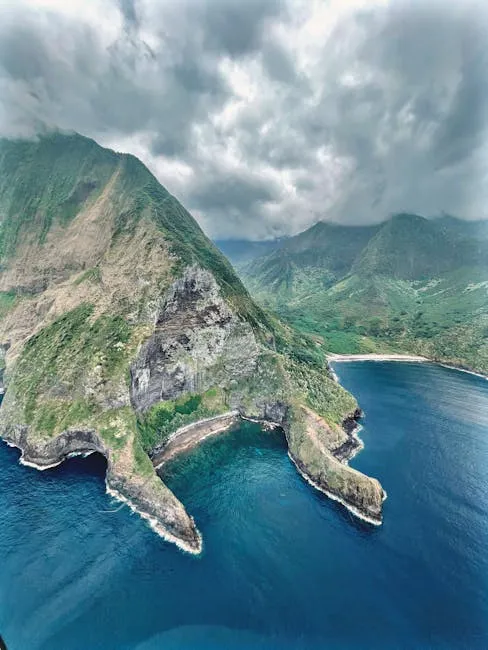
Aerial shot of Molokai's rugged cliffs and coastline, showcasing Hawaii's natural beauty by Regina Bucio / Pexels.
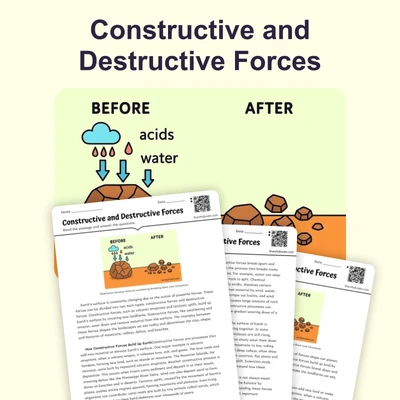
Constructive forces are natural processes that build up Earth's surface. These forces add new material to the land or raise existing land higher. Over millions of years, constructive forces create mountains, islands, and other landforms. They work constantly to change the shape of our planet.
Three main types of constructive forces shape Earth's surface. Volcanoes erupt and release hot, melted rock called magma from deep inside Earth. When magma reaches the surface, it becomes lava. The lava cools and hardens into new rock, adding layers to Earth's surface. Over time, these layers build up to form volcanic mountains and islands. The Hawaiian Islands formed this way as underwater volcanoes erupted repeatedly, building up until they rose above the ocean.
Deposition is another constructive force that builds up Earth's surface. This process occurs when water, wind, or ice carries small pieces of rock and soil called sediment and drops them in a new location. Rivers carry sediment downstream and deposit it where the water slows down. Over thousands of years, these sediment layers pile up and can form new land. The Mississippi River deposits sediment at its mouth, creating new land in the Gulf of Mexico. Beaches also form through deposition when ocean waves drop sand along the shoreline.
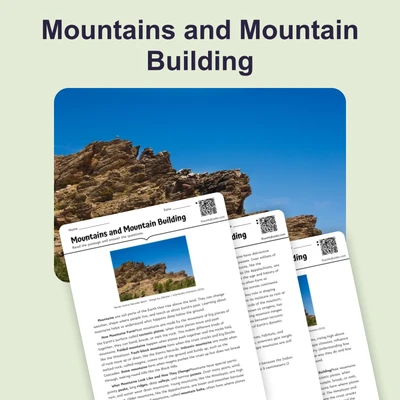
Uplift is a constructive force that pushes rock layers upward. This happens when giant pieces of Earth's outer layer, called tectonic plates, collide and push against each other. The pressure from this collision forces the rock layers to bend and rise. Mountains form through uplift when tectonic plates crash together over millions of years. The Himalayan Mountains, including Mount Everest, continue to grow taller each year because the plates beneath them are still pushing together.
All three constructive forces work slowly over long periods of time. A single volcanic eruption might add only a few feet of new rock. One flood might deposit a thin layer of sediment. Tectonic plates move just a few centimeters each year. However, these small changes add up over thousands and millions of years. The result is dramatic changes to Earth's surface, including tall mountain ranges and entire island chains.
Scientists study constructive forces to understand how Earth's surface has changed over time. They examine rock layers to see evidence of past volcanic eruptions and deposition. They measure how mountains grow taller each year due to uplift. This knowledge helps scientists predict future changes to Earth's surface. Understanding constructive forces also helps explain why different regions have different landforms and why some areas experience more volcanic activity or earthquakes than others.
Interesting Fact: Mount Everest grows approximately 4 millimeters taller each year due to the continuing collision of the Indian and Eurasian tectonic plates beneath it.
Comprehension quiz (10 questions)
1. What are constructive forces?
2. What happens when magma reaches Earth's surface?
3. What is sediment?
4. How do mountains form through uplift?
5. According to the passage, how fast do tectonic plates typically move each year?
6. Which of the following is an example of deposition mentioned in the passage?
7. Why do scientists study constructive forces?
8. Which constructive force created the Hawaiian Islands?
9. Constructive forces work quickly and create dramatic changes in just a few years.
10. The Himalayan Mountains continue to grow taller each year.
Perfect for the way you teach
- Build comprehension skills
- Auto-graded quiz
- Differentiated reading
- Read together at home
- Improve fluency
- Quiet reading time
- Reading curriculum support
- Independent practice
- Track Lexile growth