How Do Destructive Forces Wear Down Land — Reading Comprehension
Rate this
Premium Resource
Present
Present in classroom. No work saved
Assign
Classroom with student accounts, Track progress
Quick Play
No student accounts, assign with a link
Grades
6
7
8
Standards
MS-ESS2-1
PRINT+DIGITAL RESOURCE
This learning resource is available in interactive and printable formats. The interactive worksheet can be played online and assigned to students. The Printable PDF version can be downloaded and printed for completion by hand.
This comprehensive middle school science reading passage explores destructive forces that continuously reshape Earth's surface. Students will learn about erosion, weathering, and subsidence—the three main processes that break down and remove material from the geosphere. The passage defines each destructive force with clear examples, explaining how weathering breaks down rocks through physical and chemical processes, how erosion transports materials through wind, water, and ice, and how subsidence causes land to sink. Aligned with NGSS standard MS-ESS2-1, this audio-integrated resource helps students understand how Earth's systems interact to change landscapes over time. The passage includes real-world examples like the Grand Canyon and sinkholes, making abstract concepts concrete for grades 6-8 learners. Students will develop understanding of how these natural processes work together to create the varied terrain we observe today.
CONTENT PREVIEW
Expand content preview
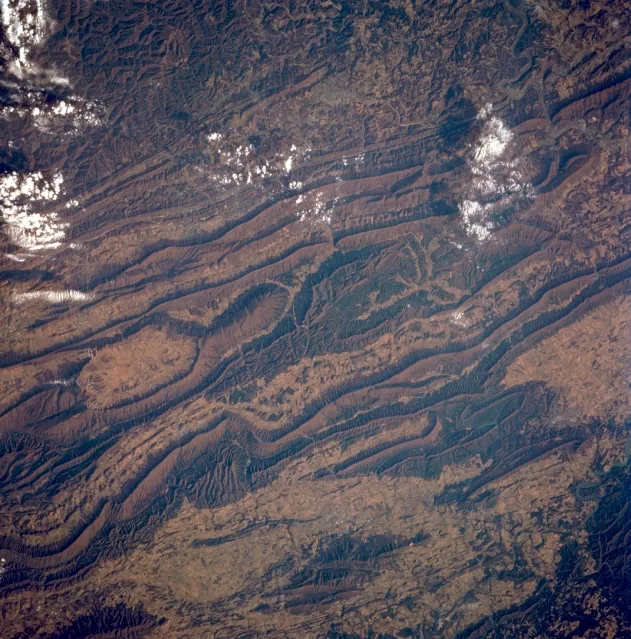
Geological evidence suggests the Appalachian Mountains, formed over 480 million years ago, were once as high as the Himalayas. Millions of years of weathering and erosion have worn them down to less than half their original height. Appalachian Mountains STS062-104-26" by NASA / Wikimedia Commons
Destructive forces are natural processes that break down and remove material from Earth's surface. These forces constantly reshape the landscape around us, wearing away mountains, carving valleys, and changing the terrain over millions of years. The three main types of destructive forces are weathering, erosion, and subsidence. Understanding these processes helps scientists predict how Earth's surface will change over time.
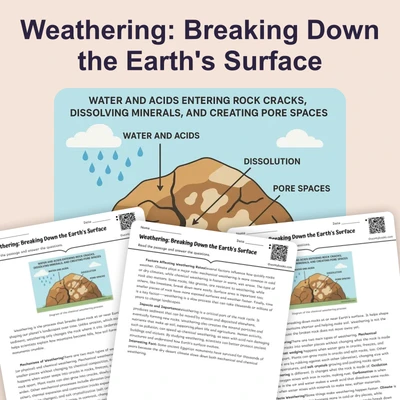
Weathering is the process that breaks down rocks and minerals into smaller pieces without moving them. There are two main types of weathering. Physical weathering breaks rocks apart through mechanical forces like freezing water, plant roots, or temperature changes. When water seeps into cracks in rocks and freezes, it expands and splits the rock apart. Chemical weathering occurs when chemical reactions change the minerals in rocks, making them weaker and easier to break down. Rainwater mixed with carbon dioxide creates a weak acid that slowly dissolves certain types of rocks like limestone.
Erosion is the process that moves weathered material from one place to another. Unlike weathering, erosion involves transportation of rock fragments, soil, and sediment. Water is the most powerful agent of erosion, carrying particles downstream in rivers and streams. Wind can pick up small particles and transport them across vast distances, creating sand dunes in deserts. Glaciers, which are massive sheets of moving ice, scrape and carry enormous amounts of rock and soil as they flow. Gravity also causes erosion through landslides and rockfalls on steep slopes.
The Grand Canyon provides an excellent example of how weathering and erosion work together. Over millions of years, the Colorado River has eroded layers of rock, cutting deeper into the geosphere. Weathering weakened the rock walls, and erosion carried the broken material downstream. This combination created one of Earth's most spectacular landscapes, revealing rock layers that are billions of years old.
Subsidence is the sinking or settling of Earth's surface to a lower level. This destructive force occurs when underground materials are removed or compressed. Natural subsidence happens when underground water dissolves limestone, creating caves that eventually collapse and form sinkholes. Human activities can also cause subsidence, such as pumping groundwater or extracting oil and gas from underground reservoirs. When these fluids are removed, the ground above may sink, sometimes damaging buildings and infrastructure.
All three destructive forces work continuously to reshape Earth's surface. They operate at different speeds—some changes happen quickly during storms or earthquakes, while others take thousands or millions of years. These processes balance constructive forces like volcanic eruptions and mountain building, creating the dynamic planet we live on. Scientists study destructive forces to understand past environmental changes and predict future landscape modifications.
Interesting Fact: The Appalachian Mountains were once as tall as the Himalayas, but millions of years of weathering and erosion have worn them down to less than half their original height.
What are the three main types of destructive forces mentioned in the passage?
Weathering, erosion, and subsidenceWind, water, and iceMountains, valleys, and canyonsPhysical, chemical, and mechanical
How does physical weathering differ from chemical weathering?
Physical weathering moves rocks while chemical weathering breaks themPhysical weathering breaks rocks mechanically while chemical weathering changes minerals through reactionsPhysical weathering is faster than chemical weatheringPhysical weathering only happens in cold climates
What is the main difference between weathering and erosion?
Weathering is faster than erosionWeathering only affects mountains while erosion affects valleysWeathering breaks down rocks without moving them, while erosion transports materialWeathering is caused by humans while erosion is natural
According to the passage, what does the term 'geosphere' refer to?
The atmosphere surrounding EarthThe water on Earth's surfaceThe solid, rocky part of EarthThe living organisms on Earth
Which agent of erosion is described as the most powerful in the passage?
WindWaterGlaciersGravity
How did the Grand Canyon form according to the passage?
A volcanic eruption created the canyon instantlyAn earthquake split the ground openWeathering and erosion worked together over millions of yearsHumans carved it out for mining
What can cause subsidence to occur?
Building more houses on the surfacePlanting trees in the groundRemoving underground water, oil, or gasAdding more soil to the surface
Based on the passage, which statement best describes how destructive forces operate?
They only work during natural disastersThey work at different speeds, some quickly and others over millions of yearsThey always work at the same slow paceThey only affect coastal areas
Destructive forces only tear down Earth's surface and never work with constructive forces.
TrueFalse
According to the passage, the Appalachian Mountains are now taller than they were millions of years ago.
TrueFalse
Perfect For:
👩🏫 Teachers
• Reading comprehension practice
• Auto-graded assessments
• Literacy skill development
👨👩👧👦 Parents
• Reading practice at home
• Comprehension improvement
• Educational reading time
🏠 Homeschoolers
• Reading curriculum support
• Independent reading practice
• Progress monitoring
Reading Features:
📖
Reading Passage
Engaging fiction or nonfiction text
❓
Comprehension Quiz
Auto-graded questions
📊
Instant Feedback
Immediate results and scoring
📄
Printable Version
Download for offline reading
🔊
Read Aloud
Voice-over with word highlighting
Reviews & Ratings
No reviews yet. Be the first to share your experience!
Related Content
Talus Slopes: Formation and Features
This earth science passage explains talus slope formation through mechanical weathering processes, aligning with NGSS MS...
MS-ESS2-1MS-ESS2-2RST.6-8.4
Biological Weathering: Types and Examples
This passage details biological weathering processes, connecting to NGSS MS-ESS2-1 (Earth's systems) and LS2.B (ecosyste...
MS-ESS2-1MS-PS1-2RST.6-8.3
Frost Wedging: How Ice Splits Rock
This passage explains frost wedging as a mechanical weathering process. Aligned with NGSS MS-ESS2-1 (Earth’s systems) a...
MS-ESS2-1MS-ESS2-2RST.6-8.3
Chemical Weathering: The Breakdown of Rocks Through Chemical Reactions
This passage explains chemical weathering processes, aligned with NGSS MS-ESS2-1 (Earth’s systems) and ESS2-2 (surface ...
MS-ESS2-1MS-ESS2-2RST.6-8.4
Limestone Caves: Nature’s Underground Wonders
This passage explains limestone cave formation through carbonation, aligned with NGSS MS-ESS2-1 (Earth’s systems) and L...
MS-ESS2-1LS2.CRST.6-8.7
The Coldest City in the World: Yakutsk
This NGSS-aligned science passage introduces middle school readers to Yakutsk, the coldest city on Earth. Students will ...
MS-ESS2-1
Igneous Rocks
This comprehensive passage introduces middle school students to igneous rocks, focusing on how these rocks form from mol...
MS-ESS2-1MS-ESS3-1
Sedimentary Rocks
This comprehensive middle school science passage introduces students to sedimentary rocks, detailing their step-by-step ...
MS-ESS2-1MS-ESS2-3MS-ESS3-1
Metamorphic Rocks
This engaging middle school science passage introduces students to the fascinating world of metamorphic rocks. Aligned w...
MS-ESS2-1MS-ESS3-1
Scientific Inquiry in Earth Science
This passage explores scientific inquiry in Earth science for grades 6-8, aligned with NGSS standards MS-ESS1-4, MS-ESS2...
MS-ESS1-4MS-ESS2-1MS-ESS3-5SEP
Contour Lines and Elevation
This passage, designed for grades 6-8 and aligned with NGSS standards MS-ESS2-2 and MS-ESS2-1, introduces students to th...
MS-ESS2-2MS-ESS2-1SEP.4SEP.8
Weathering
This comprehensive science reading passage for grades 6-8 focuses on the concept of weathering, aligning with NGSS stand...
MS-ESS2-1
Erosion
This comprehensive middle school science passage explains erosion—the process that transports weathered rock and soil fr...
MS-ESS2-1
Stream Erosion and Deposition
This middle school science passage, aligned to NGSS MS-ESS2-1, introduces students to the dynamic processes of stream er...
MS-ESS2-1
Wind Erosion and Deposition
This comprehensive science reading passage for grades 6-8 explores the processes of wind erosion and deposition, alignin...
MS-ESS2-1
Glacial Erosion and Deposition
This middle school science passage explores glacial erosion and deposition, focusing on the mechanisms by which glaciers...
MS-ESS2-1
Mass Movements
This NGSS-aligned passage introduces middle school students to the science of mass movements—gravity-driven motions of r...
MS-ESS2-1MS-ESS3-2
Soil Formation and Composition
This comprehensive middle school science passage explores soil formation and composition, perfectly aligned to NGSS stan...
MS-ESS2-1
Constructive and Destructive Forces
This middle school science passage explores how Earth's surface is constantly shaped by the interplay of constructive an...
MS-ESS2-1
Mountains and Mountain Building
This NGSS-aligned passage for grades 6-8 covers the fascinating processes that create Earth's highest landforms—mountain...