How Do Felsic and Mafic Igneous Rocks Differ — Reading Comprehension
Rate this
Premium Resource
Present
Present in classroom. No work saved
Assign
Classroom with student accounts, Track progress
Quick Play
No student accounts, assign with a link
Grades
6
7
8
Standards
MS-ESS2-1
PRINT+DIGITAL RESOURCE
This learning resource is available in interactive and printable formats. The interactive worksheet can be played online and assigned to students. The Printable PDF version can be downloaded and printed for completion by hand.
This comprehensive 650-word reading passage helps middle school students understand the fundamental differences between felsic and mafic igneous rocks. Aligned with NGSS standard MS-ESS2-1, the passage uses granite and basalt as concrete examples to explain how chemical composition affects rock properties including color, density, and texture. Students explore how silica-rich felsic rocks differ from iron-magnesium-rich mafic rocks through clear explanations and real-world applications. The passage includes audio integration for enhanced accessibility, a simplified differentiated version for struggling readers, Spanish translations, and engaging activities including multiple-choice questions, writing prompts, and graphic organizers. Key vocabulary terms are defined in context, and the content connects directly to Earth's system processes. Perfect for grades 6-8 science curriculum focusing on Earth materials and rock classification.
CONTENT PREVIEW
Expand content preview
Scientists classify igneous rocks into two main groups based on their chemical composition: felsic rocks and mafic rocks. These two categories differ in their mineral content, color, density, and where they commonly form in Earth's crust.
Igneous rocks form when molten rock, called magma, cools and solidifies either beneath Earth's surface or above it. Scientists classify igneous rocks into two main groups based on their chemical composition: felsic rocks and mafic rocks. These two categories differ in their mineral content, color, density, and where they commonly form in Earth's crust.
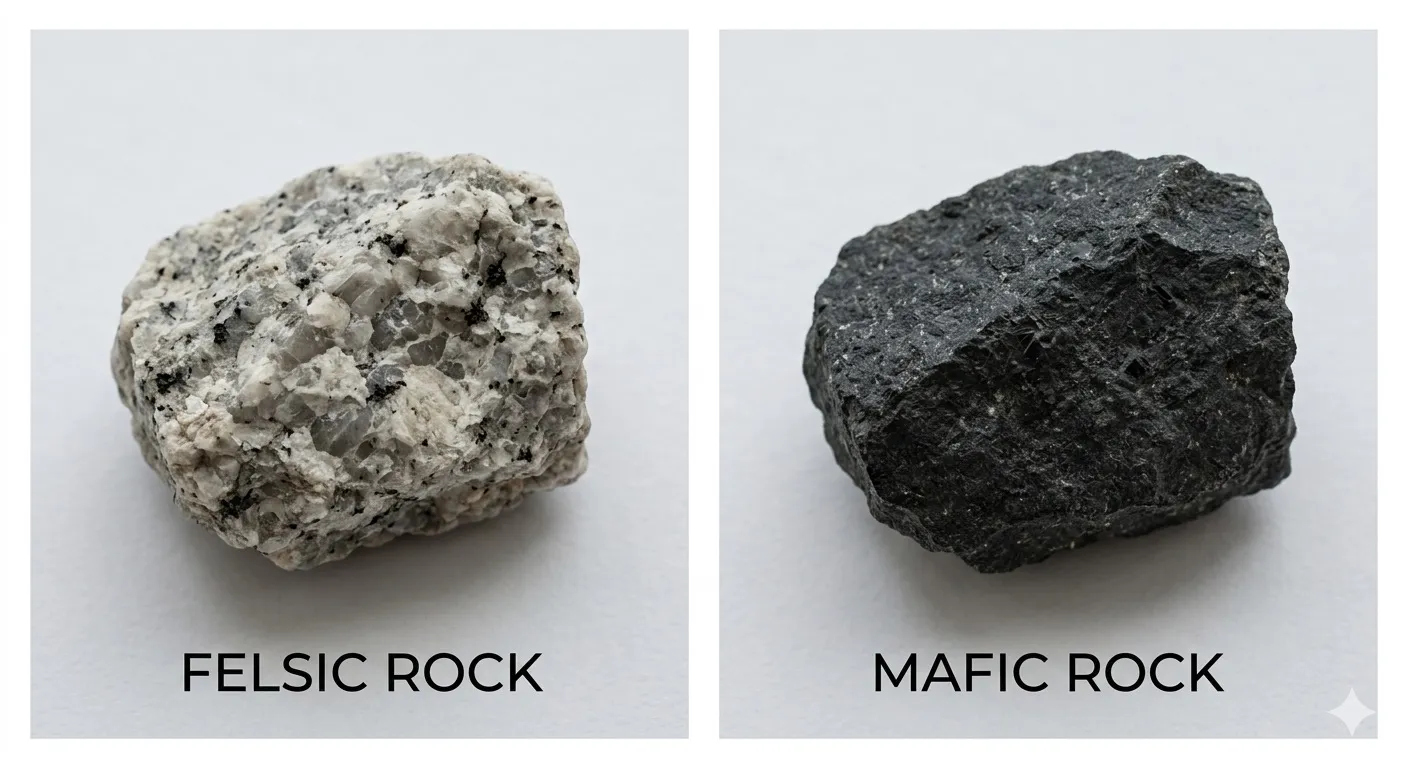
Felsic rocks are rich in silica, a compound made of silicon and oxygen. The term "felsic" comes from "feldspar" and "silica," the main components of these rocks. Felsic rocks typically contain more than 65% silica by weight. This high silica content gives felsic rocks their characteristic light colors, ranging from white to pink to light gray. Granite is the most common example of a felsic rock. When you look at granite countertops or building stones, you see light-colored minerals like quartz and feldspar. Felsic rocks have lower density compared to mafic rocks because silica-rich minerals are relatively lightweight. These rocks commonly form in continental crust, the thick layer of rock that makes up Earth's continents.
In contrast, mafic rocks contain less silica but are rich in magnesium and iron. The term "mafic" combines "magnesium" and the Latin word for iron, "ferrum." Mafic rocks typically contain between 45% and 52% silica. The iron content gives mafic rocks their dark colors, usually black, dark gray, or dark green. Basalt is the most common mafic rock and makes up most of the ocean floor. When you see dark volcanic rocks in Hawaii or Iceland, you are looking at basalt. Mafic rocks are denser than felsic rocks because iron and magnesium are heavier elements. These rocks commonly form in oceanic crust, the thinner layer of rock beneath the oceans.
The differences between felsic and mafic rocks affect how they behave when they form. Felsic magma is thick and sticky because of its high silica content. This thick magma traps gases and can lead to explosive volcanic eruptions. Mount St. Helens in Washington State erupted explosively in 1980 because it formed from felsic magma. Mafic magma is thinner and flows more easily. When mafic magma erupts, it typically produces gentle lava flows rather than violent explosions. The volcanoes in Hawaii demonstrate this pattern with their steady lava streams.
The density difference between felsic and mafic rocks explains why continents float higher on Earth's mantle than ocean floors. Continental crust, made mostly of felsic rocks like granite, is less dense and thicker. Oceanic crust, composed mainly of mafic rocks like basalt, is denser but thinner. This relationship between rock composition and crustal structure helps scientists understand plate tectonics and how Earth's surface changes over time.
Geologists can identify whether a rock is felsic or mafic by examining its color, weight, and mineral composition. A light-colored, relatively lightweight rock with visible crystals of quartz and feldspar is likely felsic. A dark, heavy rock with fine grains and dark minerals is probably mafic. These observations connect directly to the rock's chemical composition and formation history. Understanding the difference between felsic and mafic rocks helps scientists interpret Earth's geological processes and predict volcanic behavior.
Interesting Fact: The oldest rocks ever found on Earth are felsic rocks from Canada, dated at 4.28 billion years old, while new mafic basalt forms every day at mid-ocean ridges where tectonic plates spread apart.
What percentage of silica do felsic rocks typically contain?
More than 65%Between 45% and 52%Less than 40%Exactly 50%
Which rock is the most common example of a mafic rock?
GraniteQuartzBasaltFeldspar
What does the term 'mafic' combine?
Magnesium and feldsparMagnesium and iron (ferrum)Manganese and silicaMinerals and felsic
Why do felsic rocks have lower density than mafic rocks?
Because they contain more waterBecause silica-rich minerals are relatively lightweightBecause they form at lower temperaturesBecause they have larger crystals
What type of volcanic eruption is associated with felsic magma?
Based on the passage, why does continental crust float higher than oceanic crust?
Continental crust is made of less dense felsic rocks and is thickerContinental crust is older than oceanic crustContinental crust contains more waterContinental crust is warmer than oceanic crust
Which characteristic would help a geologist identify a rock as mafic?
Light color and low weightVisible quartz crystalsDark color and high densityPink or white coloring
How does the behavior of mafic magma differ from felsic magma during eruptions?
Mafic magma is thicker and more explosiveMafic magma is thinner and flows more easilyMafic magma never reaches the surfaceMafic magma cools faster underground
Felsic rocks are always lighter in color than mafic rocks.
TrueFalse
Granite is the most common rock found on the ocean floor.
TrueFalse
Perfect For:
👩🏫 Teachers
• Reading comprehension practice
• Auto-graded assessments
• Literacy skill development
👨👩👧👦 Parents
• Reading practice at home
• Comprehension improvement
• Educational reading time
🏠 Homeschoolers
• Reading curriculum support
• Independent reading practice
• Progress monitoring
Reading Features:
📖
Reading Passage
Engaging fiction or nonfiction text
❓
Comprehension Quiz
Auto-graded questions
📊
Instant Feedback
Immediate results and scoring
📄
Printable Version
Download for offline reading
🔊
Read Aloud
Voice-over with word highlighting
Reviews & Ratings
No reviews yet. Be the first to share your experience!
Related Content
Frost Wedging: How Ice Splits Rock
This passage explains frost wedging as a mechanical weathering process. Aligned with NGSS MS-ESS2-1 (Earth’s systems) a...
MS-ESS2-1MS-ESS2-2RST.6-8.3
Limestone Caves: Nature’s Underground Wonders
This passage explains limestone cave formation through carbonation, aligned with NGSS MS-ESS2-1 (Earth’s systems) and L...
MS-ESS2-1LS2.CRST.6-8.7
Chemical Weathering: The Breakdown of Rocks Through Chemical Reactions
This passage explains chemical weathering processes, aligned with NGSS MS-ESS2-1 (Earth’s systems) and ESS2-2 (surface ...
MS-ESS2-1MS-ESS2-2RST.6-8.4
Talus Slopes: Formation and Features
This earth science passage explains talus slope formation through mechanical weathering processes, aligning with NGSS MS...
MS-ESS2-1MS-ESS2-2RST.6-8.4
Biological Weathering: Types and Examples
This passage details biological weathering processes, connecting to NGSS MS-ESS2-1 (Earth's systems) and LS2.B (ecosyste...
MS-ESS2-1MS-PS1-2RST.6-8.3
The Coldest City in the World: Yakutsk
This NGSS-aligned science passage introduces middle school readers to Yakutsk, the coldest city on Earth. Students will ...
MS-ESS2-1
Igneous Rocks
This comprehensive passage introduces middle school students to igneous rocks, focusing on how these rocks form from mol...
MS-ESS2-1MS-ESS3-1
Sedimentary Rocks
This comprehensive middle school science passage introduces students to sedimentary rocks, detailing their step-by-step ...
MS-ESS2-1MS-ESS2-3MS-ESS3-1
Metamorphic Rocks
This engaging middle school science passage introduces students to the fascinating world of metamorphic rocks. Aligned w...
MS-ESS2-1MS-ESS3-1
Scientific Inquiry in Earth Science
This passage explores scientific inquiry in Earth science for grades 6-8, aligned with NGSS standards MS-ESS1-4, MS-ESS2...
MS-ESS1-4MS-ESS2-1MS-ESS3-5SEP
Contour Lines and Elevation
This passage, designed for grades 6-8 and aligned with NGSS standards MS-ESS2-2 and MS-ESS2-1, introduces students to th...
MS-ESS2-2MS-ESS2-1SEP.4SEP.8
Weathering
This comprehensive science reading passage for grades 6-8 focuses on the concept of weathering, aligning with NGSS stand...
MS-ESS2-1
Erosion
This comprehensive middle school science passage explains erosion—the process that transports weathered rock and soil fr...
MS-ESS2-1
Stream Erosion and Deposition
This middle school science passage, aligned to NGSS MS-ESS2-1, introduces students to the dynamic processes of stream er...
MS-ESS2-1
Wind Erosion and Deposition
This comprehensive science reading passage for grades 6-8 explores the processes of wind erosion and deposition, alignin...
MS-ESS2-1
Glacial Erosion and Deposition
This middle school science passage explores glacial erosion and deposition, focusing on the mechanisms by which glaciers...
MS-ESS2-1
Mass Movements
This NGSS-aligned passage introduces middle school students to the science of mass movements—gravity-driven motions of r...
MS-ESS2-1MS-ESS3-2
Soil Formation and Composition
This comprehensive middle school science passage explores soil formation and composition, perfectly aligned to NGSS stan...
MS-ESS2-1
Constructive and Destructive Forces
This middle school science passage explores how Earth's surface is constantly shaped by the interplay of constructive an...
MS-ESS2-1
Mountains and Mountain Building
This NGSS-aligned passage for grades 6-8 covers the fascinating processes that create Earth's highest landforms—mountain...