How Oceans Absorb and Store Carbon
Interactive passage with audio narration, comprehension questions, and printable PDF.
By completing this purchase you agree to our Terms of Use and Privacy Policy. Your subscription renews automatically until you cancel. You can cancel anytime from your account settings. All sales are final and non-refundable. Digital content is available for download in your account immediately upon purchase.
What's included
How Oceans Absorb and Store Carbon preview and details
About this printable How Oceans Absorb and Store Carbon science reading passage, NGSS-aligned (Grades 6-8)
Sample passage and quiz from How Oceans Absorb and Store Carbon
Reading passage and comprehension quiz preview
How Do Oceans Absorb and Store Carbon
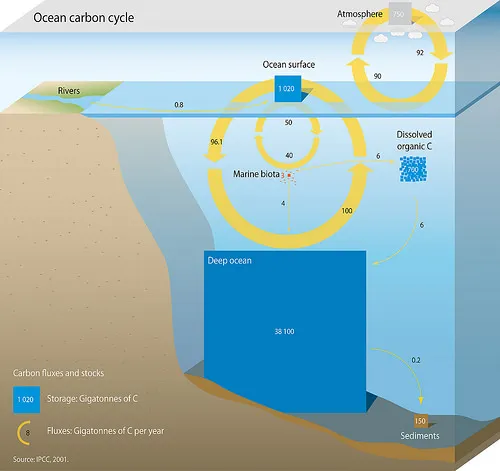
The ocean is Earth's largest carbon sink. OceanCarbonCycle by Ricardo Pravettoni / Wikimedia Commons
The ocean is Earth's largest carbon sink, a natural system that absorbs and stores carbon from the atmosphere. Every year, the ocean absorbs about one-quarter of the carbon dioxide (CO₂) that humans release by burning fossil fuels. Without this ocean storage, Earth's atmosphere would contain much more CO₂, leading to more rapid climate change. Understanding how oceans store carbon helps scientists predict future climate patterns and protect marine ecosystems.
The first way oceans store carbon is through direct dissolution, which means CO₂ gas from the air dissolves into seawater. When atmospheric CO₂ contacts the ocean surface, it dissolves and forms carbonic acid. This process works like carbon dioxide dissolving in soda to make it fizzy, except it happens naturally at a massive scale. Cold ocean water can dissolve more CO₂ than warm water, which is why polar regions absorb especially large amounts of atmospheric carbon. Ocean currents then carry this dissolved carbon throughout the world's oceans, distributing it from surface waters to deeper layers.
The second storage method involves marine organisms through a process called the biological carbon pump. Tiny ocean plants called phytoplankton use sunlight and dissolved CO₂ to perform photosynthesis, just like land plants. These microscopic organisms convert carbon dioxide into organic matter, building their bodies from carbon atoms. When phytoplankton die or are eaten by other marine animals, their carbon-containing bodies sink toward the ocean floor. This downward movement transfers carbon from the surface ocean to the deep ocean, where it can remain stored for hundreds or thousands of years before returning to the surface.
The third and longest-lasting storage happens in seafloor sediment and shells. Many marine animals, including clams, coral, and tiny organisms called foraminifera, use dissolved carbon to build shells and skeletons made of calcium carbonate. When these organisms die, their shells settle on the ocean floor and accumulate over time. Layers of sediment bury these carbon-rich shells, locking carbon away for millions of years. Eventually, geological processes can transform these sediments into limestone rock, creating a permanent carbon storage system that operates on geological timescales.
The ocean's ability to store carbon depends on several interconnected factors. Temperature affects how much CO₂ can dissolve in seawater. Ocean circulation patterns determine how quickly carbon moves from surface to deep waters. The health of marine ecosystems influences how effectively the biological carbon pump operates. Scientists monitor these factors because changes in ocean temperature, chemistry, or biology can affect the ocean's capacity to absorb atmospheric CO₂. For example, as ocean water absorbs more CO₂, it becomes more acidic, which can harm shell-building organisms and potentially weaken the ocean's carbon storage ability.
The ocean's role as a carbon sink demonstrates the interconnected nature of Earth's systems. Atmosphere, ocean, and living organisms work together in the carbon cycle, moving carbon between different reservoirs. While the ocean currently helps slow climate change by absorbing human-produced CO₂, this service has limits. Understanding ocean carbon storage helps us appreciate why protecting ocean health matters for the entire planet's climate system.
Interesting Fact: If all the carbon stored in the ocean were suddenly released into the atmosphere, the amount of CO₂ in the air would increase by about 50 times, making Earth uninhabitable for most life forms.
Comprehension quiz (10 questions)
1. What fraction of human-produced carbon dioxide does the ocean absorb each year?
2. Why do polar ocean regions absorb especially large amounts of atmospheric carbon?
3. What is the biological carbon pump?
4. In the passage, what does the term 'dissolution' mean?
5. Which material do many marine animals use to build their shells?
6. Based on the passage, what can be inferred about the relationship between ocean temperature and carbon storage?
7. How does increased ocean acidity affect the ocean's carbon storage ability?
8. Which of the following represents the longest-lasting form of ocean carbon storage?
9. True or False: Phytoplankton perform photosynthesis just like land plants.
10. True or False: The ocean's capacity to absorb CO₂ is unlimited and will never be affected by environmental changes.
Perfect for the way you teach
- Build comprehension skills
- Auto-graded quiz
- Differentiated reading
- Read together at home
- Improve fluency
- Quiet reading time
- Reading curriculum support
- Independent practice
- Track Lexile growth