Reading PassagePremium

How Do Wind Turbines Work?

Interactive passage with audio narration, comprehension questions, and printable PDF.

No ratings yet
Grades 3–7ElaReadingScienceEnglish · SpanishInteractive · Printable
Aligned toMS-ESS3-1
Just this resource
$1.50
One-time purchase
Best value
Unlock everything
$49.99$24.99/yr
50% off until Sept 15 — 10,000+ resources
Renews at $49.99/year.

By completing this purchase you agree to our Terms of Use and Privacy Policy. Your subscription renews automatically until you cancel. You can cancel anytime from your account settings. All sales are final and non-refundable. Digital content is available for download in your account immediately upon purchase.

Unlock above to use these actions

What's included

Reading passage
Audio narration
Comprehension quiz
Writing activity
Glossary & flashcards
Differentiated version
Spanish translation

How Do Wind Turbines Work? preview and details

About this printable How Do Wind Turbines Work? science reading passage, NGSS-aligned (Grades 3-7)

This NGSS-aligned reading passage for middle school students explains how wind turbines convert the energy of moving air into electricity. It describes the basic parts of a wind turbine—blades, shaft, and generator—and how they work together to create clean, renewable energy. The text also introduces the concept of wind farms and discusses both the benefits and challenges of wind power. Aligned with NGSS standard MS-ESS3-1, this passage promotes science literacy and real-world understanding of sustainable energy systems. It supports vocabulary development, reading comprehension, and environmental awareness in physical and Earth science education.
Written by Workybooks TeamPublished by Workybooks
Preview

Sample passage and quiz from How Do Wind Turbines Work?

Reading passage and comprehension quiz preview

How Do Wind Turbines Work?
QZ.MS-ESS3-1-7


Wind turbines are machines that turn wind into electricity. They are an important source of renewable energy because they use a natural force—the wind—that never runs out. Wind turbines help power homes, schools, and businesses without polluting the air.


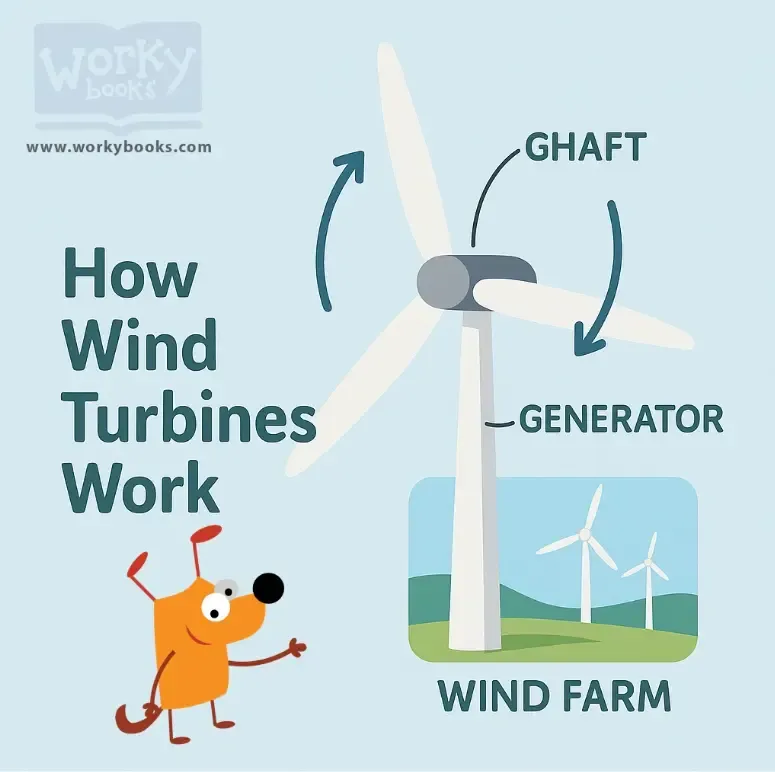
A wind turbine has three main parts: the blades, the shaft, and the generator. When the wind blows, it pushes the blades, causing them to spin. The spinning blades turn the shaft inside the turbine. This shaft is connected to a generator, which produces electricity as it turns.


Wind turbines are usually placed in open, windy areas like plains, hills, or near oceans. These areas are chosen because they have steady, strong winds that help the turbines work more efficiently. Sometimes, many wind turbines are built together in a large area called a wind farm.


The electricity made by the turbines travels through power lines to homes and buildings. Wind energy is clean because it does not release greenhouse gases or other pollution into the air. It also helps reduce the need for fossil fuels like coal and oil.


There are some challenges with wind turbines. They only produce electricity when the wind is blowing. Also, some people believe turbines are too noisy or change the look of the landscape. But engineers are working to make wind turbines quieter and more efficient.


Wind turbines show how we can use the power of nature to meet our energy needs. They are a smart way to create clean electricity and protect the planet.


Fun Fact: The blades of a large wind turbine can be as long as a football field!

Comprehension quiz (8 questions)

1. What do wind turbines use to make electricity?

Sunlight
Moving water
Wind
Fossil fuels

2. What part of a wind turbine spins when the wind blows?

Generator
Shaft
Blades
Base

3. What does the generator in a wind turbine do?

Stores electricity
Spins the blades
Produces electricity
Measures the wind

4. Where are wind turbines usually placed?

Underground
Busy cities
Open, windy areas
Rainforests

5. Why is wind energy considered clean?

It uses coal
It makes smoke
It creates greenhouse gases
It does not pollute the air

6. What is a wind farm?

A farm that grows wind
A place where turbines are built
A group of wind turbines working together
A machine that stores wind

7. What is the main idea of the passage?

Wind turbines are loud and harmful
Wind turbines use wind to make clean electricity
Wind turbines are only found in oceans
Wind turbines store gasoline

8. A town wants to use more clean energy and has steady wind. What should they install?

Solar panels
Wind turbines
Coal plants
Water tanks
Who it's for

Perfect for the way you teach

Teachers
  • Build comprehension skills
  • Auto-graded quiz
  • Differentiated reading
Parents
  • Read together at home
  • Improve fluency
  • Quiet reading time
Homeschoolers
  • Reading curriculum support
  • Independent practice
  • Track Lexile growth
Topics

Reviews & Ratings

No reviews yet. Be the first to share your experience!

More reading you might love

19 more
Passage
How Do Solar Panels Work? - reading educational content
Grades 3–7

How Do Solar Panels Work?

physical science · MS-ESS3-1

$1.50
Passage
How Does a Hydroelectric Dam Work? - reading educational content
Grades 3–7

How Does a Hydroelectric Dam Work?

physical science · MS-ESS3-1

$1.50
Passage
What Is Biofuel? - reading educational content
Grades 3–7

What Is Biofuel?

physical science · MS-ESS3-1

$1.50
Passage
What Is Tidal Energy? - reading educational content
Grades 3–7

What Is Tidal Energy?

physical science · MS-ESS3-1

$1.50
Passage
What Is Wave Energy? - reading educational content
Grades 3–7

What Is Wave Energy?

physical science · MS-ESS3-1

$1.50
Passage
What Is Green Energy? - reading educational content
Grades 3–7

What Is Green Energy?

physical science · MS-ESS3-1

$1.50
Passage
Igneous Rocks - reading educational content
Grades 5–8

Igneous Rocks

earth and space science · MS-ESS2-1+1

$1.50
Passage
Sedimentary Rocks - reading educational content
Grades 5–8

Sedimentary Rocks

earth and space science · MS-ESS2-1+2

$1.50
Passage
Metamorphic Rocks - reading educational content
Grades 5–8

Metamorphic Rocks

earth and space science · MS-ESS2-1+1

Free
Passage
Topographic Maps - reading educational content
Grades 5–8

Topographic Maps

earth and space science · MS-ESS2-2+3

$1.50
Passage
Minerals and Rocks as Resources - reading educational content
Grades 5–8

Minerals and Rocks as Resources

earth and space science · MS-ESS3-1+1

$1.50
Passage
Benefits of Volcanic Activity - reading educational content
Grades 5–8

Benefits of Volcanic Activity

earth and space science · MS-ESS2-2+1

$1.50
Passage
Groundwater - reading educational content
Grades 5–8

Groundwater

earth and space science · MS-ESS2-4+1

$1.50
Passage
Distribution of Water on Earth - reading educational content
Grades 5–8

Distribution of Water on Earth

earth and space science · MS-ESS2-4+1

$1.50
Passage
Water as a Resource - reading educational content
Grades 5–8

Water as a Resource

earth and space science · MS-ESS3-1+1

$1.50
Passage
Water Quality - reading educational content
Grades 5–8

Water Quality

earth and space science · MS-ESS3-1+1

$1.50
Passage
How Do Uranium Deposits Form - reading educational content
Grades 6–8

How Do Uranium Deposits Form

earth and space science · MS-ESS3-1

$1.50
Passage
How Are Minerals Extracted From the Earth - reading educational content
Grades 6–8

How Are Minerals Extracted From the Earth

earth and space science · MS-ESS3-1

$1.50
Passage
Why Are Resources Unevenly Distributed - reading educational content
Grades 6–8

Why Are Resources Unevenly Distributed

earth and space science · MS-ESS3-1

$1.50
Copyright © 2026 Workybooks. Made with ♥ in California.