This learning resource is available in interactive and printable formats. The interactive worksheet can be played online and assigned to students. The Printable PDF version can be downloaded and printed for completion by hand.
This passage introduces middle school students to wave energy—a clean, renewable energy source that comes from the movement of ocean waves. The passage explains how devices like point absorbers and oscillating water columns use wave motion to power generators and produce electricity. Students will explore how wave energy works, its environmental benefits, and some of the challenges engineers face when designing ocean-based power systems. The passage supports NGSS standard MS-ESS3-1, helping students build science literacy, energy awareness, and real-world understanding of sustainable energy solutions.
CONTENT PREVIEW
Expand content preview
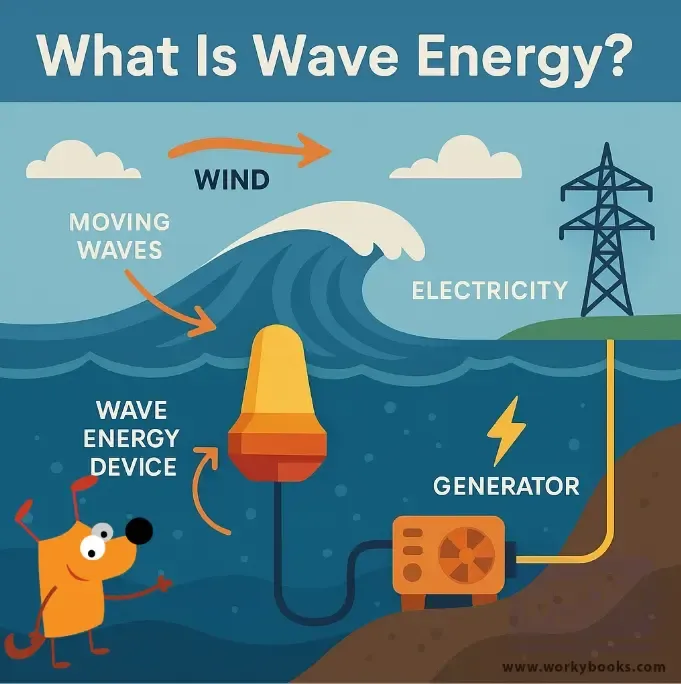
Wave energy is a form of renewable energy that comes from the movement of ocean waves. When wind blows across the surface of the sea, it creates waves. These waves carry kinetic energy, which can be captured and turned into electricity.
Wave energy is collected using special machines placed in the water. These devices float on the surface or are fixed to the ocean floor. As the waves move, they push parts of the machine up and down or back and forth. This motion is used to power a generator, which creates electricity.
One type of wave energy device is a point absorber. It is a floating buoy that moves with the waves. Inside the buoy, the movement powers a generator. Another type is an oscillating water column, which traps air above rising and falling water. The air moves through a turbine that makes electricity.
Wave energy is helpful because it is clean and predictable. Ocean waves happen all day and all year, especially in coastal areas. Like other renewable sources, wave energy does not release greenhouse gases or cause air pollution.
But wave energy also has challenges. The machines must survive harsh ocean conditions like storms and strong currents. They can also be expensive to build and maintain, and they may affect marine animals or boats nearby.
Even with these challenges, wave energy is a powerful example of how we can use the ocean’s motion to meet our energy needs. It’s a growing part of our shift toward sustainable energy.
Fun Fact: Some wave energy machines are designed to look like sea snakes, moving with the waves as they float on the water!
What creates ocean waves?
Rain and snowEarthquakesWind blowing across the seaUnderwater volcanoes
What kind of energy do waves carry?
Chemical energyKinetic energyThermal energyLight energy
What does a generator do in a wave energy device?
Cools the machineMakes electricityCollects waterStores sunlight
What is a point absorber?
A type of fishA floating wave energy deviceA kind of stormA weather tool
Why is wave energy considered renewable?
It is made from oilIt never pollutesWaves keep coming naturallyIt uses heat from the sun
What is one challenge of using wave energy?
Waves stop in summerMachines are always on landOcean conditions can damage equipmentIt needs fossil fuels
What is the main idea of the passage?
Waves are dangerous for boatsWave energy is used for fishingWave energy turns ocean motion into electricityOnly big cities use wave energy
A coastal city wants clean, predictable energy from the sea. What should they explore?
Tidal poolsOil drillingWave energy devicesGas engines
Perfect For:
👩🏫 Teachers
• Reading comprehension practice
• Auto-graded assessments
• Literacy skill development
👨👩👧👦 Parents
• Reading practice at home
• Comprehension improvement
• Educational reading time
🏠 Homeschoolers
• Reading curriculum support
• Independent reading practice
• Progress monitoring
Reading Features:
📖
Reading Passage
Engaging fiction or nonfiction text
❓
Comprehension Quiz
Auto-graded questions
📊
Instant Feedback
Immediate results and scoring
📄
Printable Version
Download for offline reading
🔊
Read Aloud
Voice-over with word highlighting
Reviews & Ratings
No reviews yet. Be the first to share your experience!
Related Content
How Do Solar Panels Work?
This middle school reading passage explains how solar panels work by turning sunlight into electricity. The passage desc...
MS-ESS3-1
How Do Wind Turbines Work?
This NGSS-aligned reading passage for middle school students explains how wind turbines convert the energy of moving air...
MS-ESS3-1
How Does a Hydroelectric Dam Work?
This NGSS-aligned science passage for middle school students explains how hydroelectric dams work to produce clean, rene...
MS-ESS3-1
What Is Biofuel?
This NGSS-aligned middle school science passage explains what biofuel is, how it is made, and why it is important as a c...
MS-ESS3-1
What Is Tidal Energy?
This engaging reading passage for middle school students introduces tidal energy, a form of renewable energy that uses t...
MS-ESS3-1
What Is Green Energy?
This science passage introduces middle school students to the concept of green energy—clean, renewable energy that comes...
MS-ESS3-1
Igneous Rocks
This comprehensive passage introduces middle school students to igneous rocks, focusing on how these rocks form from mol...
MS-ESS2-1MS-ESS3-1
Sedimentary Rocks
This comprehensive middle school science passage introduces students to sedimentary rocks, detailing their step-by-step ...
MS-ESS2-1MS-ESS2-3MS-ESS3-1
Metamorphic Rocks
This engaging middle school science passage introduces students to the fascinating world of metamorphic rocks. Aligned w...
MS-ESS2-1MS-ESS3-1
Topographic Maps
This comprehensive passage introduces middle school students to topographic maps, with a focus on how these maps represe...
MS-ESS2-2MS-ESS3-1SEP.4SEP.7
Minerals and Rocks as Resources
This middle school science passage, aligned to NGSS standards MS-ESS3-1 and MS-ESS3-4, explores the critical role that m...
MS-ESS3-1MS-ESS3-4
Benefits of Volcanic Activity
This middle school science passage explores the many positive impacts of volcanic activity, aligning with NGSS standards...
MS-ESS2-2MS-ESS3-1
Groundwater
This middle school science passage explores the essential topic of groundwater, aligned to NGSS standards MS-ESS2-4 and ...
MS-ESS2-4MS-ESS3-1
Distribution of Water on Earth
This middle school science reading passage explores the distribution of water on Earth, aligned with NGSS standards MS-E...
MS-ESS2-4MS-ESS3-1
Water as a Resource
This middle school science passage examines water as a critical resource, focusing on how it is used, managed, and conse...
MS-ESS3-1MS-ESS3-4
Water Quality
This middle school science reading passage covers the topic of water quality, aligned with NGSS standards MS-ESS3-1 and ...