How Earth's Four Spheres Interact
Interactive passage with audio narration, comprehension questions, and printable PDF.
By completing this purchase you agree to our Terms of Use and Privacy Policy. Your subscription renews automatically until you cancel. You can cancel anytime from your account settings. All sales are final and non-refundable. Digital content is available for download in your account immediately upon purchase.
What's included
How Earth's Four Spheres Interact preview and details
About this printable How Earth's Four Spheres Interact science reading passage, NGSS-aligned (Grades 6-8)
Sample passage and quiz from How Earth's Four Spheres Interact
Reading passage and comprehension quiz preview
How Earth's Four Spheres Interact
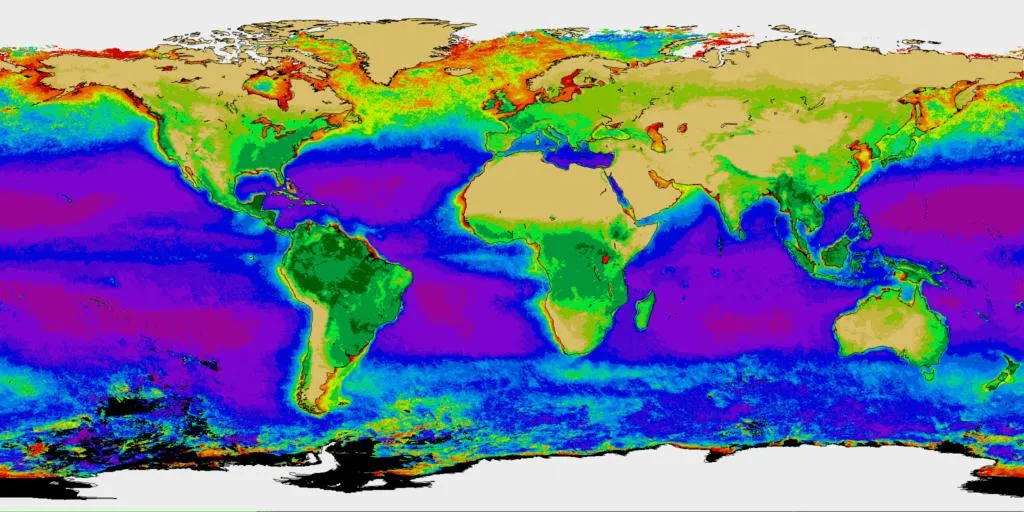
"Biosphere CZCS NDVI" by Gene Feldman, Jim Tucker, NASA / Wikimedia Commons (Public domain).
Earth functions as a complex system made up of four major parts that constantly interact with each other. The geosphere includes all the solid and molten rock that makes up Earth's interior, crust, and landforms. The hydrosphere consists of all water on Earth, including oceans, rivers, lakes, groundwater, and ice. The atmosphere is the layer of gases surrounding our planet, containing the air we breathe. Finally, the biosphere includes all living organisms on Earth, from microscopic bacteria to massive whales and towering trees.
These four systems do not exist in isolation. Instead, they continuously exchange matter and energy through various processes. Matter refers to any substance that has mass and takes up space, such as water, minerals, or gases. Energy is the ability to do work or cause change, and it flows through Earth's systems in different forms including heat, light, and chemical energy. Understanding how these systems interact helps scientists explain weather patterns, climate change, and the distribution of life on Earth.
The water cycle demonstrates a clear example of system interaction. Water evaporates from the hydrosphere when the sun's energy heats oceans and lakes. This water vapor enters the atmosphere as a gas. When atmospheric conditions change, water vapor condenses into clouds and eventually falls back to Earth as precipitation. Some precipitation soaks into the geosphere, becoming groundwater that flows through rocks and soil. Plants in the biosphere absorb this groundwater through their roots, using it for growth and releasing water vapor back into the atmosphere through transpiration. This continuous movement shows how all four systems work together.
The biosphere depends heavily on interactions with other systems for survival. Plants perform photosynthesis, a process that takes carbon dioxide from the atmosphere and water from the hydrosphere to produce food and oxygen. Animals breathe oxygen from the atmosphere and drink water from the hydrosphere. When organisms die, they decompose and return nutrients to the geosphere's soil, which supports new plant growth. These cycles of matter ensure that essential elements like carbon, nitrogen, and phosphorus move continuously between systems.
Energy flow through Earth's systems follows a different pattern than matter cycling. The sun provides most of the energy that drives Earth's processes. Solar energy warms the atmosphere and hydrosphere, creating weather and ocean currents. This energy also powers photosynthesis in the biosphere. Heat from Earth's interior, generated by radioactive decay in the geosphere, causes volcanic eruptions and drives the movement of tectonic plates. When a volcano erupts, it demonstrates interaction between multiple systems: molten rock from the geosphere releases gases into the atmosphere, and lava can vaporize water from the hydrosphere while destroying parts of the biosphere.
Human activities increasingly affect how Earth's systems interact. Burning fossil fuels transfers carbon from the geosphere into the atmosphere as carbon dioxide. This change affects the atmosphere's composition and influences global temperatures, which then impact the hydrosphere through melting ice and rising sea levels. Changes in temperature and water availability affect the biosphere by altering where plants and animals can survive. Scientists study these system interactions to predict future changes and develop solutions to environmental challenges.
Recognizing Earth as an interconnected system helps us understand that changes in one part affect all the others. A drought in the hydrosphere impacts the biosphere by reducing water available for plants and animals. Deforestation in the biosphere affects the atmosphere by reducing the number of trees that absorb carbon dioxide. Volcanic eruptions from the geosphere can temporarily cool the atmosphere by releasing particles that block sunlight. These examples show why scientists use a systems approach when studying Earth processes.
Interesting Fact: Scientists estimate that the water you drink today has cycled through Earth's systems for billions of years, meaning you might be drinking the same water molecules that dinosaurs drank millions of years ago.
Comprehension quiz (10 questions)
1. Which of Earth's systems includes all the solid and molten rock?
2. What does the term 'matter' mean in the context of Earth's systems?
3. According to the passage, what is the main source of energy that drives most of Earth's processes?
4. How do plants demonstrate interaction between the atmosphere and biosphere?
5. What happens when water evaporates from the hydrosphere?
6. Based on the passage, what is one way that volcanic eruptions demonstrate system interactions?
7. How does burning fossil fuels affect Earth's systems?
8. What role does transpiration play in the water cycle?
9. True or False: Energy flows through Earth's systems in the same pattern as matter cycles.
10. True or False: Changes in one of Earth's systems can affect all the other systems.
Perfect for the way you teach
- Build comprehension skills
- Auto-graded quiz
- Differentiated reading
- Read together at home
- Improve fluency
- Quiet reading time
- Reading curriculum support
- Independent practice
- Track Lexile growth