How Humans Disrupt Earth's Cycles — Reading Comprehension
Rate this
Premium Resource
Present
Present in classroom. No work saved
Assign
Classroom with student accounts, Track progress
Quick Play
No student accounts, assign with a link
Grades
6
7
8
Standards
MS-ESS2-1
PRINT+DIGITAL RESOURCE
This learning resource is available in interactive and printable formats. The interactive worksheet can be played online and assigned to students. The Printable PDF version can be downloaded and printed for completion by hand.
This comprehensive 650-word reading passage examines how human activities simultaneously disrupt Earth's carbon, nitrogen, and oxygen cycles. Aligned with NGSS MS-ESS2-1, the passage helps middle school students understand the interconnected nature of biogeochemical cycles and how disrupting one cycle creates cascading effects across all Earth systems. Students explore real-world examples of deforestation, fossil fuel burning, and synthetic fertilizer use, learning how these activities alter the natural balance of elements moving through Earth's atmosphere, biosphere, hydrosphere, and geosphere. The passage includes audio integration for accessibility, a simplified differentiated version for struggling readers and English Language Learners, Spanish translations, comprehensive glossary, multiple-choice questions, writing activities, and graphic organizers. Through this curriculum, students develop critical thinking skills about human impacts on Earth systems and the interconnected nature of environmental changes.
CONTENT PREVIEW
Expand content preview
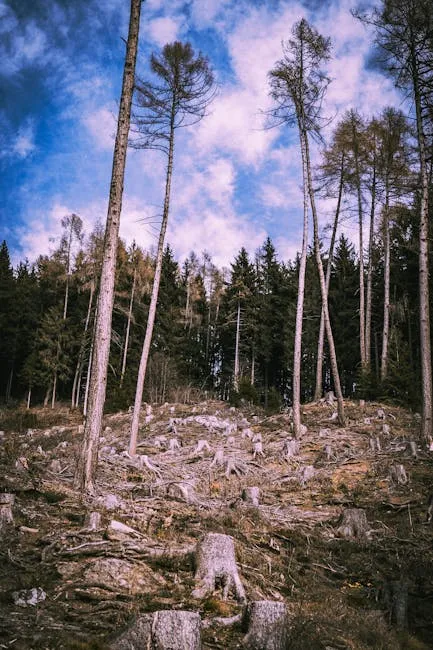
"Deforested landscape with tree stumps under a clear blue sky, highlighting environmental impact." by Cătălin Todosia / Pexels.
Earth's natural cycles move essential elements like carbon, nitrogen, and oxygen between the atmosphere, living things, water, and rocks. These biogeochemical cycles have maintained a careful balance for millions of years. However, human activities are disrupting these cycles in ways that create problems across all Earth systems. When we change one cycle, we set off a chain reaction that affects the others.
Deforestation, the large-scale removal of forests, disrupts all three major cycles simultaneously. Trees absorb carbon dioxide during photosynthesis and release oxygen as a byproduct. When forests are cut down, this carbon storage system disappears. The carbon stored in trees returns to the atmosphere as carbon dioxide when wood decays or burns. At the same time, fewer trees mean less oxygen production and less nitrogen cycling through forest ecosystems. Forest soil contains bacteria that convert nitrogen between different chemical forms, and losing forests disrupts this natural process.
Burning fossil fuels like coal, oil, and natural gas creates even more widespread disruption. These fuels formed from ancient plants and animals that stored carbon underground for millions of years. When we burn them for energy, we release this stored carbon as carbon dioxide into the atmosphere much faster than natural processes can absorb it. This excess carbon dioxide traps heat in Earth's atmosphere, contributing to climate change. Fossil fuel combustion also releases nitrogen oxides, which alter the nitrogen cycle by adding reactive nitrogen compounds to the air and water. These compounds fall back to Earth in rain, changing soil chemistry and water quality in ecosystems far from where the fuels were burned.
The use of synthetic fertilizers in agriculture directly disrupts the nitrogen cycle. Plants need nitrogen to grow, but they can only use certain forms of it. For thousands of years, farmers relied on natural nitrogen sources like animal manure and nitrogen-fixing bacteria in soil. Modern synthetic fertilizers provide concentrated nitrogen that plants can use immediately. However, plants cannot absorb all the fertilizer applied to fields. The excess nitrogen runs off into streams and rivers, eventually reaching oceans. This nutrient pollution causes algae to grow rapidly in a process called eutrophication. When the algae die and decompose, bacteria consume oxygen from the water, creating dead zones where fish and other organisms cannot survive.
These three human activities create cascading effects because Earth's cycles are interconnected. For example, when excess carbon dioxide from fossil fuels warms the atmosphere, it changes rainfall patterns. These changes affect where forests can grow, which influences the carbon and oxygen cycles. Warmer temperatures also speed up decomposition in soil, releasing more carbon and nitrogen into the atmosphere. In oceans, excess carbon dioxide makes water more acidic, harming organisms that help cycle carbon between water and the ocean floor. Meanwhile, nitrogen pollution from fertilizers can stimulate plant growth that temporarily absorbs more carbon dioxide, but this effect is short-lived and creates other problems.
Understanding these connections helps explain why environmental problems are so complex. A factory burning coal in one location affects ocean chemistry thousands of miles away. Fertilizer applied to a cornfield in the Midwest contributes to dead zones in the Gulf of Mexico. Cutting down a rainforest changes not just local carbon storage but global oxygen production and climate patterns. Scientists study these interconnected cycles to predict how Earth systems will respond to continued human activities and to develop solutions that address multiple problems at once.
Interesting Fact: The Gulf of Mexico dead zone, caused primarily by fertilizer runoff from farms along the Mississippi River, can grow to over 6,000 square miles during summer months—an area roughly the size of Connecticut.
What are biogeochemical cycles?
Cycles that only involve living organismsNatural processes that move elements between air, living things, water, and rocksHuman-made processes for producing fertilizersCycles that occur only in the ocean
How does deforestation affect the carbon cycle?
It increases carbon storage in treesIt has no effect on carbon levelsIt releases stored carbon back into the atmosphere as carbon dioxideIt converts carbon into oxygen
What does the term 'eutrophication' mean in the passage?
The process of burning fossil fuelsThe removal of forests for agricultureThe rapid growth of algae caused by excess nutrientsThe storage of carbon underground
Which statement best describes how burning fossil fuels affects multiple cycles?
It only affects the carbon cycle by releasing carbon dioxideIt releases carbon dioxide and nitrogen oxides, affecting both carbon and nitrogen cyclesIt only affects the oxygen cycleIt has no effect on biogeochemical cycles
Why can't plants absorb all the synthetic fertilizer applied to fields?
The fertilizer is applied in concentrations too high for complete absorptionPlants don't need nitrogen to growThe fertilizer evaporates before plants can use itBacteria consume all the fertilizer first
What creates dead zones in water bodies?
Too much oxygen in the waterBacteria consuming oxygen while decomposing dead algaeFish eating all the algaeCold water temperatures
According to the passage, how do Earth's cycles demonstrate interconnection?
Each cycle operates completely independentlyChanges in one cycle create cascading effects that impact other cyclesOnly the carbon cycle affects other cyclesThe cycles only interact during certain seasons
What happens when excess carbon dioxide dissolves in ocean water?
The water becomes warmerThe water becomes more acidicThe water loses all its oxygenThe water freezes faster
True or False: Fossil fuels formed from ancient plants and animals that stored carbon underground for millions of years.
TrueFalse
True or False: The Gulf of Mexico dead zone is caused by deforestation in South America.
TrueFalse
Perfect For:
👩🏫 Teachers
• Reading comprehension practice
• Auto-graded assessments
• Literacy skill development
👨👩👧👦 Parents
• Reading practice at home
• Comprehension improvement
• Educational reading time
🏠 Homeschoolers
• Reading curriculum support
• Independent reading practice
• Progress monitoring
Reading Features:
📖
Reading Passage
Engaging fiction or nonfiction text
❓
Comprehension Quiz
Auto-graded questions
📊
Instant Feedback
Immediate results and scoring
📄
Printable Version
Download for offline reading
🔊
Read Aloud
Voice-over with word highlighting
Reviews & Ratings
No reviews yet. Be the first to share your experience!
Related Content
Talus Slopes: Formation and Features
This earth science passage explains talus slope formation through mechanical weathering processes, aligning with NGSS MS...
MS-ESS2-1MS-ESS2-2RST.6-8.4
Biological Weathering: Types and Examples
This passage details biological weathering processes, connecting to NGSS MS-ESS2-1 (Earth's systems) and LS2.B (ecosyste...
MS-ESS2-1MS-PS1-2RST.6-8.3
Frost Wedging: How Ice Splits Rock
This passage explains frost wedging as a mechanical weathering process. Aligned with NGSS MS-ESS2-1 (Earth’s systems) a...
MS-ESS2-1MS-ESS2-2RST.6-8.3
Chemical Weathering: The Breakdown of Rocks Through Chemical Reactions
This passage explains chemical weathering processes, aligned with NGSS MS-ESS2-1 (Earth’s systems) and ESS2-2 (surface ...
MS-ESS2-1MS-ESS2-2RST.6-8.4
Limestone Caves: Nature’s Underground Wonders
This passage explains limestone cave formation through carbonation, aligned with NGSS MS-ESS2-1 (Earth’s systems) and L...
MS-ESS2-1LS2.CRST.6-8.7
The Coldest City in the World: Yakutsk
This NGSS-aligned science passage introduces middle school readers to Yakutsk, the coldest city on Earth. Students will ...
MS-ESS2-1
Igneous Rocks
This comprehensive passage introduces middle school students to igneous rocks, focusing on how these rocks form from mol...
MS-ESS2-1MS-ESS3-1
Sedimentary Rocks
This comprehensive middle school science passage introduces students to sedimentary rocks, detailing their step-by-step ...
MS-ESS2-1MS-ESS2-3MS-ESS3-1
Metamorphic Rocks
This engaging middle school science passage introduces students to the fascinating world of metamorphic rocks. Aligned w...
MS-ESS2-1MS-ESS3-1
Scientific Inquiry in Earth Science
This passage explores scientific inquiry in Earth science for grades 6-8, aligned with NGSS standards MS-ESS1-4, MS-ESS2...
MS-ESS1-4MS-ESS2-1MS-ESS3-5SEP
Contour Lines and Elevation
This passage, designed for grades 6-8 and aligned with NGSS standards MS-ESS2-2 and MS-ESS2-1, introduces students to th...
MS-ESS2-2MS-ESS2-1SEP.4SEP.8
Weathering
This comprehensive science reading passage for grades 6-8 focuses on the concept of weathering, aligning with NGSS stand...
MS-ESS2-1
Erosion
This comprehensive middle school science passage explains erosion—the process that transports weathered rock and soil fr...
MS-ESS2-1
Stream Erosion and Deposition
This middle school science passage, aligned to NGSS MS-ESS2-1, introduces students to the dynamic processes of stream er...
MS-ESS2-1
Wind Erosion and Deposition
This comprehensive science reading passage for grades 6-8 explores the processes of wind erosion and deposition, alignin...
MS-ESS2-1
Glacial Erosion and Deposition
This middle school science passage explores glacial erosion and deposition, focusing on the mechanisms by which glaciers...
MS-ESS2-1
Mass Movements
This NGSS-aligned passage introduces middle school students to the science of mass movements—gravity-driven motions of r...
MS-ESS2-1MS-ESS3-2
Soil Formation and Composition
This comprehensive middle school science passage explores soil formation and composition, perfectly aligned to NGSS stan...
MS-ESS2-1
Constructive and Destructive Forces
This middle school science passage explores how Earth's surface is constantly shaped by the interplay of constructive an...
MS-ESS2-1
Mountains and Mountain Building
This NGSS-aligned passage for grades 6-8 covers the fascinating processes that create Earth's highest landforms—mountain...