This learning resource is available in interactive and printable formats. The interactive worksheet can be played online and assigned to students. The Printable PDF version can be downloaded and printed for completion by hand.
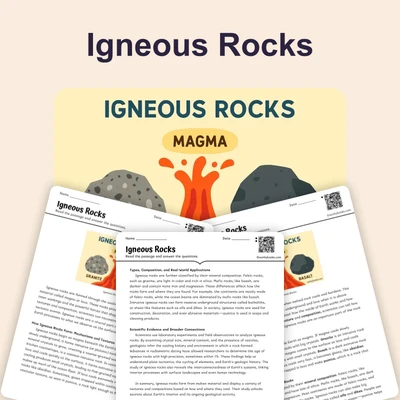
This comprehensive 650-word reading passage explains how igneous rocks form through the cooling and solidification of molten rock material. Students explore the distinction between magma beneath Earth's surface and lava at the surface, learning how cooling rates determine rock texture and how the source of molten material affects composition. The passage connects igneous rock formation to Earth's internal heat engine and plate tectonics. Aligned with NGSS standard MS-ESS2-1, this resource includes audio integration, a simplified differentiated version for struggling readers, Spanish translations, glossary terms, multiple-choice questions, writing activities, and graphic organizers. Perfect for grades 6-8 science curriculum focusing on Earth's systems and rock cycle processes.
CONTENT PREVIEW
Expand content preview
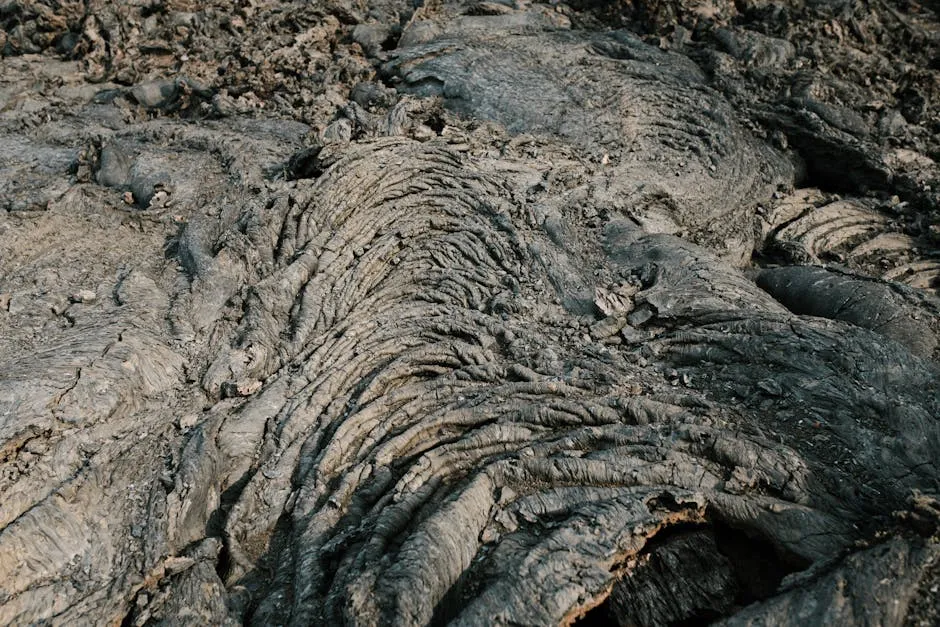
"Detailed view of cooled lava patterns in Kamchatka, showcasing geological textures and formations." by Julia Volk / Pexels.
Igneous rocks form when molten rock material cools and hardens into solid rock. The word igneous comes from the Latin word for fire, which describes the extreme heat involved in creating these rocks. All igneous rocks begin as molten material deep within Earth, where temperatures can reach over 1,000 degrees Celsius. This molten rock forms through the melting of existing rocks in Earth's mantle or crust, driven by Earth's internal heat engine.
Scientists use different terms to describe molten rock depending on its location. Magma is molten rock located beneath Earth's surface, while lava is molten rock that has reached the surface through volcanic eruptions or fissures. This distinction is important because the location where cooling occurs determines the characteristics of the resulting igneous rock. Magma that cools slowly underground forms intrusive igneous rocks, while lava that cools quickly at the surface forms extrusive igneous rocks.
The cooling rate of molten rock has a direct effect on the texture of igneous rocks, particularly the size of mineral crystals that form. When magma cools slowly deep underground, atoms have time to arrange themselves into large, visible crystals. This process, called crystallization, produces rocks with coarse-grained textures like granite. In contrast, when lava cools rapidly at Earth's surface, atoms have little time to organize, resulting in fine-grained textures with tiny crystals or even glassy textures with no crystals at all. Obsidian, a volcanic glass, forms when lava cools so quickly that crystals cannot form.
The composition of igneous rocks depends on the source of the original molten material. Magma that forms from melting mantle rock tends to be rich in iron and magnesium, creating dark-colored rocks like basalt. Magma that forms from melting crustal rock contains more silicon and aluminum, producing lighter-colored rocks like granite. The mantle, located beneath the crust, consists of dense rock that melts at spreading centers and subduction zones. The crust, Earth's outermost layer, melts when subjected to extreme heat from rising mantle material or when pushed deep into Earth during plate collisions.
Understanding igneous rock formation helps scientists interpret Earth's geologic history and current processes. The presence of granite in mountain ranges indicates ancient volcanic activity and crustal melting. Basalt covering ocean floors reveals where new crust forms at mid-ocean ridges. By examining the texture and composition of igneous rocks, geologists can determine where and how quickly the rocks cooled, providing clues about past volcanic eruptions and tectonic activity. These rocks serve as records of Earth's internal heat engine at work, constantly reshaping the planet's surface through the rock cycle.
Interesting Fact: The Giant's Causeway in Northern Ireland features about 40,000 hexagonal basalt columns formed when lava cooled and contracted, creating one of nature's most geometrically perfect rock formations.
What is the main difference between magma and lava?
Magma is beneath Earth's surface; lava is at the surfaceMagma is cooler than lavaMagma forms crystals; lava does notMagma comes from the crust; lava comes from the mantle
How does cooling rate affect the texture of igneous rocks?
Cooling rate does not affect textureSlow cooling creates large crystals; fast cooling creates small or no crystalsFast cooling creates large crystals; slow cooling creates small crystalsAll igneous rocks have the same texture
What does the word 'igneous' mean?
WaterEarthFireAir
Which term describes the process by which atoms arrange themselves into organized structures as molten rock cools?
ErosionCrystallizationWeatheringSedimentation
Why does magma from the mantle tend to form dark-colored rocks?
It cools more slowly than crustal magmaIt contains more iron and magnesiumIt reaches higher temperaturesIt forms larger crystals
What can scientists learn by examining the texture and composition of igneous rocks?
The age of the entire EarthWhere and how quickly the rocks cooledThe exact temperature of Earth's coreHow many volcanoes exist on Earth
Which rock is an example of volcanic glass that forms from very rapid cooling?
GraniteBasaltObsidianLimestone
What drives the melting of rocks in Earth's mantle and crust?
Solar energy from the sunEarth's internal heat engineOcean water pressureAtmospheric temperature
Intrusive igneous rocks form when magma cools slowly beneath Earth's surface.
TrueFalse
All igneous rocks have the same chemical composition regardless of their source.
TrueFalse
Perfect For:
👩🏫 Teachers
• Reading comprehension practice
• Auto-graded assessments
• Literacy skill development
👨👩👧👦 Parents
• Reading practice at home
• Comprehension improvement
• Educational reading time
🏠 Homeschoolers
• Reading curriculum support
• Independent reading practice
• Progress monitoring
Reading Features:
📖
Reading Passage
Engaging fiction or nonfiction text
❓
Comprehension Quiz
Auto-graded questions
📊
Instant Feedback
Immediate results and scoring
📄
Printable Version
Download for offline reading
🔊
Read Aloud
Voice-over with word highlighting
Reviews & Ratings
No reviews yet. Be the first to share your experience!
Related Content
Frost Wedging: How Ice Splits Rock
This passage explains frost wedging as a mechanical weathering process. Aligned with NGSS MS-ESS2-1 (Earth’s systems) a...
MS-ESS2-1MS-ESS2-2RST.6-8.3
Limestone Caves: Nature’s Underground Wonders
This passage explains limestone cave formation through carbonation, aligned with NGSS MS-ESS2-1 (Earth’s systems) and L...
MS-ESS2-1LS2.CRST.6-8.7
Chemical Weathering: The Breakdown of Rocks Through Chemical Reactions
This passage explains chemical weathering processes, aligned with NGSS MS-ESS2-1 (Earth’s systems) and ESS2-2 (surface ...
MS-ESS2-1MS-ESS2-2RST.6-8.4
Talus Slopes: Formation and Features
This earth science passage explains talus slope formation through mechanical weathering processes, aligning with NGSS MS...
MS-ESS2-1MS-ESS2-2RST.6-8.4
Biological Weathering: Types and Examples
This passage details biological weathering processes, connecting to NGSS MS-ESS2-1 (Earth's systems) and LS2.B (ecosyste...
MS-ESS2-1MS-PS1-2RST.6-8.3
The Coldest City in the World: Yakutsk
This NGSS-aligned science passage introduces middle school readers to Yakutsk, the coldest city on Earth. Students will ...
MS-ESS2-1
Igneous Rocks
This comprehensive passage introduces middle school students to igneous rocks, focusing on how these rocks form from mol...
MS-ESS2-1MS-ESS3-1
Sedimentary Rocks
This comprehensive middle school science passage introduces students to sedimentary rocks, detailing their step-by-step ...
MS-ESS2-1MS-ESS2-3MS-ESS3-1
Metamorphic Rocks
This engaging middle school science passage introduces students to the fascinating world of metamorphic rocks. Aligned w...
MS-ESS2-1MS-ESS3-1
Scientific Inquiry in Earth Science
This passage explores scientific inquiry in Earth science for grades 6-8, aligned with NGSS standards MS-ESS1-4, MS-ESS2...
MS-ESS1-4MS-ESS2-1MS-ESS3-5SEP
Contour Lines and Elevation
This passage, designed for grades 6-8 and aligned with NGSS standards MS-ESS2-2 and MS-ESS2-1, introduces students to th...
MS-ESS2-2MS-ESS2-1SEP.4SEP.8
Weathering
This comprehensive science reading passage for grades 6-8 focuses on the concept of weathering, aligning with NGSS stand...
MS-ESS2-1
Erosion
This comprehensive middle school science passage explains erosion—the process that transports weathered rock and soil fr...
MS-ESS2-1
Stream Erosion and Deposition
This middle school science passage, aligned to NGSS MS-ESS2-1, introduces students to the dynamic processes of stream er...
MS-ESS2-1
Wind Erosion and Deposition
This comprehensive science reading passage for grades 6-8 explores the processes of wind erosion and deposition, alignin...
MS-ESS2-1
Glacial Erosion and Deposition
This middle school science passage explores glacial erosion and deposition, focusing on the mechanisms by which glaciers...
MS-ESS2-1
Mass Movements
This NGSS-aligned passage introduces middle school students to the science of mass movements—gravity-driven motions of r...
MS-ESS2-1MS-ESS3-2
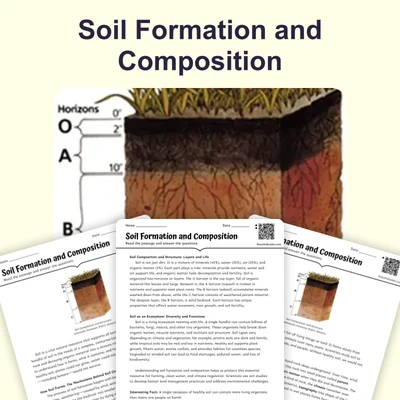
Soil Formation and Composition
This comprehensive middle school science passage explores soil formation and composition, perfectly aligned to NGSS stan...
MS-ESS2-1
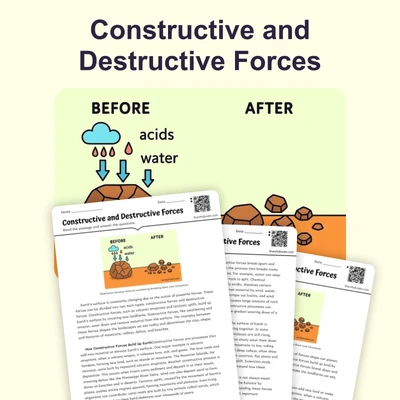
Constructive and Destructive Forces
This middle school science passage explores how Earth's surface is constantly shaped by the interplay of constructive an...
MS-ESS2-1
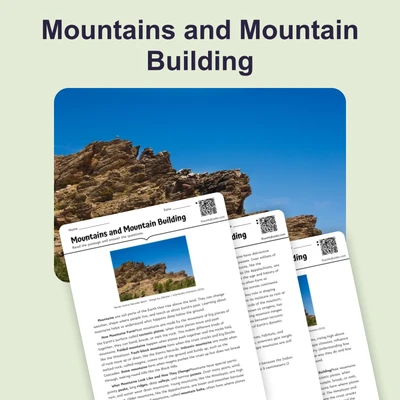
Mountains and Mountain Building
This NGSS-aligned passage for grades 6-8 covers the fascinating processes that create Earth's highest landforms—mountain...