This learning resource is available in interactive and printable formats. The interactive worksheet can be played online and assigned to students. The Printable PDF version can be downloaded and printed for completion by hand.
This 600-word informational science reading passage explains how oceans function as Earth's largest carbon sink for middle school students in grades 6-8. Aligned with NGSS standard MS-ESS2-1, the passage breaks down three main mechanisms of ocean carbon storage: chemical dissolution in seawater, biological uptake by marine organisms through photosynthesis, and long-term geological storage in seafloor sediments and shells. Students learn about the carbon cycle, how atmospheric carbon dioxide dissolves in ocean water, and how marine life plays a crucial role in moving carbon from the surface to the deep ocean. The passage includes clear definitions of key scientific vocabulary, real-world connections, and explores the importance of ocean carbon storage for Earth's climate system. This audio-integrated resource includes a simplified differentiated version for struggling readers and English Language Learners, Spanish translations, a comprehensive glossary, multiple-choice questions at various DOK levels, writing activities, and graphic organizers to support diverse learners in understanding this essential Earth science concept.
CONTENT PREVIEW
Expand content preview
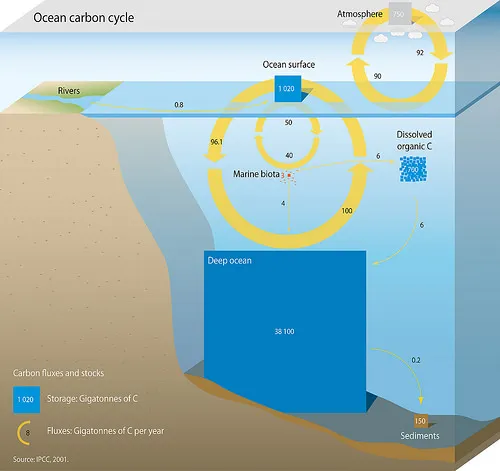
The ocean is Earth's largest carbon sink. OceanCarbonCycle by Ricardo Pravettoni / Wikimedia Commons
The ocean is Earth's largest carbon sink, a natural system that absorbs and stores carbon from the atmosphere. Every year, the ocean absorbs about one-quarter of the carbon dioxide (CO₂) that humans release by burning fossil fuels. Without this ocean storage, Earth's atmosphere would contain much more CO₂, leading to more rapid climate change. Understanding how oceans store carbon helps scientists predict future climate patterns and protect marine ecosystems.
The first way oceans store carbon is through direct dissolution, which means CO₂ gas from the air dissolves into seawater. When atmospheric CO₂ contacts the ocean surface, it dissolves and forms carbonic acid. This process works like carbon dioxide dissolving in soda to make it fizzy, except it happens naturally at a massive scale. Cold ocean water can dissolve more CO₂ than warm water, which is why polar regions absorb especially large amounts of atmospheric carbon. Ocean currents then carry this dissolved carbon throughout the world's oceans, distributing it from surface waters to deeper layers.
The second storage method involves marine organisms through a process called the biological carbon pump. Tiny ocean plants called phytoplankton use sunlight and dissolved CO₂ to perform photosynthesis, just like land plants. These microscopic organisms convert carbon dioxide into organic matter, building their bodies from carbon atoms. When phytoplankton die or are eaten by other marine animals, their carbon-containing bodies sink toward the ocean floor. This downward movement transfers carbon from the surface ocean to the deep ocean, where it can remain stored for hundreds or thousands of years before returning to the surface.
The third and longest-lasting storage happens in seafloor sediment and shells. Many marine animals, including clams, coral, and tiny organisms called foraminifera, use dissolved carbon to build shells and skeletons made of calcium carbonate. When these organisms die, their shells settle on the ocean floor and accumulate over time. Layers of sediment bury these carbon-rich shells, locking carbon away for millions of years. Eventually, geological processes can transform these sediments into limestone rock, creating a permanent carbon storage system that operates on geological timescales.
The ocean's ability to store carbon depends on several interconnected factors. Temperature affects how much CO₂ can dissolve in seawater. Ocean circulation patterns determine how quickly carbon moves from surface to deep waters. The health of marine ecosystems influences how effectively the biological carbon pump operates. Scientists monitor these factors because changes in ocean temperature, chemistry, or biology can affect the ocean's capacity to absorb atmospheric CO₂. For example, as ocean water absorbs more CO₂, it becomes more acidic, which can harm shell-building organisms and potentially weaken the ocean's carbon storage ability.
The ocean's role as a carbon sink demonstrates the interconnected nature of Earth's systems. Atmosphere, ocean, and living organisms work together in the carbon cycle, moving carbon between different reservoirs. While the ocean currently helps slow climate change by absorbing human-produced CO₂, this service has limits. Understanding ocean carbon storage helps us appreciate why protecting ocean health matters for the entire planet's climate system.
Interesting Fact: If all the carbon stored in the ocean were suddenly released into the atmosphere, the amount of CO₂ in the air would increase by about 50 times, making Earth uninhabitable for most life forms.
What fraction of human-produced carbon dioxide does the ocean absorb each year?
About one-quarterAbout one-halfAbout three-quartersAlmost all of it
Why do polar ocean regions absorb especially large amounts of atmospheric carbon?
Because they have more phytoplanktonBecause cold water can dissolve more CO₂ than warm waterBecause they have stronger ocean currentsBecause they receive more sunlight
What is the biological carbon pump?
A machine that removes carbon from the oceanThe process of CO₂ dissolving in seawaterThe process by which marine organisms transfer carbon from surface to deep watersThe formation of limestone on the seafloor
In the passage, what does the term 'dissolution' mean?
The breaking down of rocks into sedimentThe process of a gas dissolving into a liquidThe death of marine organismsThe movement of ocean currents
Which material do many marine animals use to build their shells?
Carbonic acidLimestoneCalcium carbonateSediment
Based on the passage, what can be inferred about the relationship between ocean temperature and carbon storage?
Warmer oceans will be able to store more carbonOcean temperature has no effect on carbon storageWarmer oceans may store less carbon, potentially affecting climateOnly cold oceans can store carbon
How does increased ocean acidity affect the ocean's carbon storage ability?
It increases carbon storage by dissolving more CO₂It has no effect on carbon storageIt can harm shell-building organisms and potentially weaken carbon storageIt only affects surface waters, not deep storage
Which of the following represents the longest-lasting form of ocean carbon storage?
CO₂ dissolved in surface watersCarbon in living phytoplanktonCarbon in seafloor sediment and limestoneCarbon in deep ocean currents
True or False: Phytoplankton perform photosynthesis just like land plants.
TrueFalse
True or False: The ocean's capacity to absorb CO₂ is unlimited and will never be affected by environmental changes.
TrueFalse
Perfect For:
👩🏫 Teachers
• Reading comprehension practice
• Auto-graded assessments
• Literacy skill development
👨👩👧👦 Parents
• Reading practice at home
• Comprehension improvement
• Educational reading time
🏠 Homeschoolers
• Reading curriculum support
• Independent reading practice
• Progress monitoring
Reading Features:
📖
Reading Passage
Engaging fiction or nonfiction text
❓
Comprehension Quiz
Auto-graded questions
📊
Instant Feedback
Immediate results and scoring
📄
Printable Version
Download for offline reading
🔊
Read Aloud
Voice-over with word highlighting
Reviews & Ratings
No reviews yet. Be the first to share your experience!
Related Content
Talus Slopes: Formation and Features
This earth science passage explains talus slope formation through mechanical weathering processes, aligning with NGSS MS...
MS-ESS2-1MS-ESS2-2RST.6-8.4
Biological Weathering: Types and Examples
This passage details biological weathering processes, connecting to NGSS MS-ESS2-1 (Earth's systems) and LS2.B (ecosyste...
MS-ESS2-1MS-PS1-2RST.6-8.3
Frost Wedging: How Ice Splits Rock
This passage explains frost wedging as a mechanical weathering process. Aligned with NGSS MS-ESS2-1 (Earth’s systems) a...
MS-ESS2-1MS-ESS2-2RST.6-8.3
Chemical Weathering: The Breakdown of Rocks Through Chemical Reactions
This passage explains chemical weathering processes, aligned with NGSS MS-ESS2-1 (Earth’s systems) and ESS2-2 (surface ...
MS-ESS2-1MS-ESS2-2RST.6-8.4
Limestone Caves: Nature’s Underground Wonders
This passage explains limestone cave formation through carbonation, aligned with NGSS MS-ESS2-1 (Earth’s systems) and L...
MS-ESS2-1LS2.CRST.6-8.7
The Coldest City in the World: Yakutsk
This NGSS-aligned science passage introduces middle school readers to Yakutsk, the coldest city on Earth. Students will ...
MS-ESS2-1
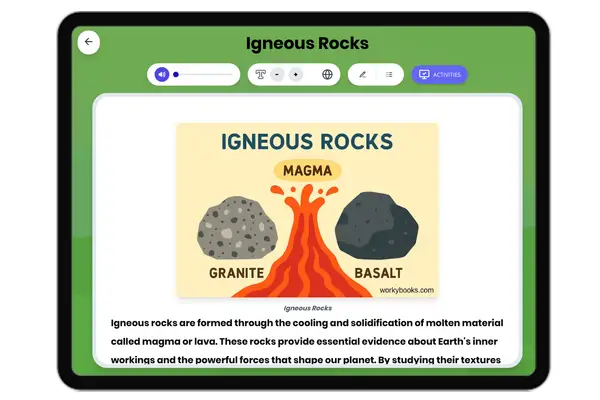
Igneous Rocks
This comprehensive passage introduces middle school students to igneous rocks, focusing on how these rocks form from mol...
MS-ESS2-1MS-ESS3-1
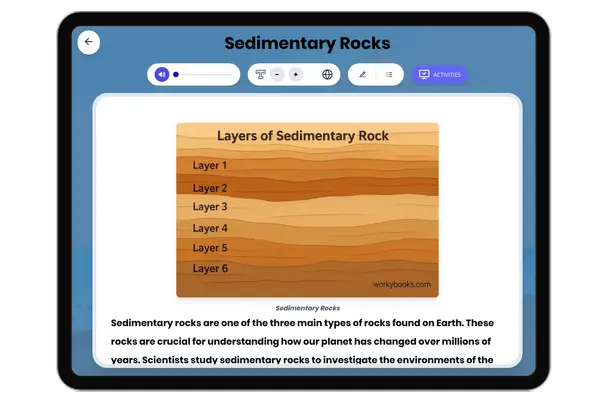
Sedimentary Rocks
This comprehensive middle school science passage introduces students to sedimentary rocks, detailing their step-by-step ...
MS-ESS2-1MS-ESS2-3MS-ESS3-1
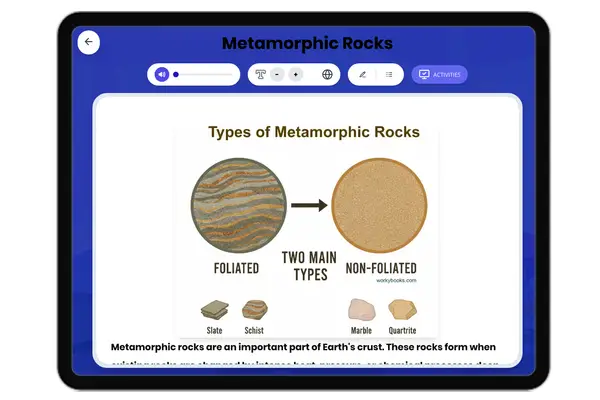
Metamorphic Rocks
This engaging middle school science passage introduces students to the fascinating world of metamorphic rocks. Aligned w...
MS-ESS2-1MS-ESS3-1
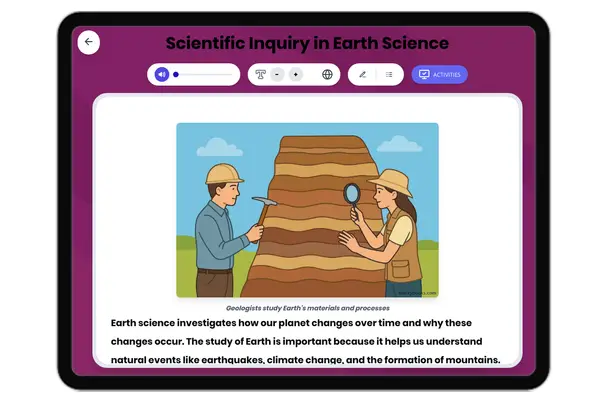
Scientific Inquiry in Earth Science
This passage explores scientific inquiry in Earth science for grades 6-8, aligned with NGSS standards MS-ESS1-4, MS-ESS2...
MS-ESS1-4MS-ESS2-1MS-ESS3-5SEP
Contour Lines and Elevation
This passage, designed for grades 6-8 and aligned with NGSS standards MS-ESS2-2 and MS-ESS2-1, introduces students to th...
MS-ESS2-2MS-ESS2-1SEP.4SEP.8
Weathering
This comprehensive science reading passage for grades 6-8 focuses on the concept of weathering, aligning with NGSS stand...
MS-ESS2-1
Erosion
This comprehensive middle school science passage explains erosion—the process that transports weathered rock and soil fr...
MS-ESS2-1
Stream Erosion and Deposition
This middle school science passage, aligned to NGSS MS-ESS2-1, introduces students to the dynamic processes of stream er...
MS-ESS2-1
Wind Erosion and Deposition
This comprehensive science reading passage for grades 6-8 explores the processes of wind erosion and deposition, alignin...
MS-ESS2-1
Glacial Erosion and Deposition
This middle school science passage explores glacial erosion and deposition, focusing on the mechanisms by which glaciers...
MS-ESS2-1
Mass Movements
This NGSS-aligned passage introduces middle school students to the science of mass movements—gravity-driven motions of r...
MS-ESS2-1MS-ESS3-2
Soil Formation and Composition
This comprehensive middle school science passage explores soil formation and composition, perfectly aligned to NGSS stan...
MS-ESS2-1
Constructive and Destructive Forces
This middle school science passage explores how Earth's surface is constantly shaped by the interplay of constructive an...
MS-ESS2-1
Mountains and Mountain Building
This NGSS-aligned passage for grades 6-8 covers the fascinating processes that create Earth's highest landforms—mountain...