This engaging 400-500 word informational science passage explores how GPS satellites track locations on Earth with remarkable precision. Aligned with NGSS MS-ESS1-1 and MS-ESS1.B standards, students examine how GPS technology relies on precise knowledge of Earth's rotation, orbit, and position relative to stars. The passage explains how ground stations use star positions to track satellites accurately and introduces Einstein's theory of relativity, which shows that clocks on satellites run slightly faster than clocks on Earth. Students discover why astronomical precision is critical—without it, GPS would fail within hours. The audio-integrated passage includes real-world connections, vocabulary development with 8-10 key science terms, comprehension activities, and differentiated versions for diverse learners. Writing prompts and graphic organizers help students analyze cause-and-effect relationships in satellite technology and understand the connection between Earth science and everyday navigation tools.
Written by Workybooks TeamPublished by Workybooks
Preview
Sample passage and quiz content
CONTENT PREVIEW
Expand content preview
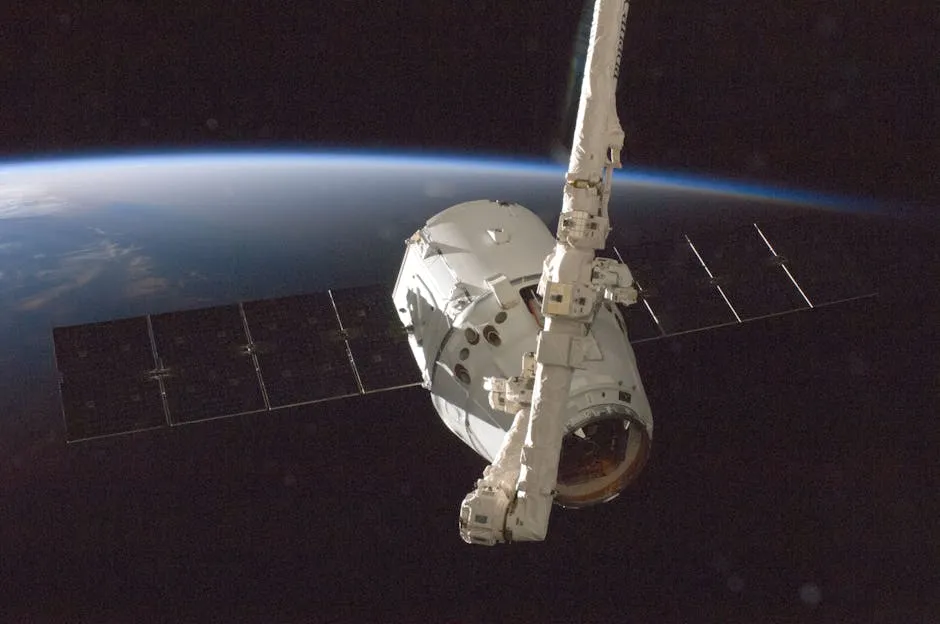
"A satellite orbiting Earth with a view of the planet from space." by SpaceX / Pexels.
When you use a phone or car navigation system, satellites orbiting Earth help pinpoint your exact location. The Global Positioning System, or GPS, relies on at least 24 satellites that circle our planet twice each day. These satellites send radio signals to receivers on Earth's surface. However, this system needs much more than just satellites sending signals. It requires precise knowledge of Earth's motion through space.
GPS satellites must know their exact positions at all times to calculate your location accurately. Scientists track Earth's rotation, which is the spinning motion our planet makes once every 24 hours. They also monitor Earth's orbit, the path our planet follows as it travels around the Sun. Ground stations located around the world use distant stars as reference points to measure satellite positions. These ground stations compare the positions of satellites against the fixed locations of stars. This astronomical precision ensures that GPS can track satellites within centimeters of their true positions.
The system also accounts for Einstein's theory of relativity, which explains how time can pass at different rates depending on gravity and speed. Satellites orbit about 20,000 kilometers above Earth's surface, where gravity is weaker than on the ground. This causes atomic clocks on satellites to run about 38 microseconds faster each day than identical clocks on Earth. Scientists must adjust for this time difference. Without these corrections, GPS location errors would grow by about 10 kilometers each day. Within hours, your navigation system would become nearly useless.
In 2016, a GPS satellite experienced a timing error of just 13 microseconds. This tiny mistake caused navigation problems across the western United States for several hours. The incident demonstrated how GPS depends on both Earth science and physics working together. Ground control teams fixed the problem by using star position data to recalibrate the satellite's clock and location information.
GPS technology matters because millions of people rely on accurate location data every day. Airplanes use GPS to navigate safely through crowded skies. Farmers use it to plant crops in precise rows. Emergency responders use it to find people who need help. All of these applications depend on scientists understanding Earth's place in space and how time works differently in orbit. The connection between astronomy, physics, and everyday technology shows how Earth science affects daily life in surprising ways.
Interesting Fact: GPS satellites travel at speeds of about 14,000 kilometers per hour. At this speed, Einstein's relativity theory predicts that time on the satellites should run slower than on Earth, but the weaker gravity in orbit has a stronger opposite effect, making satellite clocks run faster overall.
How many GPS satellites orbit Earth, and how often do they circle the planet?
At least 24 satellites that circle Earth twice each day12 satellites that circle Earth once each day50 satellites that circle Earth four times each dayAt least 24 satellites that circle Earth once each week
What do ground stations use as reference points to track satellite positions?
The Moon and planetsDistant starsOther satellitesRadio towers on Earth
What does the term 'astronomical precision' mean in the context of GPS?
Using telescopes to see satellitesMeasuring distances to other planetsUsing star positions to track satellites within centimeters of their true positionsCounting the number of stars in the sky
According to Einstein's theory of relativity, why do clocks on GPS satellites run faster than clocks on Earth?
Because satellites move faster than anything on EarthBecause gravity is weaker at the satellite's altitude, causing time to pass fasterBecause satellites are closer to the SunBecause atomic clocks work better in space
How much faster do atomic clocks on satellites run compared to clocks on Earth each day?
About 38 secondsAbout 38 millisecondsAbout 38 microsecondsAbout 38 minutes
What happened in 2016 when a GPS satellite experienced a timing error of 13 microseconds?
Nothing noticeable occurredNavigation problems occurred across the western United States for several hoursAll GPS systems worldwide stopped working permanentlyThe satellite fell out of orbit
If scientists did not correct for relativity effects, how much would GPS location errors grow each day?
About 1 meterAbout 100 metersAbout 10 kilometersAbout 100 kilometers
Based on the passage, which statement best explains why GPS technology requires knowledge of Earth science?
GPS only works during certain seasons of the yearGPS satellites must account for Earth's rotation, orbit, and position relative to stars to calculate accurate locationsEarth science helps design better satellite materialsGPS needs to know about weather patterns on Earth
GPS satellites orbit approximately 20,000 kilometers above Earth's surface.
TrueFalse
According to the passage, Einstein's relativity theory predicts that time on fast-moving satellites should run faster than time on Earth.
TrueFalse
Who it's for
Perfect for the way you teach
Teachers
Build comprehension skills
Auto-graded quiz
Differentiated reading
Parents
Read together at home
Improve fluency
Quiet reading time
Homeschoolers
Reading curriculum support
Independent practice
Track Lexile growth
Topics
GPS satellitesEarth's rotationorbital mechanicsrelativityground stationsastronomical precisionsatellite trackingMS-ESS1-1middle school science
Reviews & Ratings
No reviews yet. Be the first to share your experience!
More reading you might love
20 more
What is Solar Radiation
This NGSS-aligned science reading passage for middle school students explores the concept of solar radiation. Solar radi...
MS-ESS1-1
How Incoming Solar Radiation Changes with Latitude
This NGSS-aligned science reading passage helps middle school students understand how solar radiation, or insolation, ch...
MS-ESS1-1
Tides and Tidal Forces
This middle school science passage explores the mechanisms of tides and tidal forces, aligning with NGSS standards MS-ES...
MS-ESS1-1MS-ESS1-2
The Night Sky
This comprehensive science reading passage for grades 6-8 aligns with NGSS standard MS-ESS1-1 and explores the systems a...
MS-ESS1-1
Ancient Astronomy
This engaging passage for grades 6-8 explores the history of astronomy through the lens of ancient observations. Student...
MS-ESS1-1
Tools of Modern Astronomy
This passage introduces middle school students to modern astronomy, aligning with NGSS standard MS-ESS1-1. It explains h...
MS-ESS1-1
How Astronomy Became a Science
This passage explores the transformative period known as the Scientific Revolution, with a special focus on the history ...
MS-ESS1-1
Earth's Rotation
This middle school science passage, aligned with NGSS standard MS-ESS1-1, focuses on Earth's rotation—how Earth spins on...
MS-ESS1-1
Earth's Revolution
This middle school science passage explores the science behind Earth's revolution around the Sun, closely aligned with N...
MS-ESS1-1
Why We Have Seasons
This comprehensive middle school science reading passage explains the mechanisms behind Earth's seasons, directly addres...
MS-ESS1-1
Earth's Seasons
This comprehensive reading passage for grades 6-8 explains why Earth has seasons, revealing the scientific mechanisms be...
MS-ESS1-1
Phases of the Moon
This comprehensive middle school science passage explains the phases of the Moon, focusing on the mechanisms behind the ...
MS-ESS1-1
Tides
This comprehensive middle school science reading passage explores the phenomenon of ocean tides, aligned to NGSS standar...
MS-ESS1-1MS-ESS1-2
Eclipses
This comprehensive passage for grades 6-8 explores the science behind eclipses, including solar and lunar eclipses, thei...
MS-ESS1-1
The Moon's Characteristics
This comprehensive science reading passage for grades 6-8 examines the Moon's physical characteristics, including its si...
MS-ESS1-1MS-ESS1-2
Lunar Eclipses
This passage introduces middle school students to the phenomenon of lunar eclipses, connecting observable events to the ...
MS-ESS1-1
The Sun's Characteristics
This engaging science passage introduces middle school students to the Sun’s key characteristics, such as its classifica...
MS-ESS1-1MS-ESS1-2
What Is a Galaxy?
This comprehensive middle school science passage answers the question: What is a galaxy? Aligned to NGSS standard MS-ESS...
MS-ESS1-1
The Milky Way: Our Home Galaxy
This comprehensive science passage introduces middle school students to the Milky Way, the barred spiral galaxy that is ...
MS-ESS1-1
Types of Galaxies
This comprehensive middle school science passage introduces students to the classification and characteristics of galaxi...