How Scientists Identify Minerals
Interactive passage with audio narration, comprehension questions, and printable PDF.
By completing this purchase you agree to our Terms of Use and Privacy Policy. Your subscription renews automatically until you cancel. You can cancel anytime from your account settings. All sales are final and non-refundable. Digital content is available for download in your account immediately upon purchase.
What's included
How Scientists Identify Minerals preview and details
About this printable How Scientists Identify Minerals science reading passage, NGSS-aligned (Grades 5-8)
Sample passage and quiz from How Scientists Identify Minerals
Reading passage and comprehension quiz preview
How Scientists Identify Minerals
Minerals are naturally occurring solids that form the building blocks of rocks and Earth’s crust. Scientists must accurately identify minerals to understand Earth’s structure and its resources. The process of identification relies on observing and measuring physical properties, because many minerals look similar at first glance. To avoid mistakes, scientists use a combination of tests and careful analysis, rather than relying on just one feature.
Key Properties Used to Identify Minerals
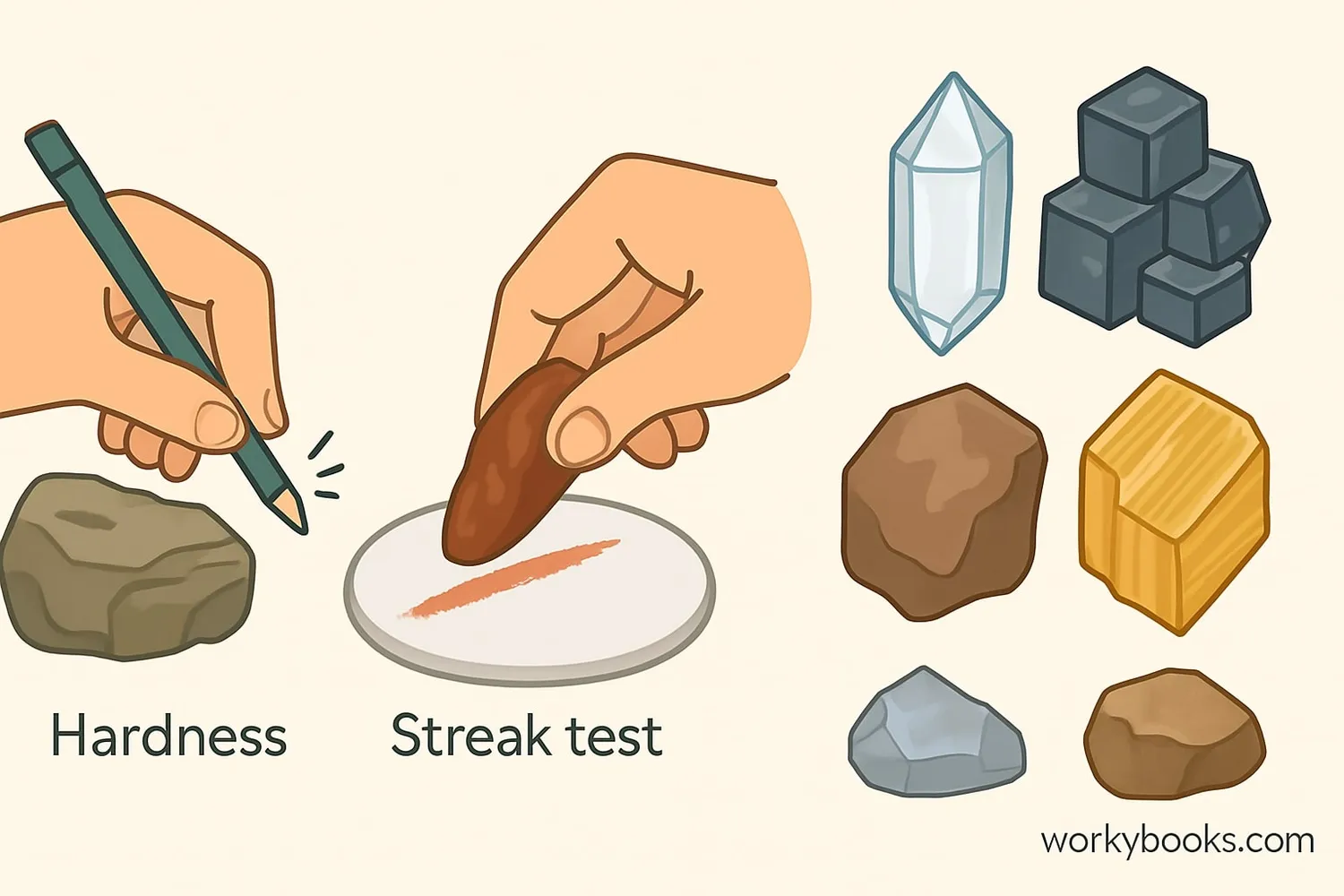
One commonly observed property is color, but color alone can be misleading. Impurities in a mineral’s structure can cause dramatic changes in color, even if its chemical makeup stays the same. For example, both sapphire and ruby are forms of the mineral corundum; their colors differ only because of trace elements. A more reliable test is the streak—the color of a mineral’s powder when rubbed on an unglazed porcelain tile. While the color of a mineral can vary, its streak is usually consistent. Luster describes how a mineral reflects light, with terms like metallic, glassy, waxy, pearly, or earthy. These differences can help distinguish minerals that look similar in color.
Hardness is another key property measured by the Mohs scale, which ranks minerals from 1 (softest, like talc) to 10 (hardest, like diamond). The ability of a mineral to resist scratching directly relates to its internal atomic structure. Cleavage describes a mineral’s tendency to break along flat planes, while fracture refers to breaking along irregular surfaces. These breakage patterns result from the arrangement and strength of chemical bonds within the mineral. Density, or specific gravity, measures how much mass is packed into a given volume; heavy minerals like galena are much denser than lighter ones like quartz.
Special Properties and the Need for Multiple Tests
Some minerals display special properties that make identification easier. For instance, magnetite is naturally magnetic, and calcite reacts with acids by fizzing due to the release of carbon dioxide gas. Fluorescence, where a mineral glows under ultraviolet light, and double refraction, which splits light into two images, are also helpful clues. Scientists always use several properties together—never just one—because relying on a single test can lead to misidentification. For example, both halite and quartz are colorless and glassy, but halite tastes salty and has perfect cubic cleavage, while quartz does not.
Mineral identification is important for many real-world applications. Geologists use these methods to locate valuable ores, while chemists and engineers analyze minerals for use in electronics, construction, and health products. The ability to classify and identify minerals also helps us understand the history of Earth’s formation and ongoing geological processes. By studying mineral properties, scientists can reconstruct past environments and predict where certain resources may be found.
Conclusion: The Scientific Process of Mineral Identification
The science of mineral identification integrates observation, experimentation, and systematic reasoning. No single property is ever enough—only through the combination of tests can minerals be accurately classified. This approach reflects broader scientific principles: careful measurement, repeated testing, and analysis of evidence all lead to better understanding. Mineral identification connects to Earth’s systems, resource management, and the advancement of technology, illustrating how science supports our daily lives.
Interesting Fact: The mineral diamond is the hardest known natural substance, ranking 10 on the Mohs scale. Yet, pure graphite, which is used in pencils, is made of the same element—carbon—but has a Mohs hardness of just 1!
Comprehension quiz (10 questions)
1. Which property describes how a mineral reflects light?
2. What is the Mohs scale used to measure?
3. Why is color alone not a reliable way to identify a mineral?
4. What does the property 'streak' refer to when identifying minerals?
5. Which of the following minerals is naturally magnetic?
6. What does 'cleavage' mean in minerals?
7. What happens when calcite reacts with acid?
8. True or False: Scientists use only one property to identify minerals.
9. True or False: Minerals with the same chemical makeup can have different colors.
10. Which property helps explain why galena feels heavier than quartz of the same size?
Perfect for the way you teach
- Build comprehension skills
- Auto-graded quiz
- Differentiated reading
- Read together at home
- Improve fluency
- Quiet reading time
- Reading curriculum support
- Independent practice
- Track Lexile growth