How Scientists Study Climate — Reading Comprehension
Rate this
Premium Resource
Present
Present in classroom. No work saved
Assign
Classroom with student accounts, Track progress
Quick Play
No student accounts, assign with a link
Grades
5
6
7
8
Standards
MS-ESS3-5
PRINT+DIGITAL RESOURCE
This learning resource is available in interactive and printable formats. The interactive worksheet can be played online and assigned to students. The Printable PDF version can be downloaded and printed for completion by hand.
This engaging science passage for grades 6-8 explains how scientists investigate Earth's climate using a variety of methods. Aligned with NGSS standard MS-ESS3-5, it covers direct measurements with thermometers, satellites, and ocean buoys, as well as historical and natural records like ship logs, diaries, ice cores, and tree rings. The passage shows how computer-based climate models help predict future climate patterns, emphasizing why multiple lines of evidence are crucial for drawing reliable conclusions. Students will learn about the interconnected processes scientists use, the importance of international collaboration, and the real-world implications for society and the environment. The passage and activities are designed for middle school students and include integrated audio support. Key vocabulary is explained, and students can reinforce learning through quizzes, writing prompts, and graphic organizers. This resource is ideal for classroom or independent learning.
CONTENT PREVIEW
Expand content preview
Scientists and technicians ready an instrument rack for mounting in NASA's DC-8 flying laboratory in preparation for a complex mission to study how air pollution and natural emissions affect climate change.Image by NASA / Tom Tschida / Wikimedia Commons
Earth’s climate affects everything from weather patterns to human societies. Understanding how our planet’s climate changes over time is essential for predicting future events and making important decisions. Scientists do not rely on just one method to study climate. Instead, they gather evidence from many different sources and look for patterns that reveal how the climate system works. These sources include direct measurements, historical records, natural clues, and modern computer models.
Direct Measurements and Historical Records
Direct measurements are one of the most reliable ways to study climate. Scientists have used thermometers to record air temperatures since the 1880s. Today, satellites and weather stations collect data from all over the world, including places that are hard to reach. Ocean buoys float in the sea and collect information about water temperature and currents. Historical records, such as ship logs, old diaries, and agricultural reports, provide clues about past climate conditions. These documents help us understand how climate affected people’s lives and the environment before modern instruments existed.
Natural Records and Climate Models
Nature itself holds many clues to past climates. Scientists study ice cores drilled from glaciers and polar ice sheets. Bubbles of ancient air trapped in the ice reveal what the atmosphere was like thousands of years ago. Tree rings show how much a tree grew each year, which depends on temperature and rainfall. Coral reefs and sediment layers in lakes and oceans also record changes in climate. Fossils provide evidence about the plants and animals that lived in different periods. To predict the future, scientists use climate models—computer programs that simulate how Earth’s systems interact. These models use data from many sources to estimate what might happen if greenhouse gases increase or if other conditions change.
Multiple Lines of Evidence and Global Collaboration
Relying on just one method would not give a complete picture. That is why scientists compare data from different sources. When multiple lines of evidence tell the same story, scientists can be more confident in their conclusions. For example, both ice cores and tree rings show that Earth’s temperature has risen quickly in recent decades. Scientists all over the world share their findings to improve our understanding. This international collaboration helps create a stronger, more reliable record of how climate changes—and why.
Studying climate is complex, but it is also vital. By using many kinds of evidence, scientists can explain the causes of climate change and predict its effects. These discoveries inform important decisions about energy use, agriculture, and preparing for extreme weather. Understanding climate science helps us take care of our planet and plan for the future.
Interesting Fact: The oldest ice core ever drilled from Antarctica contains air bubbles that are more than 800,000 years old—giving us a window into Earth’s ancient atmosphere!
What do scientists use to directly measure air temperature?
ThermometersIce coresFossilsCoral reefs
Which tool has been used to collect global climate data since the 1970s?
Tree ringsSatellitesShip logsFossils
What is an ice core?
A type of weather satelliteA record of old ship journeysA cylinder of ice that shows past climateA floating device in the ocean
What do tree rings tell scientists about the past?
The number of fish in the oceanHow much a tree grew each yearThe speed of ocean currentsThe age of fossils
What does 'multiple lines of evidence' mean in the passage?
Using different types of data to draw conclusionsStudying only one kind of recordMeasuring only air temperatureComparing just ice cores
Why do scientists use climate models?
To predict future climate changesTo measure tree ringsTo drill ice coresTo build weather stations
How do ice cores and tree rings work together as evidence?
They both show changes in Earth's temperature over timeThey are both used to measure ocean currentsThey both float in the oceanThey both predict future weather
What is one benefit of international collaboration in climate science?
It creates a stronger, more reliable climate recordIt allows scientists to use only one methodIt stops the need for computer modelsIt replaces the use of satellites
True or False: Scientists only use direct measurements to study climate.
TrueFalse
True or False: Fossils can provide information about past climates.
TrueFalse
Perfect For:
👩🏫 Teachers
• Reading comprehension practice
• Auto-graded assessments
• Literacy skill development
👨👩👧👦 Parents
• Reading practice at home
• Comprehension improvement
• Educational reading time
🏠 Homeschoolers
• Reading curriculum support
• Independent reading practice
• Progress monitoring
Reading Features:
📖
Reading Passage
Engaging fiction or nonfiction text
❓
Comprehension Quiz
Auto-graded questions
📊
Instant Feedback
Immediate results and scoring
📄
Printable Version
Download for offline reading
🔊
Read Aloud
Voice-over with word highlighting
Reviews & Ratings
No reviews yet. Be the first to share your experience!
Related Content
Natural Disaster: Hurricanes
Hurricanes are massive storms with strong winds and rain. Tracking and preparing for them helps protect people in their ...
RI.3.1RI.4.4RI.4.2RI.5.2
How Climate Change Affects Animal Migration
This NGSS-aligned science reading passage explains how climate change affects animal migration by altering seasonal cues...
MS-LS2-6MS-ESS3-5
What Is Global Warming?
This NGSS-aligned reading passage explains global warming, the greenhouse effect, and how human activities like burning ...
MS-ESS3-5
What Causes Global Warming?
This NGSS-aligned reading passage explains what causes global warming, focusing on how human activities like burning fos...
MS-ESS3-5
How to Stop Global Warming
This NGSS-aligned reading passage helps students understand how to stop global warming by reducing greenhouse gases. It ...
MS-ESS3-5
Human Impacts: Climate Change
This standards-aligned science reading passage for grades 6-8 explains the mechanisms and effects of human-driven climat...
MS-LS2-4MS-ESS3-5
Climate Change: Vulnerable Ecosystems
This middle school science passage, aligned with NGSS standards MS-ESS3-5 and MS-LS2-4, helps students understand how cl...
MS-ESS3-5MS-LS2-4
Climate Change: Solutions and Mitigation
This passage explores scientific solutions and mitigation strategies for climate change, designed for middle school scie...
MS-ESS3-4MS-ESS3-5
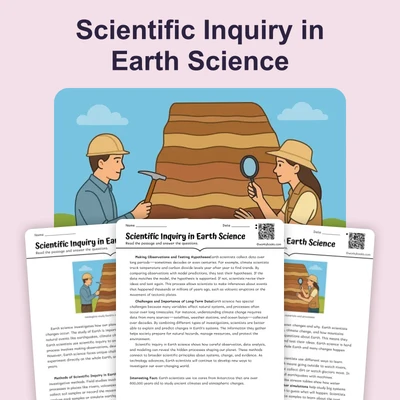
Scientific Inquiry in Earth Science
This passage explores scientific inquiry in Earth science for grades 6-8, aligned with NGSS standards MS-ESS1-4, MS-ESS2...
MS-ESS1-4MS-ESS2-1MS-ESS3-5SEP
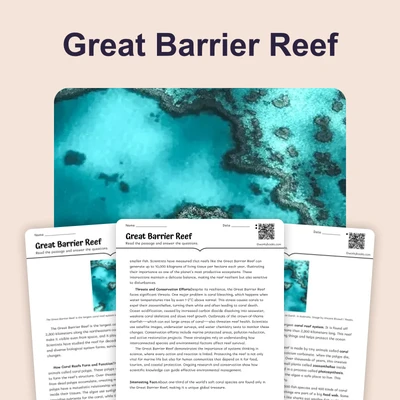
Great Barrier Reef
This passage introduces middle school students to the Great Barrier Reef, the world's largest coral reef system, located...
MS-LS2-1MS-LS2-4MS-ESS3-5
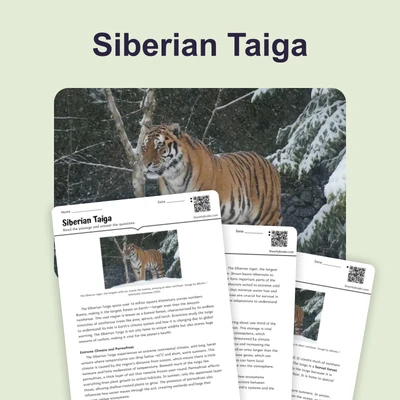
Siberian Taiga
This engaging middle school science passage explores the Siberian Taiga, the world’s largest forest ecosystem, stretchin...
MS-LS2-1MS-ESS3-5
The Greenhouse Effect
This comprehensive middle school science passage explores the greenhouse effect, a process essential to maintaining Eart...
MS-ESS2-6MS-ESS3-5
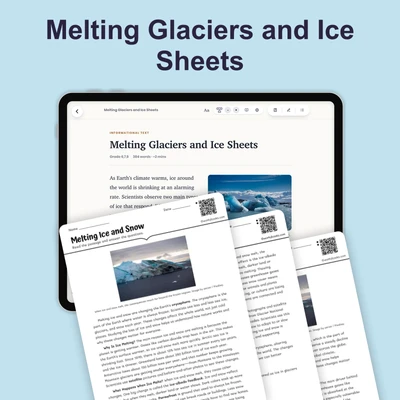
Melting Ice and Snow
This passage, designed for grades 6-8 and aligned with NGSS MS-ESS3-5, explores the mechanisms and impacts of melting ic...
MS-ESS3-5
Rising Sea Levels
This science passage, written for grades 6-8, explores the phenomenon of rising sea levels, a key topic aligned with NGS...
MS-ESS3-5
Ice Cores
This passage, aligned with NGSS standards MS-ESS3-5 and MS-ESS1-4, explores the scientific process of extracting and ana...
MS-ESS3-5MS-ESS1-4
How Climate Change Affects Weather
This middle school science passage explores how and why weather patterns are changing globally. Students will learn abou...
MS-ESS3-5
How Climate Change Affects Oceans
This NGSS-aligned passage explores major changes occurring in Earth’s oceans, focusing on the mechanisms and impacts of ...
MS-ESS3-5
Carbon Footprint
This NGSS-aligned passage for grades 6-8 explores the concept of a carbon footprint, focusing on how personal activities...
MS-ESS3-4MS-ESS3-5
El Niño
This middle school science passage provides an in-depth exploration of El Niño, the warm phase of the El Niño-Southern O...
MS-ESS2-6MS-ESS3-5
ENSO and Global Climate
This comprehensive passage explores the El Niño-Southern Oscillation (ENSO), a crucial driver of global climate variabil...