How Small Changes Affect Earth Systems — Reading Comprehension
Rate this
Premium Resource
Present
Present in classroom. No work saved
Assign
Classroom with student accounts, Track progress
Quick Play
No student accounts, assign with a link
Grades
6
7
8
Standards
MS-ESS2-1
PRINT+DIGITAL RESOURCE
This learning resource is available in interactive and printable formats. The interactive worksheet can be played online and assigned to students. The Printable PDF version can be downloaded and printed for completion by hand.
This comprehensive 600-word science reading passage examines how small changes in Earth's systems can cascade into large-scale environmental effects. Students in grades 6-8 will explore concepts including feedback loops, albedo effect, and system interactions through real-world examples like Arctic ice melting and deforestation. The passage aligns with NGSS MS-ESS2-1, focusing on how Earth's systems interact and respond to changes. Audio-integrated content includes a main passage, simplified differentiated version for struggling readers, Spanish translations, glossary of key terms, multiple-choice comprehension questions, writing activities, and graphic organizers. Students will analyze cause-and-effect relationships and understand how interconnected Earth systems amplify small initial changes into significant environmental impacts affecting weather patterns, ecosystems, and climate.
CONTENT PREVIEW
Expand content preview
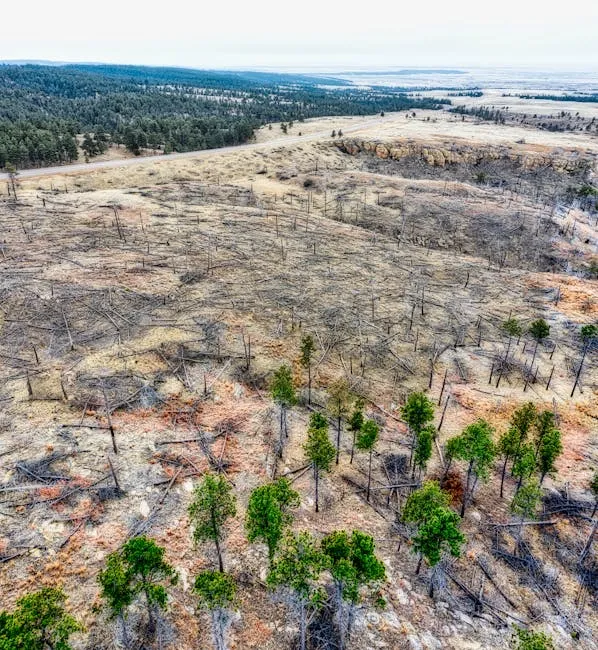
"Deforestation causes soil erosion and alters local climate systems." Image by Tom Fisk / Pexels.
Earth's systems are interconnected in complex ways. A small change in one part of the system can trigger a chain reaction that affects the entire planet. Scientists call this a cascade effect, where one change leads to another, which leads to another, creating impacts far larger than the original change. Understanding these cascade effects helps us predict how Earth will respond to environmental changes.
Temperature changes provide a clear example of cascade effects. When average temperatures rise by just a few degrees, Arctic ice begins to melt. This melting ice creates a feedback loop, which is a cycle where the result of a process influences the process itself. Ice reflects sunlight back into space, keeping Earth cool. This reflective property is called albedo. When ice melts, it exposes darker ocean water underneath. Dark water absorbs more heat than white ice, causing more warming, which melts more ice. This cycle continues, amplifying the original temperature increase.
Land cover changes also trigger cascade effects across Earth's systems. When forests are removed through deforestation, the land surface changes dramatically. Trees naturally absorb carbon dioxide and release water vapor through transpiration. Without trees, less water vapor enters the atmosphere, reducing cloud formation and rainfall. The soil, no longer protected by tree roots, erodes more easily. Local temperatures increase because trees no longer provide shade and cooling through transpiration. These changes affect not just the local area but can alter weather patterns hundreds of miles away.
Ocean systems demonstrate how small changes cascade through multiple spheres of Earth. The atmosphere (air), hydrosphere (water), biosphere (living things), and geosphere (land) all interact constantly. When ocean temperatures rise slightly, warm water holds less dissolved oxygen. Fish and other marine organisms struggle to survive in oxygen-poor water. Some species move to cooler waters, disrupting food chains. Warmer water also expands, contributing to sea level rise. Coastal communities experience flooding, forcing changes in human settlements and land use.
These cascade effects reveal an important principle: Earth operates as an integrated system, not as separate, independent parts. A temperature shift of just two degrees Celsius can reshape coastlines, alter rainfall patterns, and change where plants and animals can survive. A change in land cover in one region can influence weather patterns across an entire continent. Scientists study these connections to understand how Earth responds to both natural changes and human activities.
Recognizing cascade effects helps us make better decisions about managing Earth's resources. When we understand that small changes can have large consequences, we can take action before problems become too severe. This systems thinking approach is essential for addressing environmental challenges and protecting Earth's interconnected systems for future generations.
Interesting Fact: Scientists have discovered that the loss of just 10% of a forest can reduce rainfall in that region by up to 4%, demonstrating how relatively small land cover changes can significantly impact the water cycle.
What is a cascade effect?
A chain reaction where one change leads to many other changesA waterfall that forms in mountain regionsA type of weather pattern that occurs in winterA method scientists use to study rocks
Why does melting Arctic ice cause more warming?
Because ice releases heat when it meltsBecause dark ocean water absorbs more heat than white iceBecause melting ice creates more cloudsBecause ice traps cold air underneath it
What does the term 'albedo' refer to?
The temperature of ocean waterThe amount of oxygen in waterThe reflective property of a surfaceThe process of trees releasing water
According to the passage, what happens when forests are removed?
More oxygen enters the atmosphereSoil becomes more stable and protectedLess water vapor enters the atmosphere, reducing rainfallLocal temperatures decrease significantly
What is transpiration?
The movement of animals from one place to anotherThe process by which plants release water vapor into the atmosphereThe reflection of sunlight by iceThe expansion of warm ocean water
Why do fish struggle when ocean temperatures rise?
Warm water holds less dissolved oxygenWarm water is too bright for fish to seeWarm water contains too much saltWarm water moves too quickly
Which of the following best describes how Earth's systems operate?
As separate, independent parts that rarely interactAs an integrated system where all parts are connectedOnly the atmosphere and hydrosphere interact with each otherChanges in one system never affect other systems
Based on the passage, what can a temperature shift of just two degrees Celsius do?
It has no noticeable effect on EarthIt only affects polar regionsIt can reshape coastlines and alter rainfall patternsIt only affects the atmosphere
True or False: A feedback loop is a cycle where the result of a process influences the process itself.
TrueFalse
True or False: According to the passage, losing 10% of a forest can reduce rainfall in that region by up to 4%.
TrueFalse
Perfect For:
👩🏫 Teachers
• Reading comprehension practice
• Auto-graded assessments
• Literacy skill development
👨👩👧👦 Parents
• Reading practice at home
• Comprehension improvement
• Educational reading time
🏠 Homeschoolers
• Reading curriculum support
• Independent reading practice
• Progress monitoring
Reading Features:
📖
Reading Passage
Engaging fiction or nonfiction text
❓
Comprehension Quiz
Auto-graded questions
📊
Instant Feedback
Immediate results and scoring
📄
Printable Version
Download for offline reading
🔊
Read Aloud
Voice-over with word highlighting
Reviews & Ratings
No reviews yet. Be the first to share your experience!
Related Content
Talus Slopes: Formation and Features
This earth science passage explains talus slope formation through mechanical weathering processes, aligning with NGSS MS...
MS-ESS2-1MS-ESS2-2RST.6-8.4
Biological Weathering: Types and Examples
This passage details biological weathering processes, connecting to NGSS MS-ESS2-1 (Earth's systems) and LS2.B (ecosyste...
MS-ESS2-1MS-PS1-2RST.6-8.3
Frost Wedging: How Ice Splits Rock
This passage explains frost wedging as a mechanical weathering process. Aligned with NGSS MS-ESS2-1 (Earth’s systems) a...
MS-ESS2-1MS-ESS2-2RST.6-8.3
Chemical Weathering: The Breakdown of Rocks Through Chemical Reactions
This passage explains chemical weathering processes, aligned with NGSS MS-ESS2-1 (Earth’s systems) and ESS2-2 (surface ...
MS-ESS2-1MS-ESS2-2RST.6-8.4
Limestone Caves: Nature’s Underground Wonders
This passage explains limestone cave formation through carbonation, aligned with NGSS MS-ESS2-1 (Earth’s systems) and L...
MS-ESS2-1LS2.CRST.6-8.7
The Coldest City in the World: Yakutsk
This NGSS-aligned science passage introduces middle school readers to Yakutsk, the coldest city on Earth. Students will ...
MS-ESS2-1
Igneous Rocks
This comprehensive passage introduces middle school students to igneous rocks, focusing on how these rocks form from mol...
MS-ESS2-1MS-ESS3-1
Sedimentary Rocks
This comprehensive middle school science passage introduces students to sedimentary rocks, detailing their step-by-step ...
MS-ESS2-1MS-ESS2-3MS-ESS3-1
Metamorphic Rocks
This engaging middle school science passage introduces students to the fascinating world of metamorphic rocks. Aligned w...
MS-ESS2-1MS-ESS3-1
Scientific Inquiry in Earth Science
This passage explores scientific inquiry in Earth science for grades 6-8, aligned with NGSS standards MS-ESS1-4, MS-ESS2...
MS-ESS1-4MS-ESS2-1MS-ESS3-5SEP
Contour Lines and Elevation
This passage, designed for grades 6-8 and aligned with NGSS standards MS-ESS2-2 and MS-ESS2-1, introduces students to th...
MS-ESS2-2MS-ESS2-1SEP.4SEP.8
Weathering
This comprehensive science reading passage for grades 6-8 focuses on the concept of weathering, aligning with NGSS stand...
MS-ESS2-1
Erosion
This comprehensive middle school science passage explains erosion—the process that transports weathered rock and soil fr...
MS-ESS2-1
Stream Erosion and Deposition
This middle school science passage, aligned to NGSS MS-ESS2-1, introduces students to the dynamic processes of stream er...
MS-ESS2-1
Wind Erosion and Deposition
This comprehensive science reading passage for grades 6-8 explores the processes of wind erosion and deposition, alignin...
MS-ESS2-1
Glacial Erosion and Deposition
This middle school science passage explores glacial erosion and deposition, focusing on the mechanisms by which glaciers...
MS-ESS2-1
Mass Movements
This NGSS-aligned passage introduces middle school students to the science of mass movements—gravity-driven motions of r...
MS-ESS2-1MS-ESS3-2
Soil Formation and Composition
This comprehensive middle school science passage explores soil formation and composition, perfectly aligned to NGSS stan...
MS-ESS2-1
Constructive and Destructive Forces
This middle school science passage explores how Earth's surface is constantly shaped by the interplay of constructive an...
MS-ESS2-1
Mountains and Mountain Building
This NGSS-aligned passage for grades 6-8 covers the fascinating processes that create Earth's highest landforms—mountain...