How Does Soil Store Carbon
Interactive passage with audio narration, comprehension questions, and printable PDF.
By completing this purchase you agree to our Terms of Use and Privacy Policy. Your subscription renews automatically until you cancel. You can cancel anytime from your account settings. All sales are final and non-refundable. Digital content is available for download in your account immediately upon purchase.
What's included
How Does Soil Store Carbon preview and details
About this printable How Does Soil Store Carbon science reading passage, NGSS-aligned (Grades 6-8)
Sample passage and quiz from How Does Soil Store Carbon
Reading passage and comprehension quiz preview
How Soil Stores Carbon
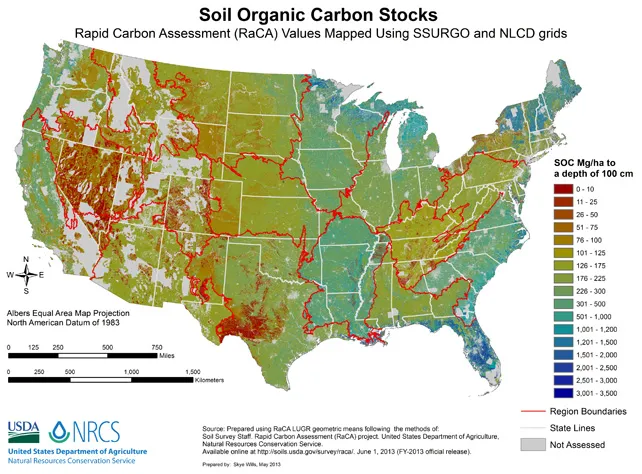
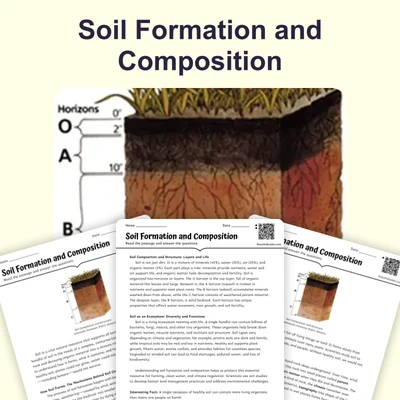
"Soil Organic Carbon Stock" by Natural Resources Conservation Service Soils / Wikimedia Commons
Soil is one of Earth's largest carbon reservoirs, storing more carbon than all the world's forests combined. A carbon reservoir is a natural storage system that holds carbon for long periods. When plants and animals die, their remains enter the soil where they break down through decomposition. During decomposition, bacteria and fungi break down dead organic matter into simpler substances. Some of this carbon returns to the atmosphere as carbon dioxide, but much of it stays locked in the soil for decades, centuries, or even thousands of years.
The carbon that remains in soil becomes part of a dark, nutrient-rich material called humus. Humus forms when organic matter decomposes partially but does not break down completely. This process happens slowly, especially in cool or dry conditions where decomposer organisms work less actively. Humus gives healthy soil its dark color and helps it retain water and nutrients. In agricultural fields, humus-rich soil can store significant amounts of carbon while also supporting plant growth. A single handful of healthy garden soil might contain billions of microorganisms working to create and maintain humus.
In wetland environments, carbon storage works differently through the formation of peat. Peat is partially decomposed plant material that accumulates in waterlogged conditions where oxygen levels are low. Without sufficient oxygen, decomposer organisms cannot break down dead plants completely. Over thousands of years, layers of peat can build up to depths of several meters. Peatlands cover only about 3% of Earth's land surface but store approximately one-third of all soil carbon. Bogs and marshes in places like Scotland, Canada, and Indonesia contain vast peat deposits that have accumulated carbon for millennia.
The most dramatic example of soil carbon storage occurs in permafrost, which is ground that remains frozen year-round. Permafrost exists in Arctic and subarctic regions, covering about 24% of land in the Northern Hemisphere. When plants and animals died in these regions thousands of years ago, the cold temperatures froze their remains before decomposition could occur. This frozen organic matter has remained locked in permafrost, creating an enormous carbon reservoir. Scientists estimate that permafrost contains nearly twice as much carbon as currently exists in Earth's atmosphere.
Soil carbon storage connects directly to the broader carbon cycle, which describes how carbon moves between the atmosphere, oceans, living organisms, and Earth's crust. Plants remove carbon dioxide from the atmosphere during photosynthesis, converting it into plant tissue. When these plants die and decompose in soil, some carbon returns to the atmosphere, but some remains stored as humus or peat. This natural balance helps regulate atmospheric carbon dioxide levels. However, human activities are disrupting this balance in concerning ways.
When soil is disturbed through activities like plowing, draining wetlands, or construction, stored carbon can be released rapidly into the atmosphere. Warming temperatures pose an even greater threat, especially to permafrost regions. As permafrost thaws due to climate change, previously frozen organic matter begins to decompose, releasing carbon dioxide and methane—both greenhouse gases that trap heat in Earth's atmosphere. This creates a dangerous feedback loop: warming causes permafrost to thaw, which releases greenhouse gases, which causes more warming. Scientists monitor these changes carefully because the release of soil carbon could significantly accelerate climate change.
Understanding soil as a carbon reservoir helps explain why protecting healthy soils matters for climate stability. Sustainable farming practices that minimize soil disturbance, protecting wetlands from drainage, and preventing permafrost thaw all help keep carbon stored safely underground. The soil beneath our feet represents thousands of years of carbon accumulation, and maintaining these natural storage systems is essential for managing Earth's climate.
Interesting Fact: If all the carbon currently stored in permafrost were released into the atmosphere, it would more than double the amount of carbon dioxide in the air, causing catastrophic climate change.
Comprehension quiz (10 questions)
1. What is a carbon reservoir?
2. How does humus form in soil?
3. What percentage of Earth's land surface do peatlands cover?
4. Why does peat accumulate in wetlands?
5. In the context of the passage, what does 'permafrost' mean?
6. Based on the passage, what happens when permafrost thaws?
7. How does soil carbon storage connect to the carbon cycle?
8. Which human activity can cause stored soil carbon to be released into the atmosphere?
9. True or False: Soil stores more carbon than all the world's forests combined.
10. True or False: Permafrost contains less carbon than currently exists in Earth's atmosphere.
Perfect for the way you teach
- Build comprehension skills
- Auto-graded quiz
- Differentiated reading
- Read together at home
- Improve fluency
- Quiet reading time
- Reading curriculum support
- Independent practice
- Track Lexile growth