How the Body Absorbs Nutrients — Reading Comprehension
Rate this
Premium Resource
Present
Present in classroom. No work saved
Assign
Classroom with student accounts, Track progress
Quick Play
No student accounts, assign with a link
Grades
3
4
5
Standards
NGSS 4-LS1-1
LS1.A
PRINT+DIGITAL RESOURCE
This learning resource is available in interactive and printable formats. The interactive worksheet can be played online and assigned to students. The Printable PDF version can be downloaded and printed for completion by hand.
This 250-word reading passage introduces fourth-grade students to the process of nutrient absorption in the human body, aligned with NGSS standard 4-LS1-1 and Disciplinary Core Ideas LS1.A. Students learn how nutrients—the tiny, useful parts of food—pass from the small intestine into the bloodstream and travel to cells throughout the body. The passage explains how broken-down food moves from the stomach into a long, winding tube where absorption occurs. Using age-appropriate language and relatable examples, students discover why nutrients are essential for energy, growth, and health. The content includes bolded vocabulary terms with immediate definitions, helping students build scientific literacy. Audio-integrated features support diverse learners by providing text-to-speech functionality. Accompanying activities include multiple-choice comprehension questions, short-answer writing prompts, and graphic organizers that reinforce understanding of body systems and processes. A simplified differentiated version ensures accessibility for all reading levels. Spanish translations of both passages support English language learners. This resource provides foundational knowledge necessary for hands-on investigations and classroom discussions about how organisms obtain and use matter and energy to live and grow.
CONTENT PREVIEW
Expand content preview
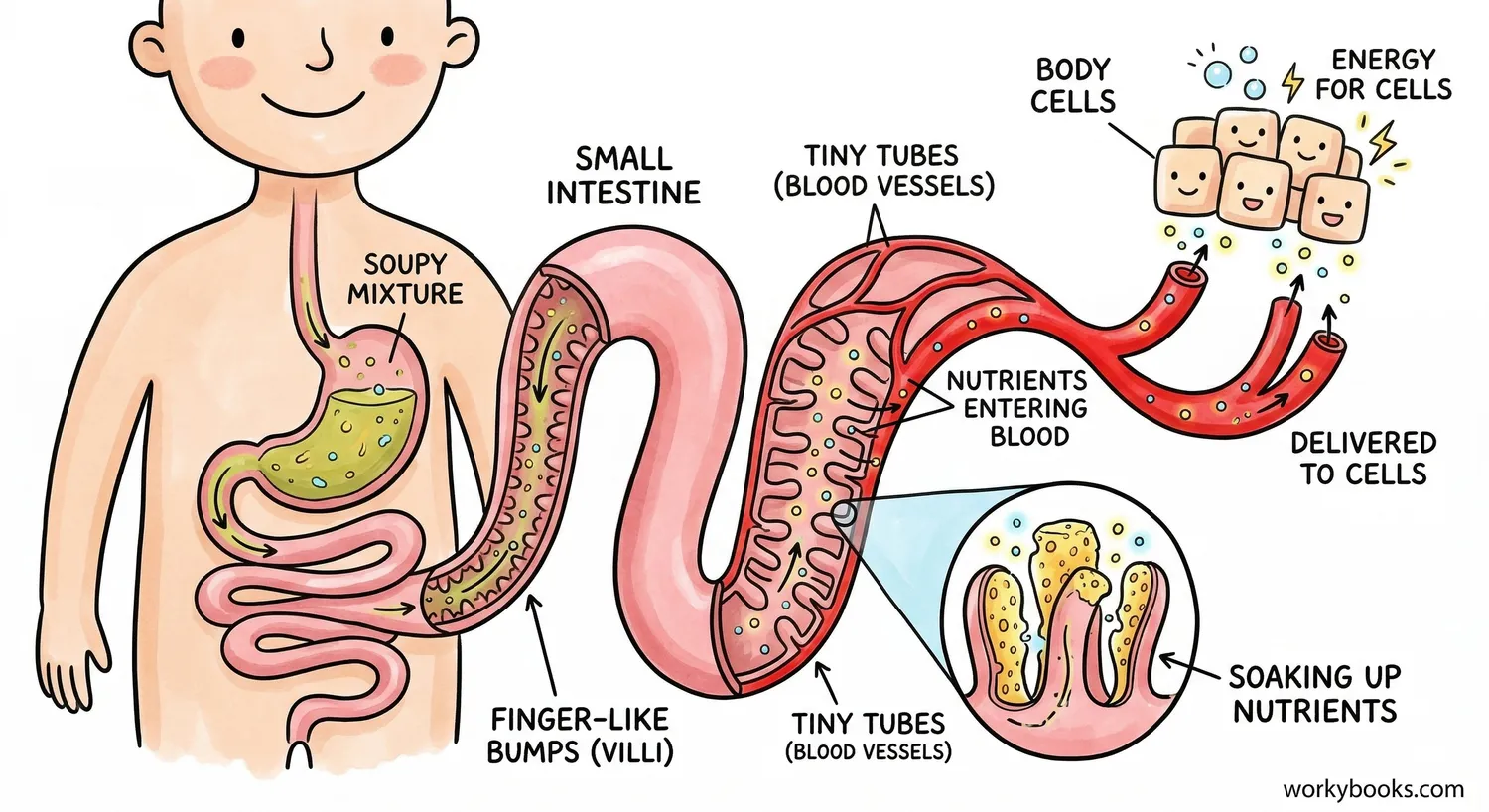
Nutrients move from the small intestine into blood vessels to fuel cells.
After food leaves your stomach, it moves into a long, winding tube called the small intestine. The small intestine is where your body absorbs the useful parts of food. By the time food reaches this tube, it has been broken down into a soupy mixture. This mixture contains nutrients—the tiny pieces of food that your body needs to survive.
Nutrients are important because they give your body energy, help you grow, and keep you healthy. Your body needs nutrients the way a car needs gasoline to run. The small intestine has special walls with tiny finger-like bumps that help absorb nutrients. These bumps are like thousands of little sponges soaking up what your body needs.
Once nutrients pass through the walls of the small intestine, they enter tiny tubes called blood vessels. The blood acts like a delivery truck, carrying nutrients to every cell in your body. Cells are the tiny building blocks that make up your skin, muscles, bones, and organs. Each cell uses nutrients to do its job and keep you alive.
This is the moment when food actually becomes fuel for your body. Without absorption in the small intestine, the food you eat would just pass through without helping you at all.
Interesting Fact: Your small intestine is about 20 feet long—that's longer than most cars! If you stretched it out, it would be taller than a two-story building.
Where does food go after the stomach?
Into the small intestineInto the lungsInto the heartOut of the body
What are nutrients?
Large pieces of undigested foodTiny useful parts of foodWater in your stomachBones in your body
What do blood vessels do?
Break down food into soupCarry nutrients to body cellsStore extra foodMake your heart beat
Why does the body need nutrients?
To make food taste betterTo give energy and help growthTo make blood redTo keep food in stomach
How do nutrients leave the small intestine?
They stay there foreverThey go back to stomachThey pass through intestine wallsThey turn into water
What are cells?
Large organs like the heartTiny building blocks of bodyTypes of food nutrientsBlood vessels in intestine
The small intestine is about 20 feet long.
TrueFalse
What does absorb mean in this passage?
To chew food completelyTo soak up or take inTo push food outTo make food cold
Perfect For:
👩🏫 Teachers
• Reading comprehension practice
• Auto-graded assessments
• Literacy skill development
👨👩👧👦 Parents
• Reading practice at home
• Comprehension improvement
• Educational reading time
🏠 Homeschoolers
• Reading curriculum support
• Independent reading practice
• Progress monitoring
Reading Features:
📖
Reading Passage
Engaging fiction or nonfiction text
❓
Comprehension Quiz
Auto-graded questions
📊
Instant Feedback
Immediate results and scoring
📄
Printable Version
Download for offline reading
🔊
Read Aloud
Voice-over with word highlighting
Reviews & Ratings
No reviews yet. Be the first to share your experience!
Related Content
What Are Bones Made Of
This engaging 250-word reading passage introduces Grade 4 students to the structure and function of bones, aligned with ...
NGSS 4-LS1-1LS1.A
How Bones Protect Organs
This engaging 250-word reading passage helps Grade 4 students understand how bones protect organs, aligned with NGSS sta...
NGSS 4-LS1-1LS1.A
How Joints Connect Bones
This 250-word reading passage teaches fourth-grade students about joints and their role in the human skeletal system. Al...
NGSS 4-LS1-1LS1.A
Layers of the Skin
This engaging 250-word reading passage introduces fourth-grade students to the three layers of skin and their functions....
NGSS 4-LS1-1LS1.A
Parts of Plant Stems
This engaging 250-word reading passage introduces fourth-grade students to the internal structure and function of plant ...
NGSS 4-LS1-1LS1.A
Parts of a Flower
This comprehensive 250-word reading passage introduces fourth-grade students to the essential parts of a flower and thei...
NGSS 4-LS1-1LS1.A
How Leaves Make Food
This engaging Grade 4 science reading passage explains how leaves make food through photosynthesis. Students discover th...
NGSS 4-LS1-1LS1.A
How Animal Hearts Work
This 250-word audio-integrated reading passage introduces fourth-grade students to the essential function of the heart a...
NGSS 4-LS1-1LS1.A
Animal Skeleton Structure
This 250-word reading passage introduces fourth grade students to animal skeleton structure, aligned with NGSS 4-LS1-1 a...
NGSS 4-LS1-1LS1.A
How Animal Lungs Work
This 250-word reading passage introduces fourth-grade students to how animal lungs work, aligned with NGSS standard 4-LS...
NGSS 4-LS1-1LS1.A
Parts of a Leaf
This 250-word reading passage introduces Grade 4 students to the internal structure of leaves, aligned with NGSS standar...
NGSS 4-LS1-1LS1.A
Stamen and Pistil
This 250-word reading passage introduces fourth-grade students to the stamen and pistil, the key reproductive structures...
NGSS 4-LS1-1LS1.A
How Internal Structures Help Plants Survive
This 250-word informational reading passage is designed for Grade 4 students and aligns with NGSS standard 4-LS1-1 (LS1....
NGSS 4-LS1-1LS1.A
How Stems Support Plants
This engaging 250-word reading passage helps Grade 4 students understand how stems support plants and contribute to thei...
NGSS 4-LS1-1LS1.A
How Plants Reproduce
This 250-word reading passage introduces fourth-grade students to plant reproduction aligned with NGSS 4-LS1-1 and the D...
NGSS 4-LS1-1LS1.A
How External Structures Help Plants Survive
This 250-word reading passage introduces fourth-grade students to how external plant structures help plants survive, gro...
NGSS 4-LS1-1LS1.A
How Internal Structures Keep Animals Alive
This engaging 250-word reading passage introduces fourth-grade students to the essential internal structures that keep a...
NGSS 4-LS1-1LS1.A
Animal External Structures
This engaging 250-word reading passage introduces fourth-grade students to the concept of animal external structures ali...
NGSS 4-LS1-1LS1.A
What Are Exoskeletons
This engaging 250-word reading passage introduces fourth-grade students to the concept of exoskeletons, aligning with NG...
NGSS 4-LS1-1LS1.A
How Skin Protects Animals
This engaging 250-word reading passage introduces fourth-grade students to the protective functions of skin, the largest...