Immigration Restriction 1920s
Interactive passage with audio narration, comprehension questions, and printable PDF.
By completing this purchase you agree to our Terms of Use and Privacy Policy. Your subscription renews automatically until you cancel. You can cancel anytime from your account settings. All sales are final and non-refundable. Digital content is available for download in your account immediately upon purchase.
What's included
Immigration Restriction 1920s preview and details
About this printable Immigration Restriction 1920s reading passage (Grades 6-8)
Sample passage and quiz from Immigration Restriction 1920s
Reading passage and comprehension quiz preview
Immigration Restriction 1920s
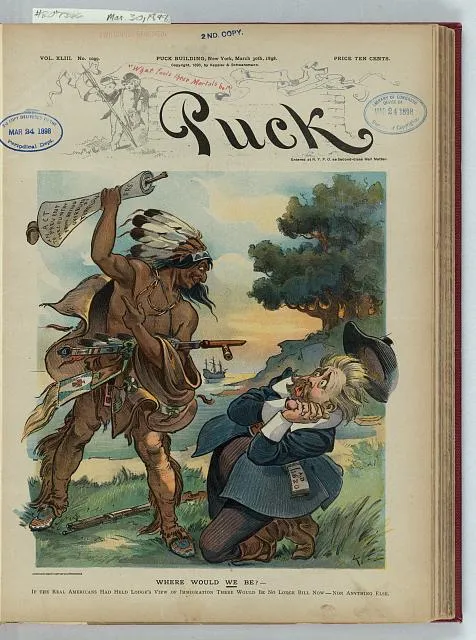
Source: Library of Congress - Keppler, Udo J., 1872-1956
In the 1920s, the United States government created new legislation that limited immigration in ways never seen before. These laws, called quota laws, drastically reduced the number of people allowed to enter the country from certain regions. This period marked a major shift in American immigration policy, and its effects are still studied by historians today.
Before the 1920s, the U.S. had welcomed millions of immigrants from all over the world. However, many Americans began to fear that too much immigration threatened jobs, wages, and the nation's identity. These worries were fueled by nativism, a belief that people born in the U.S. were superior to newcomers. Nativists argued that immigrants from Southern and Eastern Europe, as well as Asia, could not easily assimilate into American society.
In response to these anxieties, Congress passed the Emergency Quota Act of 1921. This law set strict restrictions on how many immigrants could come from each country, favoring those from Northern and Western Europe. Soon after, the Immigration Act of 1924 established even stricter quotas. This new legislation used data from the 1890 census to assign quotas, which greatly favored immigrants from Northern and Western European countries and all but excluded people from Asia and Africa.
The government justified these laws by claiming they would protect American jobs and preserve American culture. Supporters believed that limiting immigration would help the economy and prevent social problems. Critics, however, argued that the restrictions were unfair and based on prejudice rather than facts. Many families were separated, and people who hoped to build new lives in America were denied entry. The laws also ignored the contributions that immigrants had made to American society.
These 1920s immigration laws had long-lasting effects. The quota system remained in place for decades, shaping the makeup of the U.S. population. It was not until the Immigration and Nationality Act of 1965 that many of the old quotas were removed and new, fairer policies were put in place. Historians now view the 1920s as a time when the U.S. turned away from its tradition of welcoming newcomers, reflecting deep national debates about identity and fairness.
Although the laws were passed before the Great Depression, they influenced the way people viewed immigrants during hard economic times. Many Americans believed that reducing immigration would help the country recover. However, the reality was more complicated, and the debate about immigration has continued into the present day.
Interesting Fact: In the 1920s, the number of immigrants entering the U.S. dropped from over 800,000 per year to less than 150,000 after the quota laws were passed.
Comprehension quiz (8 questions)
1. What did the quota laws do?
2. When was the Emergency Quota Act passed?
3. Who did the quotas favor?
4. Why did nativists want restrictions?
5. What was a criticism of the laws?
6. How did the laws affect families?
7. The quota system lasted until 1965.
8. What does 'nativism' mean?
Common Core standards for Immigration Restriction 1920s
Explain events, procedures, ideas, or concepts in a historical, scientific, or technical text, including what happened and why, based on specific information in the text.
Determine the meaning of general academic and domain-specific words or phrases in a text relevant to a grade 4 topic or subject area.
Write informative/explanatory texts to examine a topic and convey ideas and information clearly.
Perfect for the way you teach
- Build comprehension skills
- Auto-graded quiz
- Differentiated reading
- Read together at home
- Improve fluency
- Quiet reading time
- Reading curriculum support
- Independent practice
- Track Lexile growth