This learning resource is available in interactive and printable formats. The interactive worksheet can be played online and assigned to students. The Printable PDF version can be downloaded and printed for completion by hand.
This history reading passage examines the engineering achievements of the Inca civilization, focusing on their suspension bridges constructed from woven grass to span the deep gorges of the Andes. Highlighting the Q'eswachaka bridge, which is still rebuilt annually using traditional methods, the passage explores how geography influenced Inca innovation and how these bridges facilitated communication and trade across the empire. It also connects to broader themes like technological adaptation and the role of indigenous inventions in world history. The resource includes a glossary, comprehension questions, writing prompts, graphic organizers, and a Spanish translation, making it suitable for diverse learners. Aligned with CA HSS 6.2.3 and Common Core RH.6-8.2, RH.6-8.4, this passage provides teachers and students with a rigorous, standards-based tool for exploring ancient technology with read aloud audio and Spanish translation.
CONTENT PREVIEW
Expand content preview
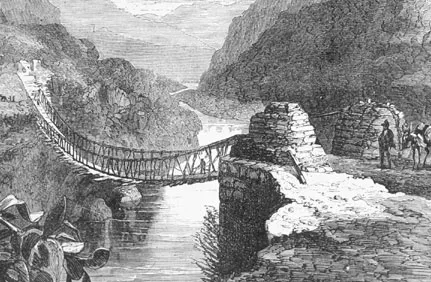
"Inca bridge" by Squier / Wikimedia Commons
The Inca civilization, which flourished in South America from the early 1400s to the 1530s, is well known for its impressive engineering. One of their most remarkable achievements was the construction of suspension bridges made from woven grass. These bridges spanned deep gorges and fast rivers across the rugged Andes Mountains, connecting remote villages and cities of the Inca Empire. The Q'eswachaka bridge, located in modern-day Peru, remains an example of this ancient technology and is still rebuilt each year using traditional methods.
Building suspension bridges in the Andes was a response to the region’s challenging geography. Deep valleys, swift rivers, and steep cliffs made travel dangerous and difficult. The Incas did not have iron tools or wheels, but they engineered bridges that could span over 150 feet. Using tough mountain grass called ichu, families gathered and twisted the fibers into thick ropes. Teams of workers would braid these ropes into massive cables, some as thick as a person’s arm. According to Spanish chronicler Garcilaso de la Vega, these bridges could support hundreds of people crossing each day.
The process of building and maintaining the bridges involved the entire local community. Each year, villages near the bridge would hold a special festival. Men would weave new ropes, while women prepared food and organized ceremonies to honor the ancestors. The old bridge would be cut and fall into the river, and a new one would be pulled across using teamwork and traditional knowledge passed down for generations. Archaeological evidence and Spanish records from the 16th century describe these bridges as vital for the movement of armies, traders, and government messengers throughout the vast Inca Empire.
The Q'eswachaka bridge stands as a living example of continuity in cultural practices. Unlike most ancient structures, it is not made of stone or metal but of renewable, biodegradable materials. The annual rebuilding ceremony shows the importance of community cooperation and respect for ancestral technology. Today, the Q'eswachaka bridge is recognized by UNESCO as an Intangible Cultural Heritage of Humanity, and it attracts visitors from around the world who want to see living history in action.
Inca suspension bridges demonstrate how societies can adapt to difficult environments using local materials and collective knowledge. These bridges changed how people and goods moved across the Andes and allowed the Inca Empire to connect its provinces over great distances. Studying these bridges helps us understand the relationship between technology, environment, and society in world history.
Interesting Fact: The word 'Q'eswachaka' comes from the Quechua language, meaning 'rope bridge,' and the bridge is rebuilt every June in a four-day festival.
What material did the Incas use?
Woven grass (ichu)StoneMetal chainsWooden planks
Where is the Q'eswachaka bridge located?
PeruMexicoBrazilChile
How often is the Q'eswachaka bridge rebuilt?
Every yearEvery 10 yearsEvery monthNever
Why did Incas build suspension bridges?
Cross deep gorgesDecorate citiesStore foodWorship gods
What does 'continuity' mean in this passage?
Keeping traditions over timeBuilding new roadsChanging materialsTraveling faster
How did the community help rebuild the bridge?
Weaving ropes and holding ceremoniesBuying new ropesHiring outside workersUsing machines
Q'eswachaka means 'rope bridge.'
TrueFalse
What is a gorge?
A deep valleyA mountain peakA riverA small village
Perfect For:
👩🏫 Teachers
• Reading comprehension practice
• Auto-graded assessments
• Literacy skill development
👨👩👧👦 Parents
• Reading practice at home
• Comprehension improvement
• Educational reading time
🏠 Homeschoolers
• Reading curriculum support
• Independent reading practice
• Progress monitoring
Reading Features:
📖
Reading Passage
Engaging fiction or nonfiction text
❓
Comprehension Quiz
Auto-graded questions
📊
Instant Feedback
Immediate results and scoring
📄
Printable Version
Download for offline reading
🔊
Read Aloud
Voice-over with word highlighting
Reviews & Ratings
No reviews yet. Be the first to share your experience!
Related Content
Native American Respect for Nature
This engaging history reading passage explores Native American respect for nature, emphasizing the close relationship be...
D2.HIS.2.3-5D2.HIS.3.3-5RI.4.3RI.4.4
Native Americans and Slavery in Early America
This comprehensive U.S. history reading passage explores the complex relationship between Native Americans and slavery d...
D2.HIS.2.3-5D2.HIS.3.3-5RI.4.3RI.4.4
Native American Tribes Across America
This engaging history reading passage introduces students to Native American tribes across America, focusing on their da...
D2.HIS.1.3-5D2.HIS.2.3-5RI.4.1RI.4.2
Traditional Native American Clothing
This engaging history passage explores traditional Native American clothing and how it reflected the environment, values...
D2.HIS.2.3-5D2.HIS.3.3-5RI.4.3RI.4.4
Native American Basket Weaving
This passage examines the historical importance of basket weaving among Indigenous Americans, highlighting how different...
Native American Treaties
This passage examines early Native American treaties, agreements that were meant to establish peace and boundaries betwe...
D2.HIS.2.3-5D2.HIS.3.3-5RI.4.3RI.4.4
Native American Land Sales
This comprehensive history reading passage examines Native American land sales in U.S. history and asks students to cons...
D2.HIS.2.3-5D2.HIS.3.3-5RI.4.3RI.4.4
Disease and Native Americans
This engaging U.S. history reading passage explores the dramatic impact of European diseases on Native American populati...
D2.HIS.2.3-5D2.HIS.3.3-5RI.4.3RI.4.4
The Cherokee Nation: History and Culture
This reading passage explores the rich history and culture of the Cherokee Nation, one of the largest Native American tr...
D2.HIS.2.3-5D2.HIS.14.3-5RI.4.3RI.4.4RI.4.10
Columbian Exchange Impact on Native Americans
This passage examines the complex effects of the Columbian Exchange on Native Americans, analyzing the causes, consequen...
D2.HIS.2.3-5D2.HIS.3.3-5RI.4.3RI.4.4
Native American Allies in Colonial Wars
This passage examines the complex role of Native American nations as allies and adversaries during the colonial wars of ...
D2.HIS.2.3-5D2.HIS.3.3-5RI.4.3RI.4.4
Spanish Missions Impact on Native American
This reading passage explores the complex impact of Spanish missions on Native American culture in what is now the south...
D2.HIS.2.3-5D2.HIS.3.3-5RI.4.3RI.4.4
Native American Civilizations Before European Contact
This engaging U.S. History reading passage explores Native American civilizations before European contact, focusing on t...
D2.HIS.2.3-5D2.HIS.3.3-5RI.4.3RI.4.4
Moccasins: Soft Leather Footwear
This passage explores the history and significance of moccasins—a soft leather footwear invented by Native American nati...
Native vs European Land Views
This passage examines the contrasting beliefs about land between Native American societies and European settlers, highli...
D2.HIS.2.3-5D2.HIS.3.3-5RI.4.3RI.4.4
Native Americans in Revolutionary War
This engaging U.S. history reading passage explores how Native American nations made difficult decisions during the Amer...
D2.HIS.2.3-5D2.HIS.3.3-5RI.4.3RI.4.4
Pemmican: High-Energy Preserved Food
This engaging history reading passage explores the invention and significance of pemmican, a high-energy preserved food ...
Black History Month Word Search
RF.4.3RF.5.3L.4.4L.5.4
The Inuit Kayak
This passage examines the history and significance of the Inuit kayak, an advanced invention developed by Arctic peoples...
American History Word Search
Word search on American History Word Search! Vocabulary practice aligned to Common Core standards!