Indentured Servants in Colonial America — Reading Comprehension
Rate this
Premium Resource
Present
Present in classroom. No work saved
Assign
Classroom with student accounts, Track progress
Quick Play
No student accounts, assign with a link
Grades
6
7
8
Standards
D2.HIS.2.3-5
D2.HIS.3.3-5
RI.4.3
RI.4.4
W.4.2
PRINT+DIGITAL RESOURCE
This learning resource is available in interactive and printable formats. The interactive worksheet can be played online and assigned to students. The Printable PDF version can be downloaded and printed for completion by hand.
This comprehensive passage and activity set explores the crucial but complex role of indentured servants in colonial America, highlighting the causes, motivations, and consequences of this labor system. Students will learn how economic hardship and opportunity motivated Europeans to become indentured servants, how colonial landowners relied on their labor, and the challenges and contradictions of the system. The passage compares the experiences and perspectives of both servants and landowners, integrates a primary source, and prompts students to analyze history using key disciplinary vocabulary. The resource includes a reading passage, glossary, timeline, multiple-choice quiz, writing activity, and a graphic organizer—plus a Spanish translation and read aloud audio. This lesson is aligned with C3 Framework and Common Core standards, making it ideal for use in history classes focused on early American society, labor systems, and social history.
CONTENT PREVIEW
Expand content preview
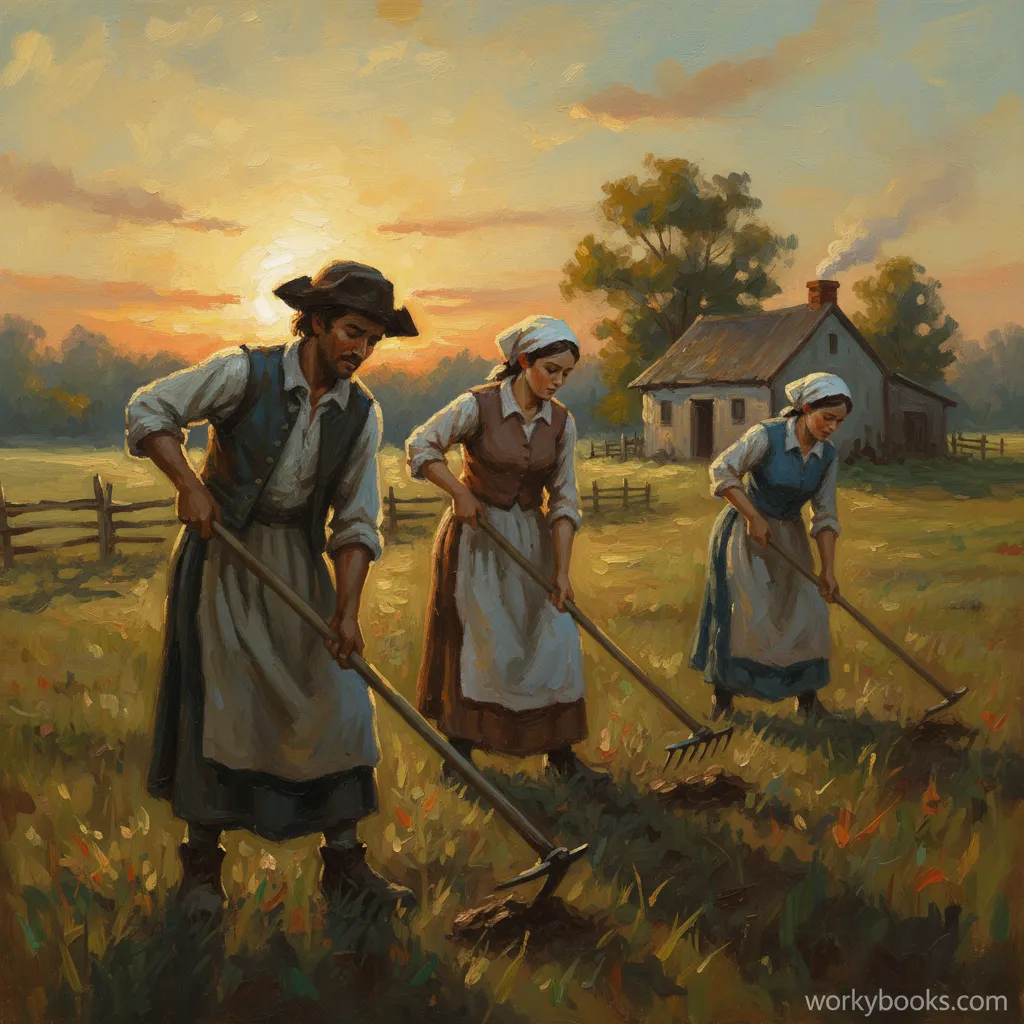
Indentured servants toiling in a field at sunset, a common scene in colonial America.
During the 1600s and 1700s, thousands of poor Europeans became indentured servants in colonial America. An indentured servant was a person who agreed, through a legal contract, to work for a certain number of years in exchange for passage across the Atlantic Ocean. This system developed because colonies in North America needed cheap labor to grow crops like tobacco and rice, but few people in Europe could afford to pay for their own journey.
To become an indentured servant, a person would sign an indenture, which was a written agreement outlining the terms of their servitude. Most indentures lasted between four to seven years. During this time, servants worked on farms, in homes, or at businesses. Their daily lives were difficult, often involving hard labor and harsh treatment. However, indentured servants were not slaves. They had legal rights and, at the end of their service, were supposed to receive freedom dues. These dues could include land, money, or tools to help them start a new life.
The indenture system created both opportunities and problems. For many, it was a way to escape poverty and build a better future. Some were able to start farms or businesses after gaining freedom. Others, however, faced broken promises. Masters sometimes refused to provide freedom dues, or extended the servants' contracts for minor reasons. Disease and poor living conditions also caused many indentured servants to die before their contracts ended.
Over time, several factors led to the decline of indentured servitude. As the economy in England improved, fewer people were willing to risk the journey. At the same time, the demand for labor in the colonies grew, especially on large plantations. Colonists increasingly turned to enslaved Africans, whose forced labor was permanent and hereditary. This shift had a major impact on the history of the United States, as the use of slavery expanded in the Southern colonies.
The legacy of indentured servitude is complex. While it provided a way for many Europeans to start new lives in America, it also exposed the harsh realities of early colonial society. The system highlighted the inequalities and challenges faced by workers, and its decline led to the expansion of a far more brutal system: slavery. Understanding indentured servitude helps us see how economic needs, labor systems, and human rights have shaped American history.
Interesting Fact: Some of the first labor strikes in America were led by former indentured servants who demanded better treatment and fair pay after gaining their freedom.
What is an indentured servant?
A person who works for passageA wealthy landownerA government officialA Native American leader
How long did most indentures last?
4-7 years1-2 years10-20 yearsLifetime
What were freedom dues?
Land, money, or toolsExtra years of workPrison timeA ship ticket home
Why did the system decline?
England's economy improvedServants became richColonists went homeSlavery was banned
Who replaced indentured servants for labor?
Enslaved AfricansNative AmericansFrench explorersWomen and children
How did indentured servants benefit?
Escape povertyFree land immediatelyNo work requiredPermanent jobs
Indentured servants always got their freedom dues.
TrueFalse
What does 'servitude' mean?
Being under someone's controlOwning landTeaching othersRuling a colony
Perfect For:
👩🏫 Teachers
• Reading comprehension practice
• Auto-graded assessments
• Literacy skill development
👨👩👧👦 Parents
• Reading practice at home
• Comprehension improvement
• Educational reading time
🏠 Homeschoolers
• Reading curriculum support
• Independent reading practice
• Progress monitoring
Reading Features:
📖
Reading Passage
Engaging fiction or nonfiction text
❓
Comprehension Quiz
Auto-graded questions
📊
Instant Feedback
Immediate results and scoring
📄
Printable Version
Download for offline reading
🔊
Read Aloud
Voice-over with word highlighting
Reviews & Ratings
No reviews yet. Be the first to share your experience!
Related Content
Native American Tribes Across America
This engaging history reading passage introduces students to Native American tribes across America, focusing on their da...
D2.HIS.1.3-5D2.HIS.2.3-5RI.4.1RI.4.2
Teepees: Homes on the Great Plains
This engaging history reading passage introduces students to teepees, the unique homes of Native American tribes on the ...
D2.HIS.2.3-5D2.HIS.14.3-5RI.4.1RI.4.2RI.4.4
Traditional Native American Clothing
This engaging history passage explores traditional Native American clothing and how it reflected the environment, values...
D2.HIS.2.3-5D2.HIS.3.3-5RI.4.3RI.4.4
The Iroquois Confederacy: A System of Peace
This engaging U.S. History reading passage introduces students to the Iroquois Confederacy, a powerful alliance of Nativ...
D2.HIS.2.3-5D2.HIS.3.3-5RI.4.3RI.4.4
The Cherokee Nation: History and Culture
This reading passage explores the rich history and culture of the Cherokee Nation, one of the largest Native American tr...
D2.HIS.2.3-5D2.HIS.14.3-5RI.4.3RI.4.4RI.4.10
The Sioux: Warriors and Tribal Leaders
This history reading passage explores the Sioux Nation, focusing on their roles as warriors and tribal leaders. Students...
D2.HIS.1.3-5D2.HIS.2.3-5RI.4.1RI.4.3
Native American Respect for Nature
This engaging history reading passage explores Native American respect for nature, emphasizing the close relationship be...
D2.HIS.2.3-5D2.HIS.3.3-5RI.4.3RI.4.4
Jamestown: The First Permanent English Colony
This engaging history passage explores the founding of Jamestown, the first permanent English colony in America. Aligned...
D2.HIS.1.3-5D2.HIS.2.3-5RI.4.3RI.4.4
Pocahontas and the Powhatan People
This engaging reading passage explores the life of Pocahontas and the Powhatan people and their important role in early ...
D2.HIS.1.3-5D2.HIS.2.3-5RI.4.1RI.4.3
Colonial Children: School and Chores
This reading passage explores the daily lives of colonial children, focusing on their experiences at school and their ma...
D2.HIS.2.3-5D2.HIS.3.3-5RI.4.1RI.4.2RI.4.4
Colonial Clothing and Homemade Goods
This engaging U.S. history passage explores the daily life of early American colonists with a focus on colonial clothing...
D2.HIS.2.3-5RI.4.3RI.4.4
Colonial Jobs: Blacksmiths, Bakers, and Craftsmen
This engaging history reading passage explores the vital roles of blacksmiths, bakers, and craftsmen in colonial America...
D2.HIS.2.3-5D2.HIS.3.3-5RI.4.3RI.4.4
Colonial Towns and Village Life
This engaging history reading passage explores the daily life, work, and unity found in colonial towns and villages. Ali...
D2.HIS.1.3-5D2.HIS.2.3-5RI.4.3RI.4.4
Colonial Trade with England and Africa
This history reading passage explores colonial trade between the American colonies, England, and Africa, focusing on the...
D2.HIS.2.3-5D2.HIS.14.3-5RI.4.3RI.4.4
Benjamin Franklin: Printer, Inventor, and Leader
This history reading passage explores the life and achievements of Benjamin Franklin, one of America's most important ea...
D2.HIS.2.3-5D2.HIS.3.3-5RI.4.1RI.4.3
George Washington Leads the Army
This engaging history reading passage explores how George Washington bravely led the Continental Army during the America...
D2.HIS.1.3-5D2.HIS.2.3-5RI.4.3RI.4.4
Women and Children During the Revolutionary War
This reading passage explores the important roles women and children played during the Revolutionary War. Students will ...
D2.HIS.2.3-5RI.4.3RI.5.3
African Americans Fight for Freedom
This educational passage explores the brave and inspiring story of how African Americans fought for freedom in the Unite...
D2.HIS.2.3-5D2.HIS.3.3-5RI.4.3RI.4.4
The Battle of Yorktown Ends War
This engaging U.S. history reading passage explores the Battle of Yorktown, a key event that ended the American Revoluti...
D2.HIS.1.3-5D2.HIS.2.3-5RI.4.1RI.4.3
Loyalists vs. Patriots: Divided Families
This engaging U.S. history reading passage explores the division between Loyalists and Patriots during the American Revo...