Industrial Revolution Child Labor
Interactive passage with audio narration, comprehension questions, and printable PDF.
By completing this purchase you agree to our Terms of Use and Privacy Policy. Your subscription renews automatically until you cancel. You can cancel anytime from your account settings. All sales are final and non-refundable. Digital content is available for download in your account immediately upon purchase.
What's included
Industrial Revolution Child Labor preview and details
About this printable Industrial Revolution Child Labor reading passage (Grades 5-8)
Sample passage and quiz from Industrial Revolution Child Labor
Reading passage and comprehension quiz preview
Industrial Revolution Child Labor
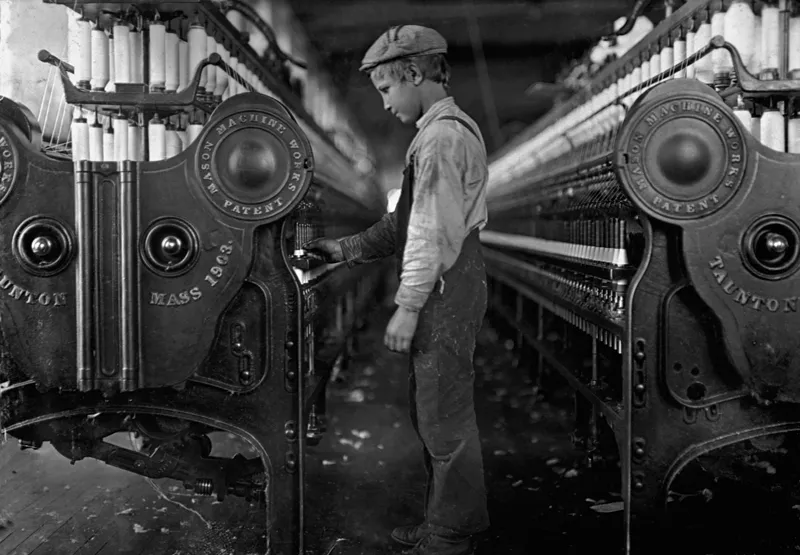
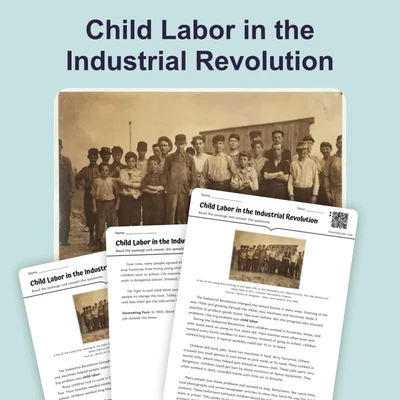
"Child Labor, 1918" by Lewis Hine /
Source: Wikimedia Commons (Public domain).
During the Industrial Revolution, children became a vital part of the workforce in Europe and the United States. Factories and mines hired children as young as five or six years old. Many families depended on the wages their children earned, even though the work was often dangerous and exhausting.
The Industrial Revolution began in Great Britain in the late 1700s and spread rapidly to other countries. Factories were built in cities, and people moved from rural areas to find jobs. The owners of textile mills, coal mines, and other industries needed cheap labor to keep their businesses running. Children were seen as ideal workers because they could be paid less than adults, and their small size allowed them to fit into tight spaces. In coal mines, for example, children called “trappers” opened and closed ventilation doors to keep air flowing. In textile factories, children operated machines and cleaned under spinning frames where adults could not reach. According to a factory report from Manchester, England, in 1833, some children worked over twelve hours each day with only brief breaks.
Working conditions for child laborers were often harsh and dangerous. Factories were loud and filled with dust, which caused breathing problems. Machines had no safety guards, so injuries were common. In mines, children crawled through narrow tunnels, sometimes carrying heavy loads of coal on their backs. A parliamentary investigation in 1842 revealed that children as young as eight worked underground for up to fourteen hours daily. In many cases, children suffered from accidents, illnesses, and severe fatigue. Despite these hardships, families often needed the extra income to survive in crowded industrial cities.
The use of child labor sparked debates among reformers, factory owners, and lawmakers. Some people argued that work taught children discipline and responsibility, but others believed that it harmed their health and denied them an education. Reformers like Lord Ashley in Britain and Lewis Hine in the United States used photographs and reports to expose the realities of child labor. Their efforts led to new laws. In Britain, the Factory Act of 1833 set limits on the number of hours children could work and required some factory owners to provide basic education. In the United States, similar laws followed in the early 1900s, although progress was slow and varied by state.
Over time, public attitudes shifted, and governments began to see education and health as more important for children than labor. By the early 20th century, many countries passed laws banning or restricting child labor in dangerous jobs. However, the fight to protect children’s rights continues in some parts of the world today.
The story of child labor during the Industrial Revolution helps us understand the connections between economic growth, social change, and human rights. It also shows how people can work together to improve society and protect the most vulnerable.
Interesting Fact: In 1900, over 1.75 million children under the age of 16 were working in the United States, according to the U.S. Census.
Comprehension quiz (8 questions)
1. When did the Industrial Revolution begin?
2. Why did factory owners hire children?
3. What job did 'trappers' do in mines?
4. What was a common danger in factories?
5. How did reformers try to stop child labor?
6. What law limited child labor in Britain?
7. Children worked less than 4 hours daily. True or false?
8. What does 'fatigue' mean in the passage?
Perfect for the way you teach
- Build comprehension skills
- Auto-graded quiz
- Differentiated reading
- Read together at home
- Improve fluency
- Quiet reading time
- Reading curriculum support
- Independent practice
- Track Lexile growth