Textiles Industry Revolution — Reading Comprehension
Rate this
Premium Resource
Present
Present in classroom. No work saved
Assign
Classroom with student accounts, Track progress
Quick Play
No student accounts, assign with a link
Grades
5
6
7
8
PRINT+DIGITAL RESOURCE
This learning resource is available in interactive and printable formats. The interactive worksheet can be played online and assigned to students. The Printable PDF version can be downloaded and printed for completion by hand.
This history reading passage examines how the spinning jenny, water frame, and power loom revolutionized textile production during the Industrial Revolution. Students will learn about the causes and effects of these inventions, the people involved, and their impact on society and daily life. The passage uses vocabulary like mechanization, innovation, and efficiency in context to support academic language acquisition. Activities include a glossary, multiple-choice quiz, writing prompts, graphic organizers, and a timeline. The passage is aligned with California History-Social Science Standard 6.4 and CCSS RI.6-8, and is available with read aloud audio and a full Spanish translation. The text encourages students to analyze historical change, connect technological advances to social developments, and explore the consequences of industrialization in world history.
CONTENT PREVIEW
Expand content preview
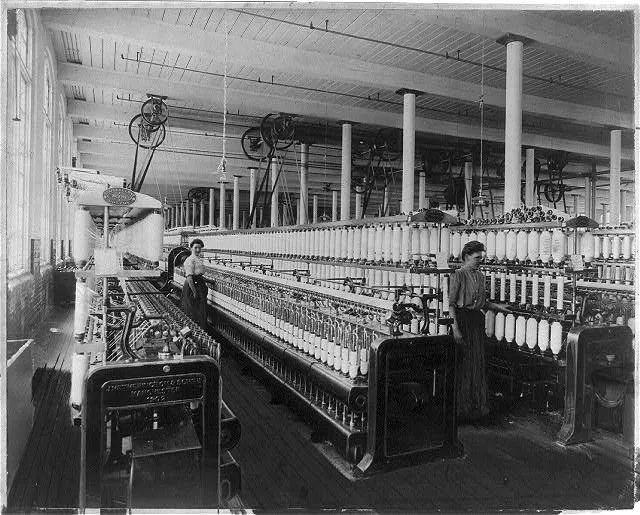
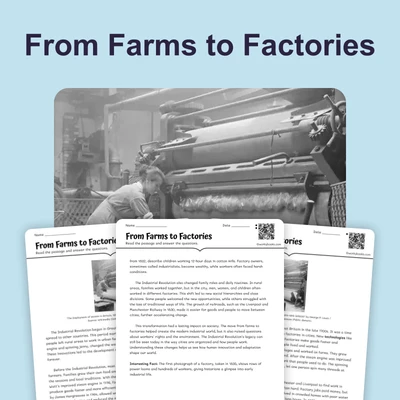
"Textile factory with two women at machines" / Source: Library of Congress.
The Industrial Revolution changed the way people made goods, especially textiles, which are cloth products like clothing and fabric. Before this period, most people spun thread and wove fabric by hand, often at home or in small workshops. Starting in the mid-18th century in Britain, new mechanical inventions transformed textile production. These machines made it possible to produce cloth much faster and in greater quantities than ever before.
The spinning jenny, invented by James Hargreaves in 1764, allowed one worker to spin several threads at once. Before this, spinning was done with a spinning wheel, which made only one thread at a time. A primary source from 1767 describes how families in Lancashire used the spinning jenny to produce more yarn for weaving. The jenny made thread production eight times faster and reduced the need for skilled labor, but it also threatened traditional spinners, leading to protests by those who feared losing their jobs.
In 1769, Richard Arkwright invented the water frame. This machine used water power to spin stronger and more even thread. Arkwright’s factory in Cromford, England, is considered the first successful water-powered textile mill. Factory records from 1771 show that his mill employed hundreds of workers from nearby villages. The water frame made it possible to move textile production out of homes and into large factories, changing the location and scale of work. These new factories often hired women and children, reflecting shifts in social roles and labor hierarchies.
The power loom, invented by Edmund Cartwright in 1785, further increased textile output by automating the weaving process. Cartwright’s early looms were improved by later inventors, making them more efficient and reliable. By the early 1800s, factories in cities like Manchester and Leeds were filled with power looms, producing massive quantities of cloth for Britain and its colonies. Reports from 1813 describe how a single power loom could do the work of several skilled weavers, lowering costs and making textiles more affordable to ordinary people.
These inventions had enormous impact. They led to the rise of factory towns, urbanization, and new social challenges such as long working hours and difficult conditions. While many workers lost traditional jobs, others found new employment in the factories. The increased supply of textiles changed daily life around the world, as more people could buy clothing and fabric at lower prices. Over time, the spread of these machines to Europe, the United States, and beyond helped shape the modern global economy.
The story of textile inventions connects to larger themes in world history, such as technological change, economic growth, and the ways people adapt to new inventions.
Interesting Fact: In 1779, Samuel Crompton combined features of the spinning jenny and water frame to create the spinning mule, which produced even finer thread for luxury fabrics.
Who invented the spinning jenny?
James HargreavesRichard ArkwrightEdmund CartwrightSamuel Crompton
What year was the water frame invented?
1764176917851813
Which city had early power loom factories?
ManchesterParisRomeBerlin
How did the spinning jenny affect workers?
Gave jobs to allThreatened some jobsMade cloth weakerMoved factories to cities
Why was the power loom important?
It made weaving fasterIt used only hand powerIt replaced water framesIt spun multiple threads
What was one social effect of factories?
More people lived in citiesFewer women workedHomes grew largerLess cloth was made
The spinning mule was invented after the power loom.
TrueFalse
What does 'efficient' mean?
Works well and quicklyUses a lot of effortNeeds many peopleMeans expensive
Perfect For:
👩🏫 Teachers
• Reading comprehension practice
• Auto-graded assessments
• Literacy skill development
👨👩👧👦 Parents
• Reading practice at home
• Comprehension improvement
• Educational reading time
🏠 Homeschoolers
• Reading curriculum support
• Independent reading practice
• Progress monitoring
Reading Features:
📖
Reading Passage
Engaging fiction or nonfiction text
❓
Comprehension Quiz
Auto-graded questions
📊
Instant Feedback
Immediate results and scoring
📄
Printable Version
Download for offline reading
🔊
Read Aloud
Voice-over with word highlighting
Reviews & Ratings
No reviews yet. Be the first to share your experience!
Related Content
American Industrial Revolution
This World History reading passage explores the spread of the Industrial Revolution from Britain to the United States, f...
Industrial Revolution Global Impact
This world history reading passage examines the global impact of the Industrial Revolution, focusing on how industrializ...
Capitalism Industrial Revolution
This engaging world history passage examines the rise of capitalism and its critical role in the Industrial Revolution. ...
Industrial Revolution Child Labor
This rigorous world history reading passage examines the harsh reality of child labor in factories and mines during the ...
Industrial Revolution Working Conditions
This world history reading passage examines the working conditions and workers' struggles during the Industrial Revoluti...
Pollution and the Industrial Revolution
This passage explores the environmental costs of industrialization during the Industrial Revolution, focusing on air and...
The Steam Engine Revolution
This rigorous world history passage explores the origins and impact of the steam engine during the Industrial Revolution...
New Social Classes: Industrial Society
This reading passage examines how the Industrial Revolution led to the development of new social classes and changed the...
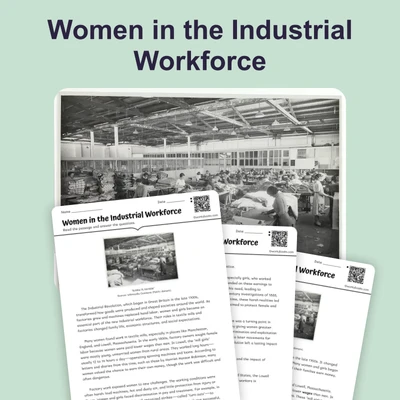
Women in the Industrial Workforce
This rigorous world history reading passage explores the key role women and girls played in the industrial workforce dur...
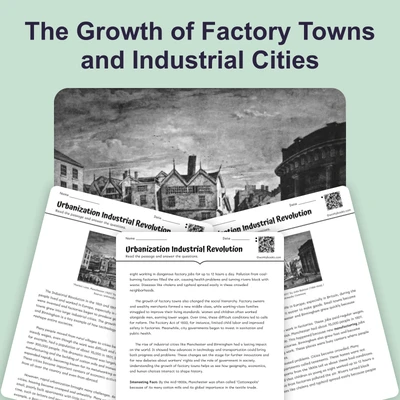
The Growth of Factory Towns and Industrial Cities
This history reading passage examines how the Industrial Revolution caused the rapid growth of factory towns and industr...
Steamboat Industrial Revolution
This engaging passage introduces students to the impact of steamboats during the Industrial Revolution in U.S. history. ...
D2.HIS.1.3-5D2.HIS.2.3-5RI.4.3RI.4.4
Industrial Revolution Cities
This engaging U.S. history passage explores the growth and transformation of American cities during the Industrial Revol...
D2.HIS.2.3-5D2.HIS.3.3-5RI.4.3RI.4.4
Industrial Revolution Pollution
This reading passage explores the impact of the Industrial Revolution on pollution in the United States, focusing on the...
D2.HIS.2.3-5D2.HIS.3.3-5RI.4.3RI.4.4
Industrial Revolution Benefits
This engaging reading passage explores the positive effects of the Industrial Revolution in the United States, highlight...
D2.HIS.3.3-5D2.HIS.14.3-5RI.4.3RI.4.4
Child Labor in the Industrial Revolution
This engaging history reading passage introduces students to the topic of child labor during the Industrial Revolution i...
D2.HIS.2.3-5D2.HIS.16.3-5RI.4.3RI.4.4
Industrial Revolution Schools
This engaging reading passage explores how schools changed during the Industrial Revolution and Progressive Era in the U...
D2.HIS.2.3-5D2.HIS.3.3-5RI.4.3RI.4.4
American Revolution Global Influence
This engaging U.S. History reading passage explores how the American Revolution influenced revolutions around the world,...
D2.HIS.2.3-5D2.HIS.3.3-5RI.4.3RI.4.4
The Industrial Revolution in America
This engaging history reading passage explores the Industrial Revolution in America, a time of great change and innovati...
D2.HIS.1-6.3-5RI.4.3RI.4.4
From Farms to Factories
This engaging passage, "From Farms to Factories," delves into the profound changes brought by the Industrial Revolution ...