New Social Classes: Industrial Society
Interactive passage with audio narration, comprehension questions, and printable PDF.
By completing this purchase you agree to our Terms of Use and Privacy Policy. Your subscription renews automatically until you cancel. You can cancel anytime from your account settings. All sales are final and non-refundable. Digital content is available for download in your account immediately upon purchase.
What's included
New Social Classes: Industrial Society preview and details
About this printable New Social Classes: Industrial Society reading passage (Grades 5-8)
Sample passage and quiz from New Social Classes: Industrial Society
Reading passage and comprehension quiz preview
Industrial Revolution Social Classes
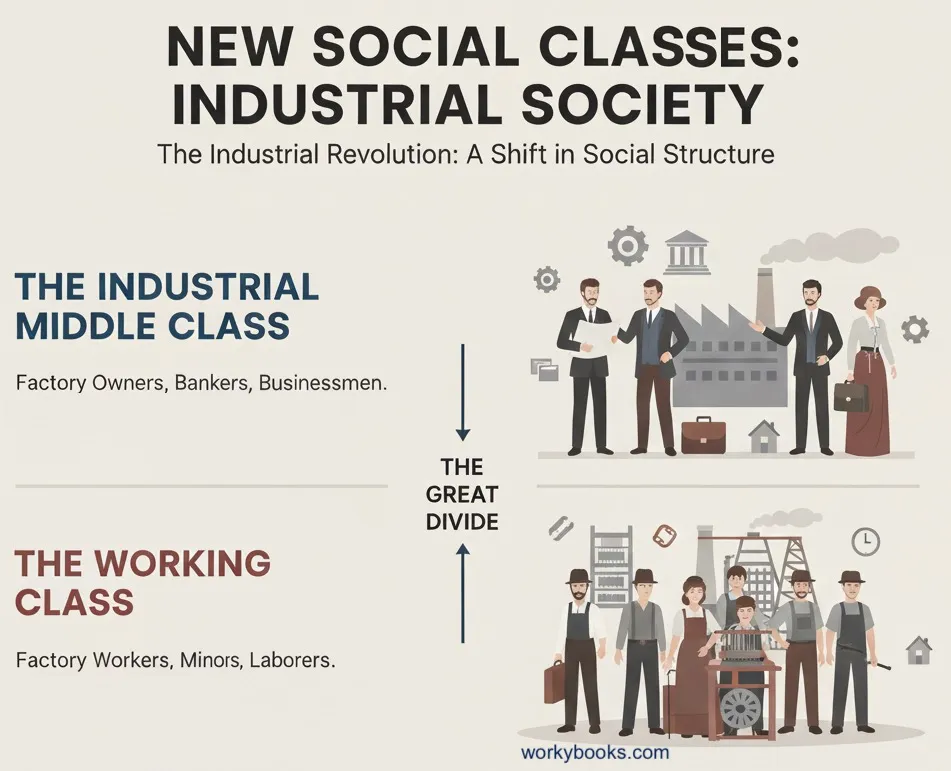
The Industrial Revolution, which began in Great Britain in the late 1700s, led to rapid changes in society, economics, and daily life. One of its most important effects was the creation of new social classes. Before this period, most people in Europe lived in rural areas and worked as farmers or craftspeople. However, as factories and machines became common, millions moved to cities to work in industries.
A major change during the Industrial Revolution was the rise of the industrial middle class. These were people who owned factories, banks, or businesses, and they gained wealth from manufacturing goods. For example, in Manchester and Liverpool, factory owners and merchants built large houses and had lifestyles that were very different from the working poor. Letters from the time, such as those by Elizabeth Gaskell, describe how these wealthy families invested in education and culture, and often influenced local politics. The middle class valued hard work, innovation, and education, which helped shape the new industrial society.
At the same time, a large working class developed. Many of these workers lived in crowded city neighborhoods and worked long hours in factories, mines, or textile mills. Primary sources like the reports from the British Parliament’s Sadler Committee in 1832 reveal harsh conditions: long shifts, low wages, and poor housing. Children and women often worked alongside men, facing similar dangers. Despite these hardships, workers formed communities and sometimes organized to demand better pay or safer conditions. The rise of workers’ associations and early labor unions marked an important step toward greater rights for this group.
These new social classes caused clear divisions in society. The middle class and working class had different experiences, goals, and opportunities. The middle class often had access to better schools and healthier environments, while the working class faced poverty and limited chances to improve their lives. Over time, some reforms were made, such as laws limiting child labor and creating public health systems. These changes were influenced by geography, as industrial cities like Berlin, Manchester, and Lyon grew quickly where coal and waterways were available.
The emergence of new social classes during the Industrial Revolution reshaped the social hierarchy and daily life in Europe and other industrializing regions. Understanding these changes helps us see how economic forces, technology, and geography can transform societies and create lasting impacts on people’s lives.
Interesting Fact: Interesting Fact: In 1842, British factory workers led the world’s first general strike, showing the power of organized labor in industrial society.
Comprehension quiz (8 questions)
1. Where did the Industrial Revolution begin?
2. Which city grew quickly due to factories?
3. Who reported harsh factory conditions in 1832?
4. What caused the rise of new social classes?
5. Why did workers move to cities?
6. How did the middle class differ from the working class?
7. The first general strike was in 1842.
8. What is 'urbanization'?
Perfect for the way you teach
- Build comprehension skills
- Auto-graded quiz
- Differentiated reading
- Read together at home
- Improve fluency
- Quiet reading time
- Reading curriculum support
- Independent practice
- Track Lexile growth