What Are Inherited Traits
Interactive passage with audio narration, comprehension questions, and printable PDF.
By completing this purchase you agree to our Terms of Use and Privacy Policy. Your subscription renews automatically until you cancel. You can cancel anytime from your account settings. All sales are final and non-refundable. Digital content is available for download in your account immediately upon purchase.
What's included
What Are Inherited Traits preview and details
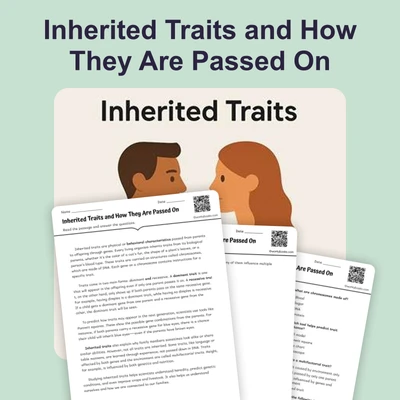
About this printable What Are Inherited Traits science reading passage, NGSS-aligned (Grades 5-8)
Sample passage and quiz from What Are Inherited Traits
Reading passage and comprehension quiz preview
Inherited vs. Acquired Traits
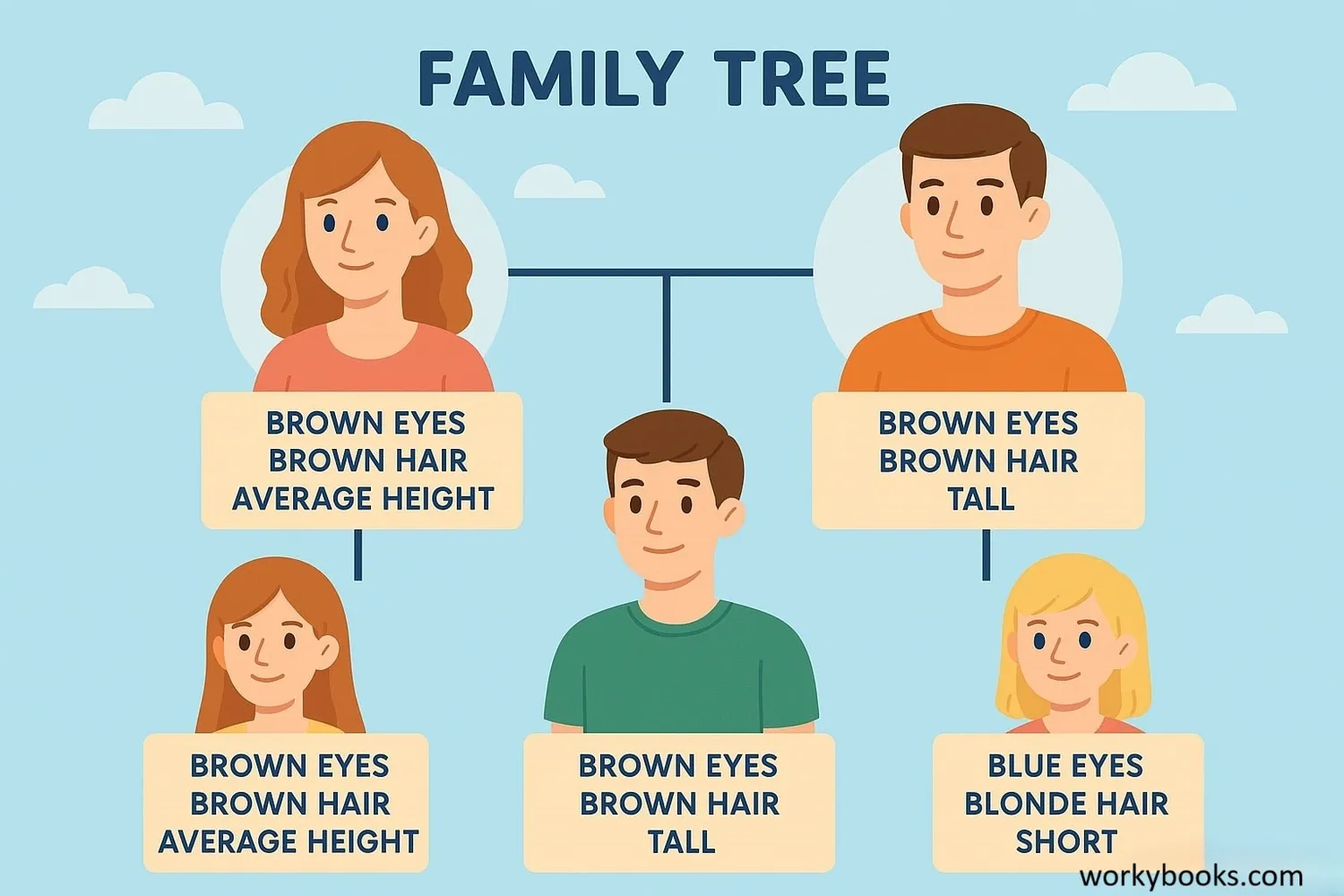
Traits are the characteristics that make each living thing unique. Some traits, like the color of your eyes or the pattern on a tiger’s fur, are passed down from parents to their offspring. These are called inherited traits. Others, like a scar from a cut or the ability to ride a bicycle, develop during an organism's life. These are known as acquired traits. Understanding the difference between inherited and acquired traits helps scientists explain why organisms look and behave the way they do, and how species change over generations.
How Inherited Traits Are Passed Down
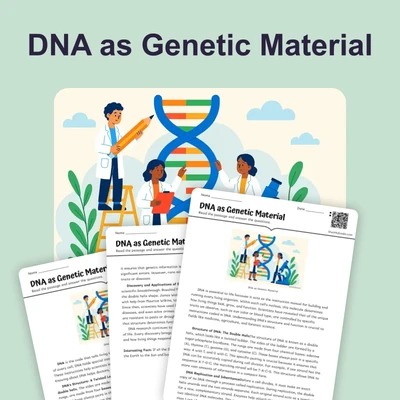
Inherited traits are transmitted from one generation to the next through genes. Genes are segments of DNA, the molecule that carries the instructions for building and operating living things. For example, your blood type, hair texture, and natural eye color all depend on the information stored in your DNA. Each parent contributes half of their genes to their offspring, so you inherit a unique combination. Some inherited traits, like genetic diseases, can be traced to specific changes in DNA. Scientists have discovered that humans share about 99.9% of their DNA, but small differences result in the wide variety of inherited traits we observe.
Acquired Traits: Developed During Life
Acquired traits are not passed down through genes. Instead, they develop as a result of experiences, environment, or learning. For example, if you learn to speak a new language, develop strong muscles from lifting weights, or get a scar from an injury, these are all acquired traits. No matter how skilled a bodybuilder becomes, their children will not inherit large muscles at birth; they will need to exercise to develop them. Similarly, if a dog’s tail is docked, its puppies will still be born with full-length tails. This is because acquired traits do not change the DNA in reproductive cells, so they are not inherited.
Why Acquired Traits Aren’t Inherited: The Role of DNA
In the early 1800s, a scientist named Lamarck mistakenly believed that acquired traits could be passed to offspring. However, modern research has shown that only changes in an organism’s DNA, specifically in the reproductive cells, can be inherited. DNA is like a set of instructions stored in every cell, and only inherited traits are written into this code. Acquired traits, such as learned behaviors or injuries, do not alter the DNA that is passed to the next generation. This fundamental principle explains why the offspring of a bodybuilder or a musician must develop their own skills and abilities.
Understanding the difference between inherited and acquired traits is crucial in genetics, medicine, and conservation. It helps researchers predict how diseases and beneficial traits are passed through populations, and why some changes in organisms must happen over many generations. This knowledge forms the basis for studying evolution, genetic engineering, and heredity.
Interesting Fact: Humans share about 98% of their DNA with chimpanzees, but even a 2% difference leads to huge changes in traits and abilities!
Comprehension quiz (10 questions)
1. What are inherited traits?
2. Which of the following is an example of an acquired trait?
3. How are inherited traits transmitted to offspring?
4. What does DNA do in living things?
5. What is the main reason acquired traits are not inherited?
6. What percentage of DNA do all humans share?
7. What is the main role of genes?
8. If a dog’s tail is cut off, will its puppies be born without tails? (True/False)
9. Children of bodybuilders inherit large muscles at birth. (True/False)
10. Which scientist incorrectly believed acquired traits could be inherited?
Perfect for the way you teach
- Build comprehension skills
- Auto-graded quiz
- Differentiated reading
- Read together at home
- Improve fluency
- Quiet reading time
- Reading curriculum support
- Independent practice
- Track Lexile growth