Islam in West Africa
Interactive passage with audio narration, comprehension questions, and printable PDF.
By completing this purchase you agree to our Terms of Use and Privacy Policy. Your subscription renews automatically until you cancel. You can cancel anytime from your account settings. All sales are final and non-refundable. Digital content is available for download in your account immediately upon purchase.
What's included
Islam in West Africa preview and details
About this printable Islam in West Africa reading passage (Grades 5-8)
Sample passage and quiz from Islam in West Africa
Reading passage and comprehension quiz preview
Islam in West Africa
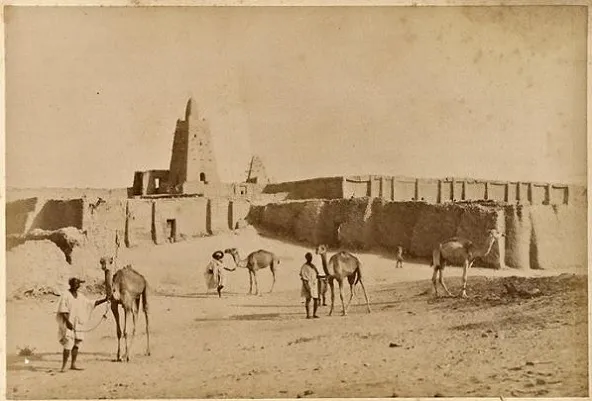
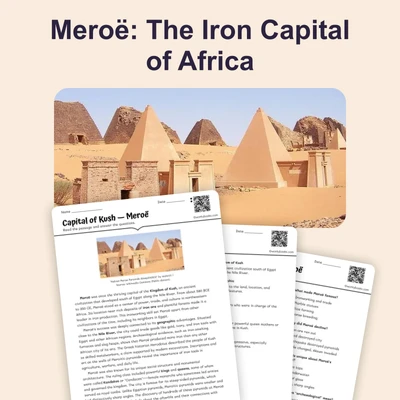
Djinguereber Mosque is one of three ancient centers of learning located in Timbuktu, Mali, Africa. It is part of the ancient University of Timbuktu. Image by Louis Archinard (1850-1932) / Wikimedia Commons
Islam first came to West Africa in the 8th century through trade across the Sahara Desert. Merchants from North Africa brought not only goods like salt and gold, but also new religious ideas. As Islam spread, West Africans found ways to blend the new faith with their own traditions and cultural practices. This process of adaptation allowed Islam to become part of daily life in the region, rather than replacing all local customs.
The growth of powerful empires, such as Ghana, Mali, and Songhai, played a major role in the spread of Islam. In the empire of Mali, which reached its height in the 14th century under the rule of Mansa Musa, Islam was embraced by the royal family and the urban elite. Mansa Musa, who ruled from 1312 to 1337, became famous for his pilgrimage to Mecca in 1324. He built many mosques, like the Djinguereber Mosque in Timbuktu, which remains a symbol of West African Islamic architecture. However, even as rulers supported Islam, many rural communities continued to practice traditional religions alongside Islamic beliefs.
West Africans adapted Islamic practices to fit their own needs. For example, while the Quran was written in Arabic, West Africans often used their native languages in prayers and ceremonies. Storytellers known as griots continued to play a central role in society, preserving oral histories and teaching moral lessons. Islamic law, or sharia, was sometimes combined with local customs when settling disputes. Scholars and archaeologists have found evidence of this blending in manuscripts from Timbuktu and in local family traditions recorded by griots.
One of the most important effects of Islam’s arrival was the spread of literacy and new forms of learning. Timbuktu became a famous center for Islamic scholarship, attracting students from across Africa. The use of Arabic script allowed West Africans to record history, trade, and poetry in new ways. At the same time, traditional art, music, and social structures continued, showing the continuity of local culture even as new religious ideas took root.
The adaptation of Islam in West Africa shows how religions can change as they move between different regions and cultures. By blending Islam with their own customs, West Africans created a unique form of religious life that reflected both local heritage and global connections.
This example connects to the broader theme of cultural diffusion and adaptation in world history, showing how people shape and are shaped by global influences.
Interesting Fact: The city of Timbuktu once had over 180 Islamic schools and libraries, making it a leading center of learning in the 15th century.
Comprehension quiz (8 questions)
1. Who brought Islam to West Africa?
2. Which empire peaked under Mansa Musa?
3. What is a griot?
4. How did Islam affect education in West Africa?
5. Why did West Africans adapt Islam?
6. What shows continuity in West Africa?
7. Timbuktu became a learning center.
8. What is 'adaptation'?
Perfect for the way you teach
- Build comprehension skills
- Auto-graded quiz
- Differentiated reading
- Read together at home
- Improve fluency
- Quiet reading time
- Reading curriculum support
- Independent practice
- Track Lexile growth