Jamestown Colony and Tobacco — Reading Comprehension
Rate this
Premium Resource
Present
Present in classroom. No work saved
Assign
Classroom with student accounts, Track progress
Quick Play
No student accounts, assign with a link
Grades
6
7
8
Standards
D2.HIS.2.3-5
D2.HIS.3.3-5
RI.4.3
RI.4.4
W.4.2
PRINT+DIGITAL RESOURCE
This learning resource is available in interactive and printable formats. The interactive worksheet can be played online and assigned to students. The Printable PDF version can be downloaded and printed for completion by hand.
This rigorous U.S. History reading passage explores the founding and development of the Jamestown Colony with a focus on the immense survival challenges faced by English colonists and the transformation brought by the tobacco economy. Students analyze multiple perspectives, including those of colonists and the Powhatan people, and examine causes, motivations, and consequences of key events. The content incorporates disciplinary vocabulary, a primary source excerpt, and encourages historical reasoning. Activities include a comprehension quiz, writing prompts, a T-Chart graphic organizer, and a timeline. This passage aligns with C3 Framework and Common Core ELA standards. Read aloud audio and a Spanish translation are provided to support diverse learners and bilingual classrooms. Ideal for developing historical analysis and critical thinking skills.
CONTENT PREVIEW
Expand content preview
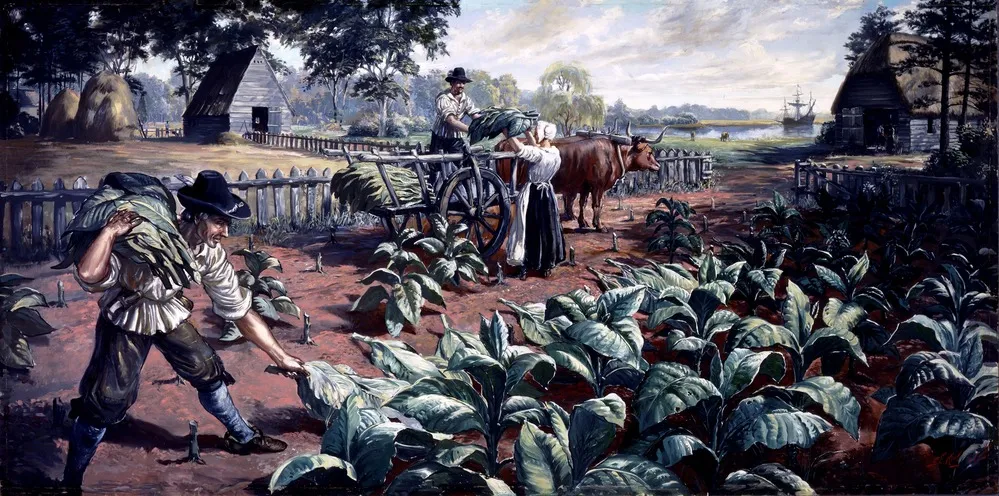
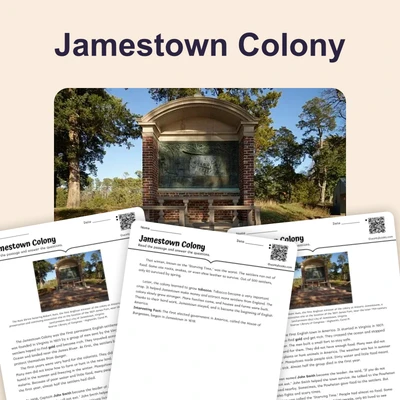
"Tobacco Farming" by Sidney E. King. Source: Wikimedia Commons (Public domain).
In 1607, a group of English settlers established the Jamestown colony in Virginia, hoping to find wealth and new opportunities. However, the early years were filled with hardship. Many colonists died from disease, hunger, and conflicts with local Native American groups. The colony struggled to survive, and its future was uncertain. Leaders and colonists had to make difficult choices to keep the settlement alive.
One major problem was the lack of profitable exports. The colonists needed a cash crop—a plant grown to be sold for money—to support themselves and to pay back investors in England. Early attempts to grow crops like silk and grapes failed. The colony’s leaders searched for a solution that would provide economic stability and growth.
The solution came when John Rolfe, a colonist, brought a new type of tobacco seed from the Caribbean in 1612. This tobacco was milder and more appealing to European tastes than the local varieties. Soon, tobacco became Jamestown’s main export. The demand for Virginia tobacco in Europe soared, creating profit for the colony and attracting more settlers seeking fortune.
However, growing tobacco required large amounts of land and labor. Colonists began clearing forests and establishing plantations—large farms focused on one main crop. To work these plantations, colonists first relied on indentured servants, who agreed to work for a certain number of years in exchange for passage to America. Over time, as the tobacco industry expanded, colonists turned increasingly to enslaved Africans to meet labor demands. This shift laid the foundation for a society deeply divided by race and class for centuries.
Tobacco’s success also had environmental and social consequences. The crop quickly exhausted the soil, pushing settlers to seek new land, often leading to new conflicts with Native Americans. The pursuit of profit sometimes led to harsh treatment of workers and increased tensions between different groups in the colony. Still, tobacco’s profitability allowed Jamestown to grow into a permanent English settlement and influenced the development of the Southern colonies.
Historians use the story of Jamestown and tobacco to understand the complexities of colonial America. The colony’s survival depended on adaptation and innovation, but also caused long-lasting social and environmental changes. Through the rise of the tobacco economy, the roots of plantation agriculture and the system of forced labor were established, shaping the region’s history for generations.
Interesting Fact: In 1614, John Rolfe married Pocahontas, the daughter of Powhatan, which helped bring temporary peace between English settlers and Native Americans.
When was Jamestown founded?
1607162016121700
Who brought tobacco seeds to Jamestown?
John RolfeJohn SmithPocahontasPowhatan
What was Jamestown's main export?
TobaccoCornSilkGrapes
Why did Jamestown need a cash crop?
To earn money and surviveTo fight Native AmericansTo build shipsTo make laws
How did tobacco farming affect the environment?
It exhausted the soilIt made soil richerIt stopped conflictsIt grew forests
What new demand did tobacco create?
LaborGoldSilkHorses
John Rolfe married Pocahontas. True or false?
TrueFalse
What is a plantation?
Large farm for one cropSmall villageShip's cabinTrading post
Perfect For:
👩🏫 Teachers
• Reading comprehension practice
• Auto-graded assessments
• Literacy skill development
👨👩👧👦 Parents
• Reading practice at home
• Comprehension improvement
• Educational reading time
🏠 Homeschoolers
• Reading curriculum support
• Independent reading practice
• Progress monitoring
Reading Features:
📖
Reading Passage
Engaging fiction or nonfiction text
❓
Comprehension Quiz
Auto-graded questions
📊
Instant Feedback
Immediate results and scoring
📄
Printable Version
Download for offline reading
🔊
Read Aloud
Voice-over with word highlighting
Reviews & Ratings
No reviews yet. Be the first to share your experience!
Related Content
Native American Tribes Across America
This engaging history reading passage introduces students to Native American tribes across America, focusing on their da...
D2.HIS.1.3-5D2.HIS.2.3-5RI.4.1RI.4.2
Teepees: Homes on the Great Plains
This engaging history reading passage introduces students to teepees, the unique homes of Native American tribes on the ...
D2.HIS.2.3-5D2.HIS.14.3-5RI.4.1RI.4.2RI.4.4
Traditional Native American Clothing
This engaging history passage explores traditional Native American clothing and how it reflected the environment, values...
D2.HIS.2.3-5D2.HIS.3.3-5RI.4.3RI.4.4
The Iroquois Confederacy: A System of Peace
This engaging U.S. History reading passage introduces students to the Iroquois Confederacy, a powerful alliance of Nativ...
D2.HIS.2.3-5D2.HIS.3.3-5RI.4.3RI.4.4
The Cherokee Nation: History and Culture
This reading passage explores the rich history and culture of the Cherokee Nation, one of the largest Native American tr...
D2.HIS.2.3-5D2.HIS.14.3-5RI.4.3RI.4.4RI.4.10
The Sioux: Warriors and Tribal Leaders
This history reading passage explores the Sioux Nation, focusing on their roles as warriors and tribal leaders. Students...
D2.HIS.1.3-5D2.HIS.2.3-5RI.4.1RI.4.3
Native American Respect for Nature
This engaging history reading passage explores Native American respect for nature, emphasizing the close relationship be...
D2.HIS.2.3-5D2.HIS.3.3-5RI.4.3RI.4.4
Jamestown: The First Permanent English Colony
This engaging history passage explores the founding of Jamestown, the first permanent English colony in America. Aligned...
D2.HIS.1.3-5D2.HIS.2.3-5RI.4.3RI.4.4
Pocahontas and the Powhatan People
This engaging reading passage explores the life of Pocahontas and the Powhatan people and their important role in early ...
D2.HIS.1.3-5D2.HIS.2.3-5RI.4.1RI.4.3
Colonial Children: School and Chores
This reading passage explores the daily lives of colonial children, focusing on their experiences at school and their ma...
D2.HIS.2.3-5D2.HIS.3.3-5RI.4.1RI.4.2RI.4.4
Colonial Clothing and Homemade Goods
This engaging U.S. history passage explores the daily life of early American colonists with a focus on colonial clothing...
D2.HIS.2.3-5RI.4.3RI.4.4
Colonial Jobs: Blacksmiths, Bakers, and Craftsmen
This engaging history reading passage explores the vital roles of blacksmiths, bakers, and craftsmen in colonial America...
D2.HIS.2.3-5D2.HIS.3.3-5RI.4.3RI.4.4
Colonial Towns and Village Life
This engaging history reading passage explores the daily life, work, and unity found in colonial towns and villages. Ali...
D2.HIS.1.3-5D2.HIS.2.3-5RI.4.3RI.4.4
Colonial Trade with England and Africa
This history reading passage explores colonial trade between the American colonies, England, and Africa, focusing on the...
D2.HIS.2.3-5D2.HIS.14.3-5RI.4.3RI.4.4
Benjamin Franklin: Printer, Inventor, and Leader
This history reading passage explores the life and achievements of Benjamin Franklin, one of America's most important ea...
D2.HIS.2.3-5D2.HIS.3.3-5RI.4.1RI.4.3
George Washington Leads the Army
This engaging history reading passage explores how George Washington bravely led the Continental Army during the America...
D2.HIS.1.3-5D2.HIS.2.3-5RI.4.3RI.4.4
Women and Children During the Revolutionary War
This reading passage explores the important roles women and children played during the Revolutionary War. Students will ...
D2.HIS.2.3-5RI.4.3RI.5.3
African Americans Fight for Freedom
This educational passage explores the brave and inspiring story of how African Americans fought for freedom in the Unite...
D2.HIS.2.3-5D2.HIS.3.3-5RI.4.3RI.4.4
The Battle of Yorktown Ends War
This engaging U.S. history reading passage explores the Battle of Yorktown, a key event that ended the American Revoluti...
D2.HIS.1.3-5D2.HIS.2.3-5RI.4.1RI.4.3
Loyalists vs. Patriots: Divided Families
This engaging U.S. history reading passage explores the division between Loyalists and Patriots during the American Revo...