This learning resource is available in interactive and printable formats. The interactive worksheet can be played online and assigned to students. The Printable PDF version can be downloaded and printed for completion by hand.
This comprehensive history reading passage explores the forced relocation and internment of over 120,000 Japanese Americans during World War II. Aligned to HSS 11.7.5 and CCSS.RI.6-8.1, RI.6-8.6, the passage provides students with a nuanced understanding of the U.S. government's decision, the impact on civil liberties, and the personal experiences of those affected. The text supports critical thinking by modeling historical reasoning and evidence analysis. In addition to the main passage, the resource includes a glossary of key academic vocabulary, a simplified differentiated version, and full Spanish translations for accessibility. Students can engage with multiple-choice and writing activities, as well as graphic organizers and a timeline to deepen comprehension. Read aloud audio and visually supported content make this resource ideal for diverse learners studying U.S. and world history.
CONTENT PREVIEW
Expand content preview
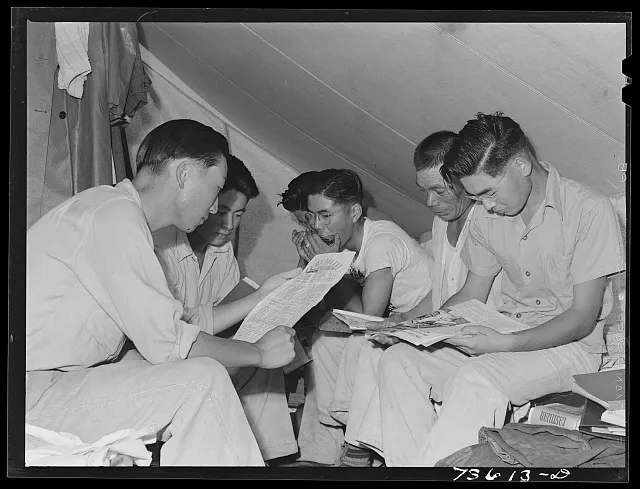
"Nyssa, Oregon. FSA (Farm Security Administration) mobile camp. Japanese-Americans who live at the camp" by Lee, Russell, 1903-1986 / Library of Congress.
The United States government established internment camps during World War II, forcing over 120,000 Japanese Americans to leave their homes. This relocation affected families, businesses, and entire communities, mostly along the West Coast. The government argued that removing people of Japanese ancestry was necessary for national security after the attack on Pearl Harbor in 1941. However, more than two-thirds of those sent to camps were American citizens, raising serious questions about civil liberties and constitutional rights.
President Franklin D. Roosevelt signed Executive Order 9066 in February 1942. This order gave the military the power to designate certain areas as off-limits and to remove anyone considered a threat. As a result, Japanese Americans were given only days or weeks to sell their property and pack what they could carry. They were transported by train or bus to remote facilities surrounded by barbed wire and guarded by soldiers. Conditions varied, but many camps were located in desolate areas with harsh weather.
Inside the camps, families lived in cramped barracks. Privacy was limited, and basic necessities such as food and medical care were often in short supply. Despite these hardships, Japanese Americans tried to maintain a sense of normalcy. They organized schools, newspapers, and community events. Children continued their education and adults took up jobs within the camp. These efforts demonstrated resilience and a strong sense of community.
The government justified the internment as a wartime measure to prevent espionage or sabotage. However, there was little evidence that Japanese Americans posed a real threat to national security. Many historians now consider the decision to be driven by fear, prejudice, and political pressure rather than solid evidence. The Supreme Court upheld the policy at the time, but later investigations recognized the injustice and violation of rights.
After the war ended in 1945, the camps were closed and Japanese Americans were allowed to return home. Unfortunately, many had lost their property, jobs, and savings. In 1988, the U.S. government formally apologized and provided reparations to surviving internees. This act recognized the harm caused and the importance of protecting civil liberties, even during times of crisis.
Studying Japanese internment camps helps us understand the challenges of balancing national security with individual rights. It serves as a reminder that fear and discrimination can lead to unjust policies, and that protecting civil liberties remains a crucial part of democracy.
Interesting Fact: The largest internment camp, Tule Lake, held nearly 19,000 people at its peak—almost the size of a small city.
What year did internment begin?
1942192919391988
Who signed Executive Order 9066?
Franklin D. RooseveltAbraham LincolnHarry TrumanGeorge Washington
How many Japanese Americans were interned?
Over 120,000About 10,000About 1,000Over 500,000
Why were the camps created?
Wartime security fearsEconomic reasonsTo teach EnglishFor fun
What was a major effect on Japanese Americans?
Lost homes and jobsBecame soldiersMoved to JapanGot rich
What does 'civil liberties' mean?
Legal rights and freedomsMilitary uniformsWeather patternsFood supplies
Most internees were American citizens. True or false?
TrueFalse
What does 'internment' mean?
Being confined by the governmentGetting a new jobMoving by choiceVoting in elections
Perfect For:
👩🏫 Teachers
• Reading comprehension practice
• Auto-graded assessments
• Literacy skill development
👨👩👧👦 Parents
• Reading practice at home
• Comprehension improvement
• Educational reading time
🏠 Homeschoolers
• Reading curriculum support
• Independent reading practice
• Progress monitoring
Reading Features:
📖
Reading Passage
Engaging fiction or nonfiction text
❓
Comprehension Quiz
Auto-graded questions
📊
Instant Feedback
Immediate results and scoring
📄
Printable Version
Download for offline reading
🔊
Read Aloud
Voice-over with word highlighting
Reviews & Ratings
No reviews yet. Be the first to share your experience!
Related Content
Native American Tribes Across America
This engaging history reading passage introduces students to Native American tribes across America, focusing on their da...
D2.HIS.1.3-5D2.HIS.2.3-5RI.4.1RI.4.2
Teepees: Homes on the Great Plains
This engaging history reading passage introduces students to teepees, the unique homes of Native American tribes on the ...
D2.HIS.2.3-5D2.HIS.14.3-5RI.4.1RI.4.2RI.4.4
Traditional Native American Clothing
This engaging history passage explores traditional Native American clothing and how it reflected the environment, values...
D2.HIS.2.3-5D2.HIS.3.3-5RI.4.3RI.4.4
The Iroquois Confederacy: A System of Peace
This engaging U.S. History reading passage introduces students to the Iroquois Confederacy, a powerful alliance of Nativ...
D2.HIS.2.3-5D2.HIS.3.3-5RI.4.3RI.4.4
The Cherokee Nation: History and Culture
This reading passage explores the rich history and culture of the Cherokee Nation, one of the largest Native American tr...
D2.HIS.2.3-5D2.HIS.14.3-5RI.4.3RI.4.4RI.4.10
The Sioux: Warriors and Tribal Leaders
This history reading passage explores the Sioux Nation, focusing on their roles as warriors and tribal leaders. Students...
D2.HIS.1.3-5D2.HIS.2.3-5RI.4.1RI.4.3
Native American Respect for Nature
This engaging history reading passage explores Native American respect for nature, emphasizing the close relationship be...
D2.HIS.2.3-5D2.HIS.3.3-5RI.4.3RI.4.4
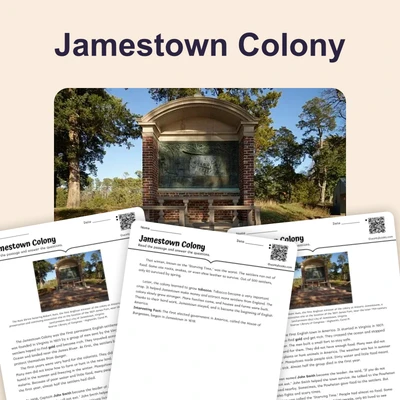
Jamestown: The First Permanent English Colony
This engaging history passage explores the founding of Jamestown, the first permanent English colony in America. Aligned...
D2.HIS.1.3-5D2.HIS.2.3-5RI.4.3RI.4.4
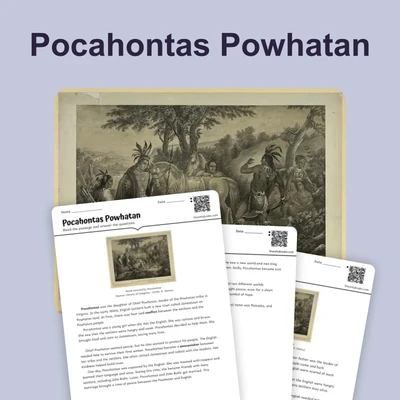
Pocahontas and the Powhatan People
This engaging reading passage explores the life of Pocahontas and the Powhatan people and their important role in early ...
D2.HIS.1.3-5D2.HIS.2.3-5RI.4.1RI.4.3
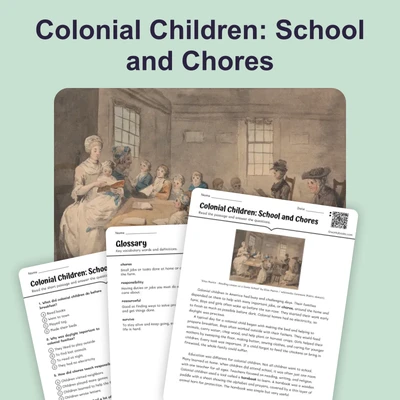
Colonial Children: School and Chores
This reading passage explores the daily lives of colonial children, focusing on their experiences at school and their ma...
D2.HIS.2.3-5D2.HIS.3.3-5RI.4.1RI.4.2RI.4.4
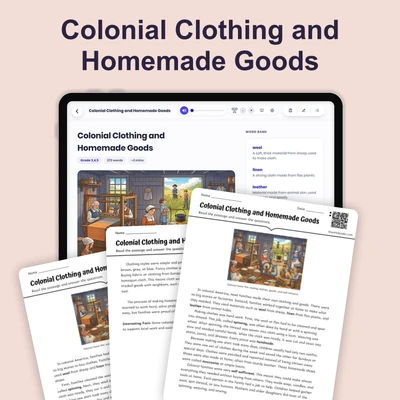
Colonial Clothing and Homemade Goods
This engaging U.S. history passage explores the daily life of early American colonists with a focus on colonial clothing...
D2.HIS.2.3-5RI.4.3RI.4.4
Colonial Jobs: Blacksmiths, Bakers, and Craftsmen
This engaging history reading passage explores the vital roles of blacksmiths, bakers, and craftsmen in colonial America...
D2.HIS.2.3-5D2.HIS.3.3-5RI.4.3RI.4.4
Colonial Towns and Village Life
This engaging history reading passage explores the daily life, work, and unity found in colonial towns and villages. Ali...
D2.HIS.1.3-5D2.HIS.2.3-5RI.4.3RI.4.4
Colonial Trade with England and Africa
This history reading passage explores colonial trade between the American colonies, England, and Africa, focusing on the...
D2.HIS.2.3-5D2.HIS.14.3-5RI.4.3RI.4.4
Benjamin Franklin: Printer, Inventor, and Leader
This history reading passage explores the life and achievements of Benjamin Franklin, one of America's most important ea...
D2.HIS.2.3-5D2.HIS.3.3-5RI.4.1RI.4.3
George Washington Leads the Army
This engaging history reading passage explores how George Washington bravely led the Continental Army during the America...
D2.HIS.1.3-5D2.HIS.2.3-5RI.4.3RI.4.4
Women and Children During the Revolutionary War
This reading passage explores the important roles women and children played during the Revolutionary War. Students will ...
D2.HIS.2.3-5RI.4.3RI.5.3
African Americans Fight for Freedom
This educational passage explores the brave and inspiring story of how African Americans fought for freedom in the Unite...
D2.HIS.2.3-5D2.HIS.3.3-5RI.4.3RI.4.4
The Battle of Yorktown Ends War
This engaging U.S. history reading passage explores the Battle of Yorktown, a key event that ended the American Revoluti...
D2.HIS.1.3-5D2.HIS.2.3-5RI.4.1RI.4.3
Loyalists vs. Patriots: Divided Families
This engaging U.S. history reading passage explores the division between Loyalists and Patriots during the American Revo...