John D Rockefeller: Standard Oil Monopoly
Interactive passage with audio narration, comprehension questions, and printable PDF.
By completing this purchase you agree to our Terms of Use and Privacy Policy. Your subscription renews automatically until you cancel. You can cancel anytime from your account settings. All sales are final and non-refundable. Digital content is available for download in your account immediately upon purchase.
What's included
John D Rockefeller: Standard Oil Monopoly preview and details
About this printable John D Rockefeller: Standard Oil Monopoly reading passage (Grades 6-8)
Sample passage and quiz from John D Rockefeller: Standard Oil Monopoly
Reading passage and comprehension quiz preview
John D. Rockefeller: Standard Oil Monopoly
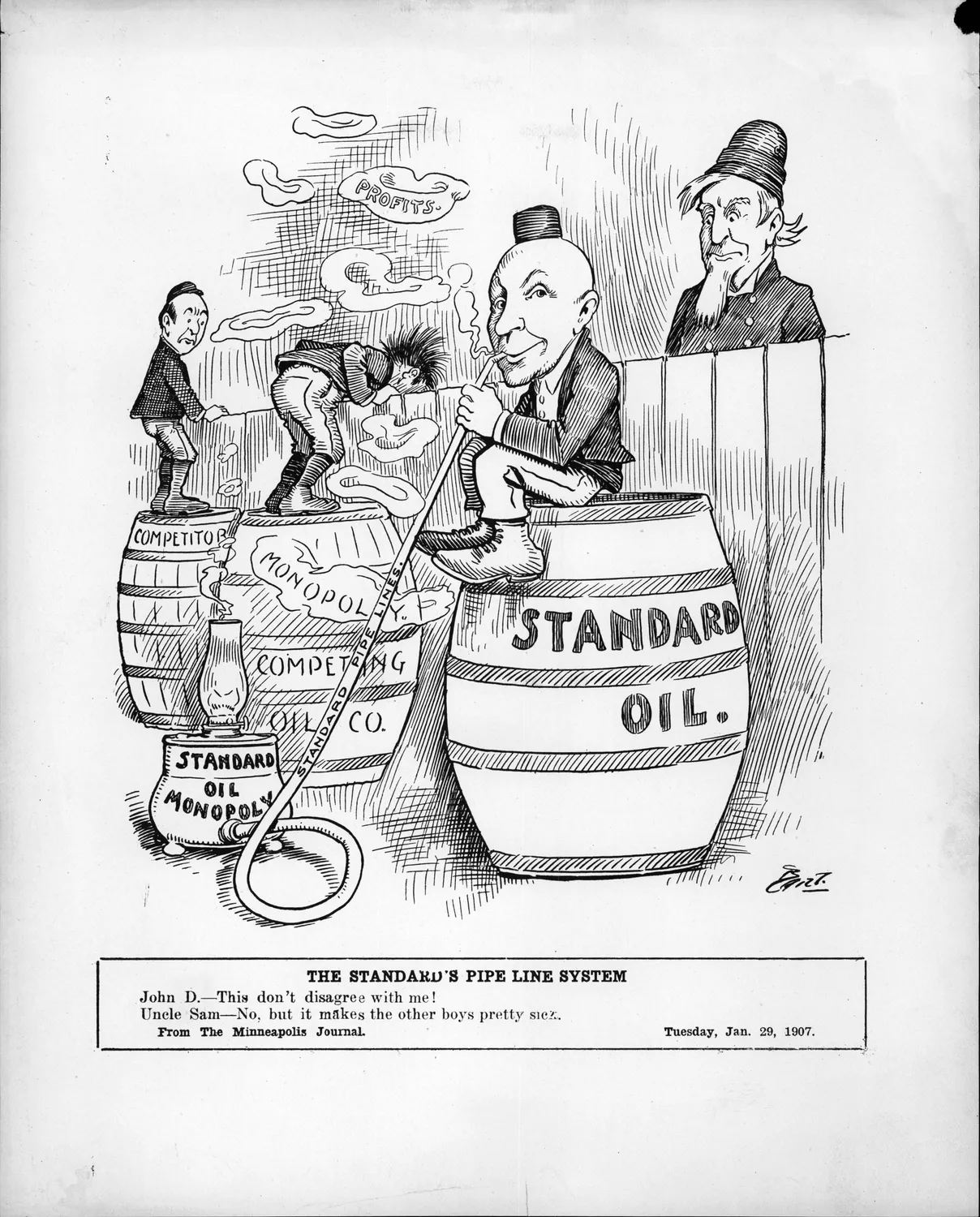
"The Standard's Pipe Line System - DPLA - 3a54d77cff3ff64144101dfe23dcc278" by Bartholomew, Charles Lewis 'Bart', 1869-1949.
Source: Wikimedia Commons (Public domain)
John D. Rockefeller was a leading figure in American business during the late 1800s and early 1900s. He founded the Standard Oil Company, which became the largest oil refining business in the United States. By the 1880s, Standard Oil controlled over 90% of American oil refining, making it a powerful monopoly. Rockefeller's business methods, including consolidation of smaller companies and market control, changed how businesses operated in the United States.
Standard Oil's success was not only due to its size but also to its efficiency and organization. Rockefeller used new technologies to make oil refining cheaper and faster. He also made deals with railroads for lower shipping rates, giving Standard Oil an advantage over competitors. This allowed the company to lower prices and drive rivals out of business. As a result, Standard Oil became a trust, a form of business organization where a single group holds control over many companies.
However, Standard Oil's practices raised concerns about competition and fairness. Many Americans worried that monopolies like Standard Oil hurt small businesses and limited choices for consumers. Critics argued that too much market control allowed companies to set high prices once their competitors were gone. Some believed that the government needed to regulate large corporations to protect the public and encourage fair competition.
The government responded with new laws, such as the Sherman Antitrust Act of 1890. This law aimed to prevent monopolies and promote competition. In 1911, after years of legal battles, the U.S. Supreme Court decided that Standard Oil had violated antitrust laws. The Court ordered the company to break up into smaller, independent companies. This decision changed the future of American business and set important legal precedents for how the government could regulate big corporations.
Rockefeller's legacy is complex. On one hand, he helped create a modern oil industry and made products like kerosene affordable for many people. On the other hand, his methods led to debates about the limits of business power and the need for government rules. The controversy over Standard Oil showed that the rise of big business brought both progress and new challenges for American society.
Interesting Fact: At its peak, Standard Oil was so powerful that it influenced the price of oil around the world, not just in the United States.
Comprehension quiz (8 questions)
1. Who founded Standard Oil?
2. What industry did Standard Oil dominate?
3. What law broke up Standard Oil?
4. How did Rockefeller lower costs?
5. Why were monopolies a problem?
6. What was an effect of the Supreme Court decision in 1911?
7. Standard Oil controlled over 90% of oil refining.
8. What is a monopoly?
Common Core standards for John D Rockefeller: Standard Oil Monopoly
Explain events, procedures, ideas, or concepts in a historical, scientific, or technical text, including what happened and why, based on specific information in the text.
Determine the meaning of general academic and domain-specific words or phrases in a text relevant to a grade 4 topic or subject area.
Write informative/explanatory texts to examine a topic and convey ideas and information clearly.
Perfect for the way you teach
- Build comprehension skills
- Auto-graded quiz
- Differentiated reading
- Read together at home
- Improve fluency
- Quiet reading time
- Reading curriculum support
- Independent practice
- Track Lexile growth