Labor Unions in America
Interactive passage with audio narration, comprehension questions, and printable PDF.
What's included
Labor Unions in America preview and details
About this printable Labor Unions in America reading passage (Grades 6-8)
Sample passage and quiz from Labor Unions in America
Reading passage and comprehension quiz preview
Labor Unions in America
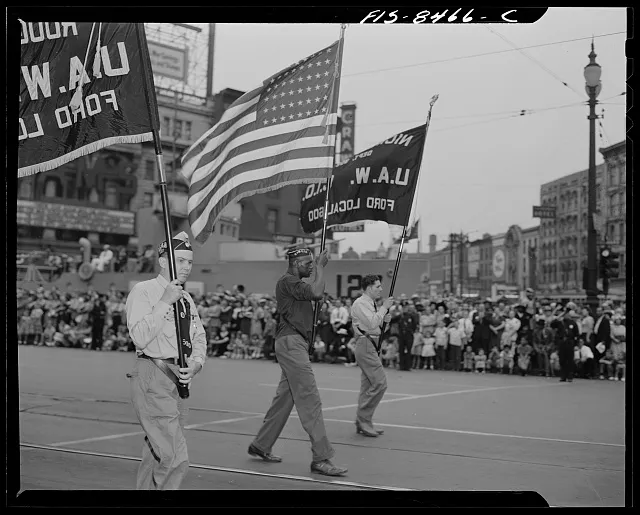
Source: Library of Congress - Siegel, Arthur S.
During the Progressive Era, labor unions became a powerful force in shaping American society. As factories and industries grew in the late 1800s, millions of workers faced difficult conditions. Many worked long hours in dangerous environments for low wages. Factory owners often put profit before worker safety, and children sometimes labored alongside adults. These problems caused workers to seek ways to improve their lives.
One important solution was for workers to organize into unions. A union is a group of workers who join together to fight for better conditions. By acting together, workers increased their collective power. This made it harder for employers to ignore their demands. Through collective bargaining, union leaders would negotiate with company owners about pay, hours, and safety rules. If talks failed, unions could call a strike, where workers refused to work until their demands were heard.
The fight for labor rights was not easy. Factory owners and government leaders often opposed unions. Some companies hired strikebreakers or even the police to stop strikes. Workers risked losing their jobs or being hurt during protests. Despite these dangers, unions such as the American Federation of Labor (AFL) and the Industrial Workers of the World (IWW) grew in size and influence. Union members used their unity to push for new laws and workplace protections.
Throughout the early 1900s, unions achieved important victories. They helped create laws that limited child labor, set minimum wages, and required safer workplaces. The process of negotiation meant workers and employers had to listen to each other and find compromise. Over time, union struggles led to the idea that workers deserved fair treatment and a voice in how their workplaces were run.
Labor unions changed American society by giving workers the ability to demand rights they could not win alone. The history of unions also shows the challenges of balancing different interests in a growing industrial nation. The legacy of the Progressive Era can still be seen today in labor laws and workplace standards that protect millions of Americans.
Interesting Fact: In 1886, over 300,000 workers across the United States went on strike on May 1st, a day now celebrated as International Workers’ Day in many countries.
Comprehension quiz (8 questions)
1. What is a labor union?
2. When did over 300,000 workers strike?
3. What did unions use to reach agreements?
4. Why did workers organize?
5. How did employers sometimes react to strikes?
6. What was a major result of unions?
7. Labor unions only helped factory owners. True or false?
8. What does 'negotiate' mean?
Common Core standards for Labor Unions in America
Explain events, procedures, ideas, or concepts in a historical, scientific, or technical text, including what happened and why, based on specific information in the text.
Determine the meaning of general academic and domain-specific words or phrases in a text relevant to a grade 4 topic or subject area.
Write informative/explanatory texts to examine a topic and convey ideas and information clearly.
Perfect for the way you teach
- Build comprehension skills
- Auto-graded quiz
- Differentiated reading
- Read together at home
- Improve fluency
- Quiet reading time
- Reading curriculum support
- Independent practice
- Track Lexile growth