Layers of Our Planet's Biosphere — Reading Comprehension
Rate this
Premium Resource
Present
Present in classroom. No work saved
Assign
Classroom with student accounts, Track progress
Quick Play
No student accounts, assign with a link
Grades
6
PRINT+DIGITAL RESOURCE
This learning resource is available in interactive and printable formats. The interactive worksheet can be played online and assigned to students. The Printable PDF version can be downloaded and printed for completion by hand.
This educational content features an audio-integrated reading passage titled 'Layers of Our Planet's Biosphere,' designed for a Grade 6 reading level. It explores how the biosphere, the region of Earth where life exists, interacts with the geosphere (land), hydrosphere (water), and atmosphere (air). Students will learn about the different components of the biosphere, such as ecosystems and habitats, and understand their vital roles in supporting life. The passage includes key terms like photosynthesis and biodiversity, explained in simple language. Aligned with NGSS 5-ESS2-1, it helps students develop a model to describe ways Earth's systems interact. The content includes multiple-choice questions, a glossary, and short answer questions to reinforce learning about Earth's interconnected systems and the importance of the biosphere.
CONTENT PREVIEW
Expand content preview
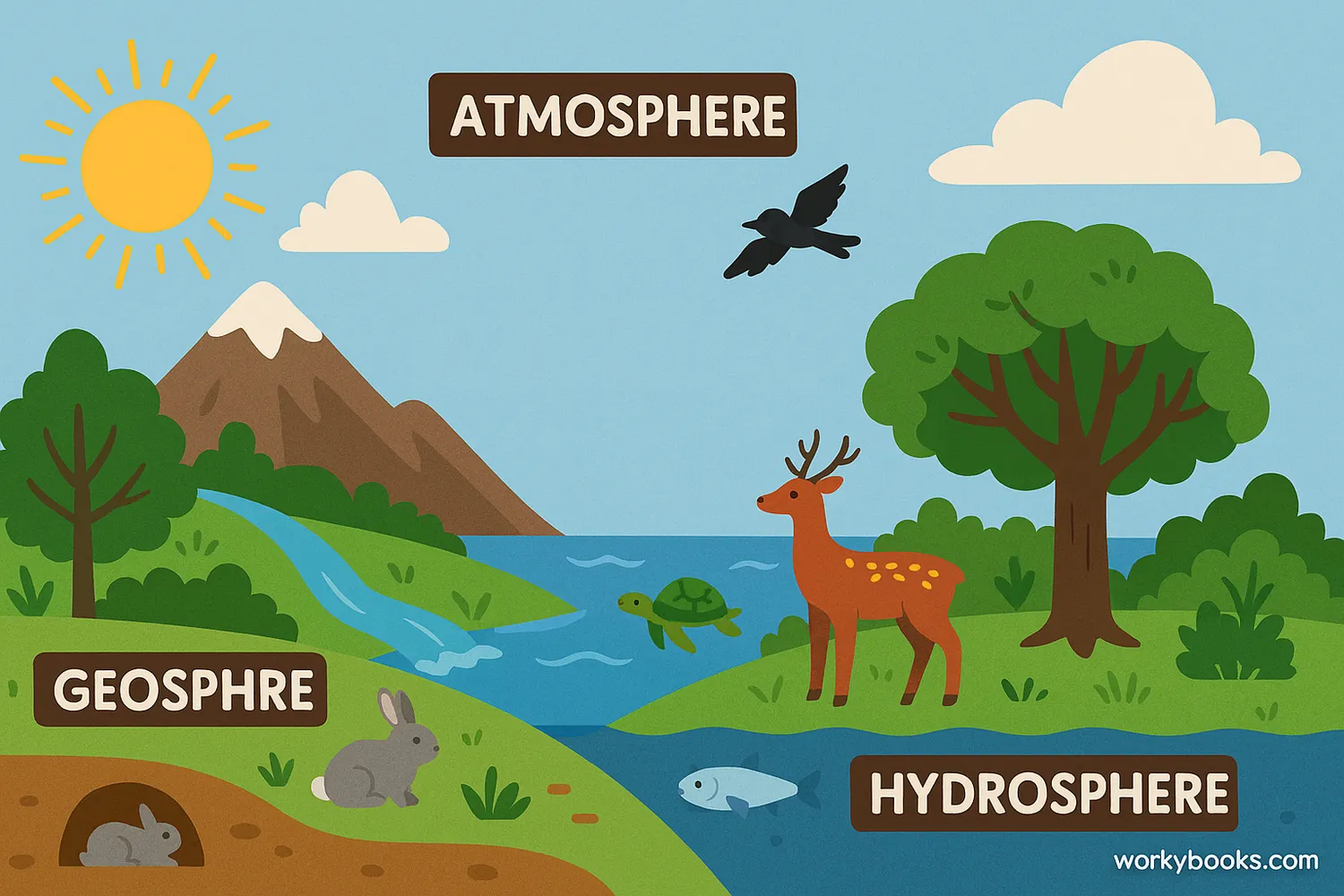
Biosphere and Earth systems shown through forests, oceans, sky, and soil with living organisms.
Have you ever wondered where all living things on Earth live? They live in the biosphere! The biosphere is the part of Earth where life exists. It's like a thin blanket around our planet, extending from the deepest oceans to high in the sky. This incredible layer is where all ecosystems are found, from dense forests to vast deserts.
The biosphere isn't just one solid layer; it's a collection of many different habitats where plants, animals, and microorganisms thrive. Think of a rainforest, a coral reef, or even your backyard – these are all parts of the biosphere. All living things need energy to survive. Most of this energy comes from the sun. Plants use sunlight in a process called photosynthesis to create their own food, forming the base of many food chains.
The biosphere doesn't exist alone. It constantly interacts with three other major Earth systems: the geosphere, the hydrosphere, and the atmosphere. The geosphere is the solid part of Earth, including rocks, soil, and mountains. Plants grow in soil, and animals dig burrows in the ground. This shows how the biosphere uses the geosphere for shelter and nutrients. For example, decomposers like bacteria and fungi in the soil break down dead plants and animals, returning nutrients to the geosphere.
The hydrosphere is all the water on Earth – oceans, rivers, lakes, and even water vapor in the air. Water is essential for all life. Fish live in water, and plants absorb water through their roots. Animals drink water to survive. The water cycle, a key part of the hydrosphere, moves water through the biosphere, affecting everything from plant growth to animal migration patterns.
Finally, the atmosphere is the layer of gases surrounding Earth. It contains the air we breathe, including oxygen, which is vital for most living things. Plants take in carbon dioxide from the atmosphere for photosynthesis, releasing oxygen back into the air. The atmosphere also protects the biosphere from harmful radiation from the sun and helps regulate Earth's temperature. These interactions are crucial for maintaining biodiversity, the variety of life on Earth.
Understanding how the biosphere interacts with the geosphere, hydrosphere, and atmosphere helps us appreciate the delicate balance of our planet. Every part plays a role in supporting the amazing diversity of life.
Interesting Fact: The deepest known part of the biosphere is in the Mariana Trench, over 11,000 meters deep, where unique life forms thrive under immense pressure and in complete darkness!
What is the biosphere?
Part of Earth with lifeAll rocks on EarthGases around EarthWater on Earth
Essential for all lifeOnly for fishOnly for plantsMainly for rocks
What would happen without photosynthesis?
Less food for lifeMore oxygenMore carbon dioxideMore water
The biosphere only includes land animals. (True/False)
FalseTrue
What does 'biodiversity' mean?
Variety of life on EarthSame types of animalsOnly plants in an areaOnly water animals
How does human activity, like building homes, impact the interaction between the biosphere and geosphere?
Changes habitats, alters landIncreases water supplyAdds gases to atmosphereBoosts photosynthesis
Perfect For:
👩🏫 Teachers
• Reading comprehension practice
• Auto-graded assessments
• Literacy skill development
👨👩👧👦 Parents
• Reading practice at home
• Comprehension improvement
• Educational reading time
🏠 Homeschoolers
• Reading curriculum support
• Independent reading practice
• Progress monitoring
Reading Features:
📖
Reading Passage
Engaging fiction or nonfiction text
❓
Comprehension Quiz
Auto-graded questions
📊
Instant Feedback
Immediate results and scoring
📄
Printable Version
Download for offline reading
🔊
Read Aloud
Voice-over with word highlighting
Reviews & Ratings
No reviews yet. Be the first to share your experience!
Related Content
Earth: Our Home in Space
This engaging Grade 4-5 science passage, aligned to NGSS, introduces students to Earth's special place in the solar syst...
Tools and Technology in Earth Science
This middle school science reading passage explores the wide range of tools and technologies used in Earth science, from...
MS-ESS2-2MS-ESS3-2MS-ETS1-1MS-PS4-3
Earth's Place in the Universe
This reading passage explains Earth's place in the universe, supporting NGSS 1-ESS1-1. It describes how Earth is one of ...
1-ESS1-1
Scientific Inquiry in Earth Science
This passage explores scientific inquiry in Earth science for grades 6-8, aligned with NGSS standards MS-ESS1-4, MS-ESS2...
MS-ESS1-4MS-ESS2-1MS-ESS3-5SEP
What Is Space Weather and How Does It Affect the Earth?
This NGSS-aligned science passage for middle school explains what space weather is and how it affects Earth. Students le...
MS-ESS2-2
Escape Velocity and Space Travel
This middle school science passage introduces students to the concept of escape velocity—the minimum speed required to b...
MS-ESS1-2MS-PS2-4
Space Stations
This informational science reading passage for grades 6-8 explores the complex systems and technology behind space stati...
MS-ESS1-3MS-ETS1-1
What Is Earth Science?
This engaging middle school science passage introduces students to the field of Earth science, aligning with NGSS standa...
MS-ESS1MS-ESS2MS-ESS3SEP
The Space Garden
This innovative passage combines plant science with space exploration, aligning with NGSS standards for life sciences an...
RL.3.1RL.2.1RL.4.9
Measuring Distances in Space
This middle school science passage explores how astronomers measure the vast distances in space, aligning with NGSS stan...
MS-ESS1-3
Earth: Our Home Planet
This comprehensive science passage for grades 6-8 explores Earth’s unique characteristics and the interconnected systems...
MS-ESS1-2
Meteorite Impacts on Earth
This engaging science reading passage for Grades 4-5 explores meteorite impacts on Earth, aligning with NGSS standards. ...
Exploring Space: Rockets and Spacecraft
Space exploration has been one of humanity's greatest achievements, made possible by rockets and spacecraft. Rockets act...
RI.4.4RI.4.2
Earth's Rotation
This middle school science passage, aligned with NGSS standard MS-ESS1-1, focuses on Earth's rotation—how Earth spins on...
MS-ESS1-1
Facts About Earth
This engaging science reading passage introduces Grade 4 and 5 students to Earth, our home planet. Aligned with NGSS sta...
International Space Station
Discover the wonders of the International Space Station with this informative coloring page showcasing the orbiting outpost where astronauts live and work in space. As children color the complex modul...
Earth's Moon Facts
This engaging science passage, 'The Moon: Earth's Companion,' is designed for Grade 4-5 students and aligns with NGSS ge...
The Space Needle
Students read a passage about the history and features of Seattle's Space Needle, then answer comprehension questions to...
RI.4.2
Earth's Seasons
This comprehensive reading passage for grades 6-8 explains why Earth has seasons, revealing the scientific mechanisms be...
MS-ESS1-1
Venus: Earth's Twin?
This comprehensive science passage for grades 6-8 examines Venus—often called Earth's twin—by exploring its similarities...