Learning About Intermediate Directions
Interactive passage with audio narration, comprehension questions, and printable PDF.
What's included
Learning About Intermediate Directions preview and details
About this printable Learning About Intermediate Directions reading passage (Grades 3-7)
Sample passage and quiz from Learning About Intermediate Directions
Reading passage and comprehension quiz preview
Learning About Intermediate Directions
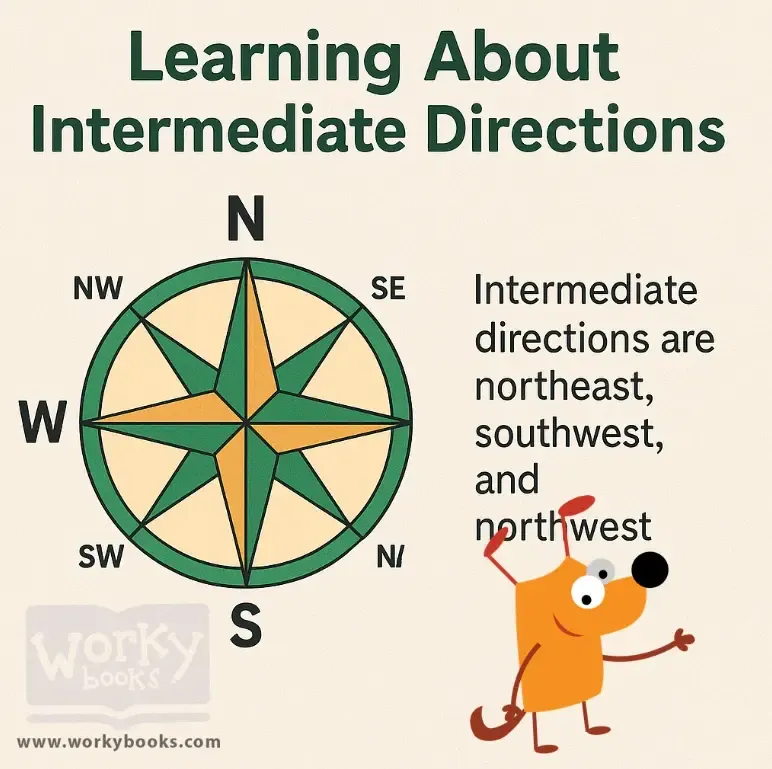
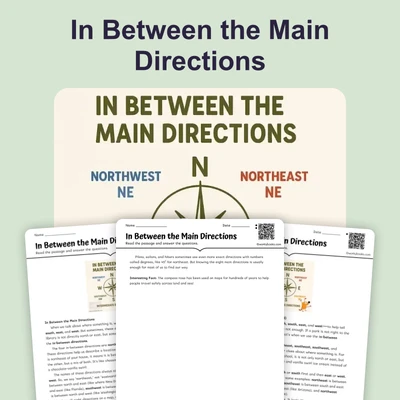
Intermediate Directions help us describe exactly where something is. The four main intermediate directions are northeast (NE), southeast (SE), southwest (SW), and northwest (NW). They are also called ordinal directions. These directions sit between the four cardinal directions: north, east, south, and west.
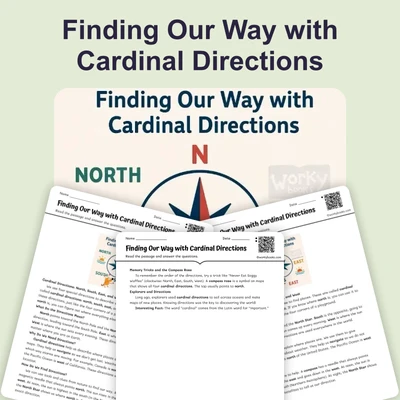
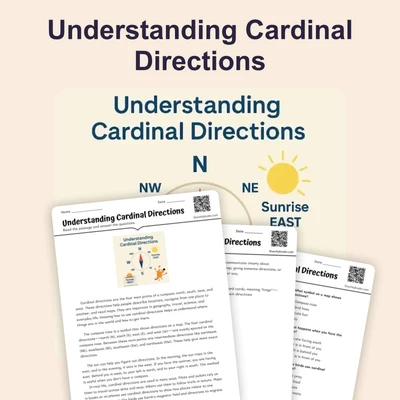
If you look at a compass rose, you will see the cardinal directions at the top (N), right (E), bottom (S), and left (W). The intermediate directions are exactly halfway between each pair of cardinal directions. For example, northeast is between north and east, while southwest is between south and west.
Intermediate directions are useful because sometimes just saying 'north' or 'east' is not specific enough. For example, if the park is not straight north of your school, but a little to the east too, you can say, 'The park is northeast of the school.' This gives a more precise location.
There is a pattern for naming intermediate directions. They always start with north or south, then add east or west. So, it's 'northeast,' not 'eastnorth.' The order is important!
We use intermediate directions in many ways. In weather reports, you might hear, 'Winds are coming from the southwest.' When giving directions, someone might say, 'Drive northwest to reach the lake.' On a map, you may find, 'The treasure is buried northeast of the big tree.' The United States even uses these terms to describe regions, like 'Arizona is in the southwestern United States.'
Most compasses show an 8-point compass rose, which includes the four cardinal and four intermediate directions. Some compasses are even more detailed, showing 16 points, but the eight main directions are the most common.
Think of intermediate directions like cutting a pizza. If you cut a pizza into four slices, those are the cardinal directions. But if you cut it into eight slices, you get more precise pieces—the intermediate directions!
Interesting Fact: Some maps and compasses use even more directions, like 'north-northeast' (NNE), to be super exact!
Comprehension quiz (8 questions)
1. Which is an intermediate direction?
2. What is a compass rose?
3. How many main intermediate directions are there?
4. Why do we use intermediate directions?
5. What would you say if a park is not directly north but also a little east?
6. Which direction is between south and west?
7. A compass rose only shows four directions. True or false?
8. What is another name for intermediate directions?
Perfect for the way you teach
- Build comprehension skills
- Auto-graded quiz
- Differentiated reading
- Read together at home
- Improve fluency
- Quiet reading time
- Reading curriculum support
- Independent practice
- Track Lexile growth