Levels of Ecological Organization — Reading Comprehension
Rate this
Present
Present in classroom. No work saved
Assign
Classroom with student accounts, Track progress
Quick Play
No student accounts, assign with a link
Grades
5
6
7
8
Standards
MS-LS2-1
PRINT+DIGITAL RESOURCE
This learning resource is available in interactive and printable formats. The interactive worksheet can be played online and assigned to students. The Printable PDF version can be downloaded and printed for completion by hand.
This comprehensive passage introduces middle school students to the concept of ecological organization, covering levels from individual organisms up to the biosphere. It explains mechanisms of organization, such as population size, density, distribution patterns, and the structure of ecological communities, including dominant and keystone species. Students learn the difference between habitat and niche, with real-world examples and scientific reasoning. The passage aligns with NGSS MS-LS2-1 and encourages systems thinking about how living and nonliving components interact within ecosystems. Activities include a glossary, differentiated reading versions, a Spanish translation, multiple-choice and writing questions, and graphic organizers. Audio integration is available for accessibility, making this resource ideal for diverse learners in grades 6-8.
CONTENT PREVIEW
Expand content preview
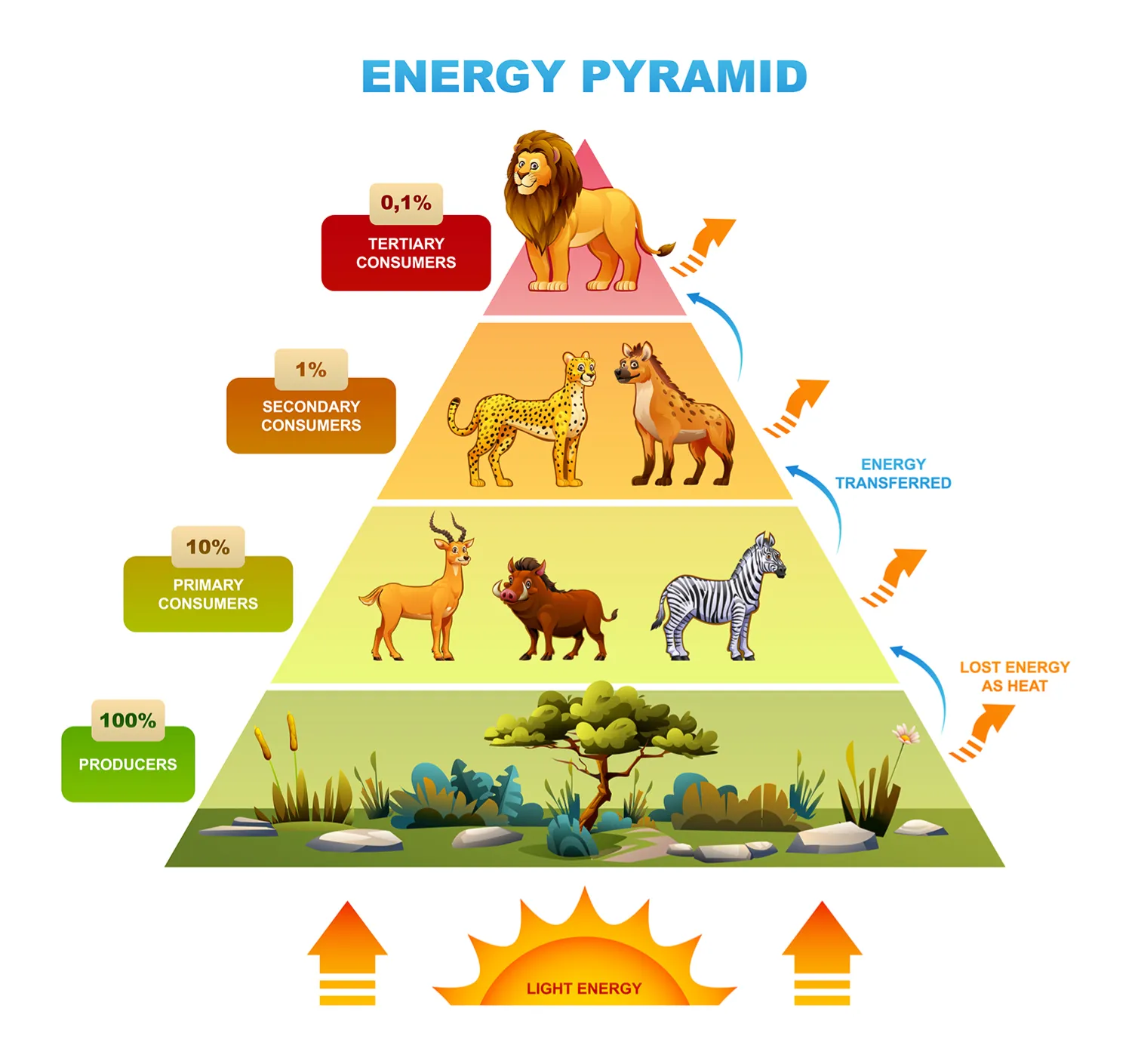
Energy pyramid highlighting energy transfer with lion cheetah zebra producers
Ecology is the science that studies how living things interact with each other and with their environment. Scientists use the concept of levels of organization to understand these complex relationships. Starting from a single organism and expanding to the entire planet, each level reveals new interactions and patterns. This structure helps us see how small changes can affect the whole system and why protecting diverse habitats is important for Earth's health.
Levels of Ecological Organization
The first level is the individual, which is a single organism, like a wolf or a tree. A group of individuals of the same species living in the same area is called a population. Scientists study population characteristics, such as size (the number of individuals), density (how many individuals are in a given space), and distribution patterns. For example, bison may gather in clumped groups for protection, while penguins may spread out in a uniform pattern to guard their nests. Some plants have a random distribution, depending on how seeds are scattered.
A community includes all the populations of different species living together in an area. Community structure is shaped by factors such as species richness (the number of different species), dominant species (the most abundant or influential species), and keystone species, which have a strong effect on the entire community. For instance, sea otters are keystone species because they control sea urchin populations, helping kelp forests thrive.
Ecosystems, Biomes, and the Biosphere
An ecosystem is formed by a community and its nonliving environment, such as soil, water, and climate. Interactions in ecosystems include energy flow (like sunlight powering photosynthesis) and nutrient cycles (like nitrogen moving through plants and animals). Multiple ecosystems with similar climates and organisms make up a biome, such as the tundra or rainforest. All Earth's biomes together create the biosphere, which is the zone of life on our planet.
Each organism has a habitat—the place where it lives—and a niche—its role in the ecosystem, like what it eats and how it interacts with others. For example, a woodpecker's habitat is the forest, and its niche is digging insects from tree bark. Understanding niches helps scientists predict how changes, like introducing a new species, can affect an ecosystem.
Interactions and Scientific Study
Ecologists use data and observations to study these levels. They might count the number of frogs in a pond to learn about population size or monitor how removing a keystone species changes the whole community. Research shows that ecosystems with higher species richness are more stable and recover faster from disturbances. Scientists also use computer models to predict how changes in one level (like a drop in population density) can affect the rest of the system.
Understanding the levels of ecological organization helps us protect the natural world. By studying how living things are connected, we can make better decisions about conservation and resource management. This knowledge supports efforts to keep ecosystems healthy, which is essential for humans and all other life on Earth.
Interesting Fact: Earth’s biosphere is just a thin layer—about 20 kilometers thick—surrounding the planet, yet it supports millions of species and complex systems!
What is the smallest level of ecological organization?
IndividualPopulationCommunityBiome
Which of the following best describes a population?
All living and nonliving things in an areaA group of individuals of the same species living in the same areaAll the species in the worldThe place where an organism lives
What does 'species richness' mean?
The number of individuals of one speciesThe number of different species in a communityHow evenly species are spread outThe amount of resources in an ecosystem
What is a 'keystone species'?
A species that is the most numerousA species that has a strong effect on a communityA species that lives aloneA species that forms random patterns
Which term describes the place where an organism lives?
NicheHabitatBiomeCommunity
What is the biosphere?
A single ecosystemAll populations in a forestThe zone of life on EarthJust the plants on Earth
In the passage, why are sea otters important in kelp forest communities?
They are the largest animalsThey control sea urchin populations, helping kelp forests surviveThey live in random patternsThey make new habitats
If a population's density decreases, what might happen to its community?
It may have less effect on the community, and other species might increaseIt always becomes a keystone speciesIt will form a biomeNothing will change
True or False: An ecosystem includes both living things and their nonliving environment.
TrueFalse
True or False: A niche is the physical place where an organism lives.
TrueFalse
Perfect For:
👩🏫 Teachers
• Reading comprehension practice
• Auto-graded assessments
• Literacy skill development
👨👩👧👦 Parents
• Reading practice at home
• Comprehension improvement
• Educational reading time
🏠 Homeschoolers
• Reading curriculum support
• Independent reading practice
• Progress monitoring
Reading Features:
📖
Reading Passage
Engaging fiction or nonfiction text
❓
Comprehension Quiz
Auto-graded questions
📊
Instant Feedback
Immediate results and scoring
📄
Printable Version
Download for offline reading
🔊
Read Aloud
Voice-over with word highlighting
Reviews & Ratings
No reviews yet. Be the first to share your experience!
Related Content
The Leafy Sea Dragon: Nature's Living Seaweed
This NGSS-aligned passage explores how leafy sea dragons (Phycodurus eques) demonstrate key life science concepts for mi...
MS-LS2-1RI.6.3RI.7.3RI.8.8
The Narwhal: Arctic’s Unicorn of the Sea
This NGSS-aligned passage (MS-LS2-1) explores how narwhals survive in Arctic ecosystems. Students learn about specialize...
MS-LS2-1RI.6.3RI.7.3RI.8.8
The Blue-Ringed Octopus
This NGSS aligned passage explores how the tiny blue-ringed octopus impacts its ecosystem through predator-prey relation...
MS-LS2-1RI.6.3RI.7.3RI.8.8
Tardigrades: Microscopic Superheroes
Aligned to MS-LS1-1, this passage examines how tardigrade cell structures (TDP proteins, DNA-repair enzymes) allow survi...
MS-LS2-1RI.6.3RI.7.3RI.8.8
What Do Axolotls Eat?
This science reading passage, titled "What Do Axolotls Eat?", offers an engaging exploration into the feeding habits of ...
MS-LS2-1
Where Do Axolotls Live?
This science reading passage, titled "The Axolotl's Home," delves into the specific natural environment of the fascinati...
MS-LS4-DMS-LS2-1
The Blobfish
This science reading passage, titled "The Blobfish: A Deep-Sea Mystery," introduces students to one of Earth's most pecu...
MS-LS4-DMS-LS2-1
What Do Blobfish Eat?
This science reading passage, titled "What Do Blobfish Eat?", offers an engaging exploration into the feeding habits of ...
MS-LS2-1
Where Do Penguins Live?
This engaging science reading passage, titled "Where Do Penguins Live? A Cold and Coastal World," clarifies the diverse ...
MS-LS2-1
The Emperor Penguin
This science reading passage, titled "The Emperor Penguin: Antarctica's Royal Survivor," introduces students to one of t...
MS-LS2-1
The Adélie Penguin
This engaging science reading passage, titled "The Adélie Penguin: Antarctica's Little Explorer," introduces students to...
MS-LS2-1
How Does Global Warming Affect Adélie Penguins?
This comprehensive science passage, titled "How Does Global Warming Affect Adélie Penguins?", details the significant im...
MS-LS2-1
Desert Birds
This informational passage for grades 6-8 examines how desert birds survive and thrive in some of the harshest environme...
MS-LS2-1MS-LS2-2MS-LS1-4
Abiotic Factors in Ecosystems
This comprehensive informational reading passage is designed for middle school science students and aligns with NGSS sta...
MS-LS2-1
Biomes: Terrestrial Ecosystems
This NGSS-aligned science reading passage for grades 6-8 provides a comprehensive survey of Earth’s major terrestrial bi...
MS-LS2-1
Biomes: Aquatic Ecosystems
This middle school science passage, aligned with NGSS standard MS-LS2-1, introduces students to the key features and mec...
MS-LS2-1
Galápagos Islands
This engaging science passage explores the Galápagos Islands, a volcanic archipelago located off the coast of Ecuador in...
MS-LS2-1MS-LS4-4MS-ESS3-4
Florida Everglades
This comprehensive passage introduces middle school students to the Florida Everglades, a distinctive wetland ecosystem ...
MS-LS2-1MS-LS2-4MS-ESS3-3MS-ESS3-4
Great Barrier Reef
This passage introduces middle school students to the Great Barrier Reef, the world's largest coral reef system, located...
MS-LS2-1MS-LS2-4MS-ESS3-5
Wetland Biomes
This comprehensive science passage introduces middle school students to the concept of wetland biomes. Aligned with NGSS...