This learning resource is available in interactive and printable formats. The interactive worksheet can be played online and assigned to students. The Printable PDF version can be downloaded and printed for completion by hand.
This passage provides an in-depth look at the Lincoln-Douglas Debates of 1858, an essential event in U.S. history that helped define the national conversation about slavery and the future of the country. Abraham Lincoln and Stephen Douglas, both candidates for the Illinois Senate, debated critical issues such as the expansion of slavery and states’ rights, offering contrasting perspectives that shaped public opinion. Students will analyze the problem of slavery’s spread, the positions taken by both men, and the significance of these debates in the lead-up to the Civil War. The resource includes a Spanish translation, a differentiated version for accessibility, engaging activities, and a glossary. Aligned with HSS 8.10.3 and CCSS.RI.6-8.1, RI.6-8.2, this passage supports history and literacy standards and is ideal for classroom instruction, with read aloud audio, Spanish translation, and interactive graphic organizers.
CONTENT PREVIEW
Expand content preview
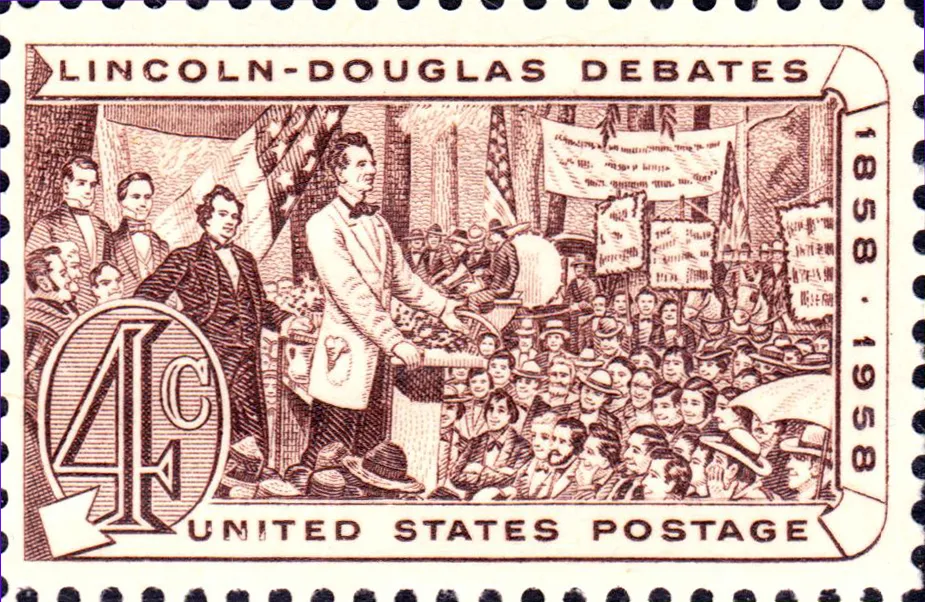
"Lincoln Douglas Debates 1958 issue-4c" by U.S. Government, Post Office Department / Wikimedia Commons (Public domain).
In the summer and fall of 1858, Abraham Lincoln and Stephen A. Douglas faced each other in a series of seven public debates while running for the U.S. Senate from Illinois. The main issue at stake was whether slavery should be allowed to expand into new western territories. Their arguments revealed deep divisions in the United States and shaped the nation's future.
At this time, the U.S. was rapidly growing westward. New territories were being settled, and Americans disagreed sharply over whether slavery should be legal in those areas. Some people, like Stephen Douglas, believed in popular sovereignty. This meant that people living in each territory should vote to decide if slavery would be allowed. Douglas argued, "If the people of any territory want slavery, they have a right to it." He defended this idea as democratic and fair, but others saw problems with it.
Abraham Lincoln took a different position. Lincoln believed that slavery was morally wrong and should not be allowed to expand, although he did not call for its immediate end where it already existed. Lincoln feared that the spread of slavery would make it impossible for the nation to live up to its founding ideals of liberty and equality. In one debate, he stated, "A house divided against itself cannot stand." This famous quote showed his belief that the country could not last permanently half-slave and half-free.
The debates did not just focus on the law. The two men also discussed the Constitution, the role of Congress, and the rights of both black and white Americans. Douglas accused Lincoln of wanting equality for African Americans, which was unpopular with many white voters at the time. Lincoln responded that he simply opposed the expansion of slavery, not full social or political equality. This revealed a contradiction: Lincoln wanted to limit slavery but was cautious about openly advocating for full rights for all people.
Both sides used historical reasoning and evidence to support their views. Douglas cited the Kansas-Nebraska Act as proof that popular sovereignty worked. Lincoln referred to the Declaration of Independence to argue that freedom was a founding American principle. Their debates forced citizens to think about what kind of nation the United States should become.
The outcome of the debates was complex. Douglas won the Senate seat, but Lincoln's powerful arguments made him famous across the country. The debates increased tensions between North and South, as each region had different economic interests and moral beliefs about slavery. These tensions would soon erupt into the Civil War.
Ultimately, the Lincoln-Douglas Debates helped Americans see that the issue of slavery in the territories was not simply a local matter. It was a national crisis that tested democracy, the Constitution, and the meaning of freedom. The debates did not resolve the conflict, but they set the stage for the intense struggles that followed.
Interesting Fact: After losing the Senate race, Abraham Lincoln used the fame he gained from the debates to successfully run for President in 1860.
Who won the 1858 Senate race?
Stephen DouglasAbraham LincolnFrederick DouglassAndrew Johnson
How many debates did Lincoln and Douglas have?
FiveSevenNineThree
What main issue did the debates address?
Railroad buildingSlavery in new territoriesWomen's rightsTrade with Europe
What did Douglas believe in?
Popular sovereigntyAbolishing slavery everywhereNo new statesEqual rights for all
What did Lincoln fear about slavery's expansion?
It would end the economyIt would divide the nationIt would make new lawsIt would help the South
Why did the debates increase tensions?
They led to a new lawThey highlighted North-South divisionsThey stopped westward expansionThey ended slavery immediately
Lincoln supported slavery's expansion. True or false?
TrueFalse
What does 'popular sovereignty' mean?
Rule by the peopleRule by CongressRule by the presidentRule by judges
Perfect For:
👩🏫 Teachers
• Reading comprehension practice
• Auto-graded assessments
• Literacy skill development
👨👩👧👦 Parents
• Reading practice at home
• Comprehension improvement
• Educational reading time
🏠 Homeschoolers
• Reading curriculum support
• Independent reading practice
• Progress monitoring
Reading Features:
📖
Reading Passage
Engaging fiction or nonfiction text
❓
Comprehension Quiz
Auto-graded questions
📊
Instant Feedback
Immediate results and scoring
📄
Printable Version
Download for offline reading
🔊
Read Aloud
Voice-over with word highlighting
Reviews & Ratings
No reviews yet. Be the first to share your experience!
Related Content
Pocahontas: Myth vs. Historical Reality
This passage explores the nuanced history of Pocahontas, moving beyond the myth made popular by movies and stories. Stud...
HSS 5.3.1RI.6-8.1RI.6-8.8
Roger Williams Religious Freedom
This passage explores the life and legacy of Roger Williams, a key figure in Colonial America who was banished from Mass...
HSS 5.4.38.2.2RI.6-8.1RI.6-8.6
Benjamin Franklin in Colonial America
This U.S. History reading passage explores the life and influence of Benjamin Franklin, a key colonial leader whose idea...
HSS 5.58.1RI.6-8.1RI.6-8.3
Colonial Apprenticeship System
This comprehensive passage explores the Colonial Apprenticeship System and its role in education during Colonial America...
HSS 5.4.6RI.6-8.1RI.6-8.2
Cities in Colonial America
This engaging U.S. history reading passage explores the rise of colonial American cities such as Boston, Philadelphia, a...
HSS 5.4.68.1RI.6-8.1RI.6-8.7
Frontier Life in Colonial America
This passage examines the realities of frontier life in colonial America, highlighting both the promise and peril faced ...
HSS 5.4.68.1RI.6-8.1RI.6-8.2
Colonial Printing Press
This passage explores the revolutionary impact of the colonial printing press in America, examining how it enabled the s...
HSS 5.58.1RI.6-8.1RI.6-8.2
Mercy Otis Warren: Political Writer
This passage explores the life and impact of Mercy Otis Warren, a significant political writer during the American Revol...
HSS 5.6.38.1RI.6-8.1RI.6-8.6
Crispus Attucks
This comprehensive U.S. History reading passage examines the life and legacy of Crispus Attucks, the first person killed...
HSS 5.5.38.1RI.6-8.1RI.6-8.3
Lewis and Clark Expedition
This comprehensive U.S. History reading passage explores the Lewis and Clark Expedition (1804-1806), a pivotal journey l...
HSS 8.4.18.8.2RI.6-8.1RI.6-8.3
Exodusters
This passage explores the migration of Exodusters—African Americans who left the South in the 1870s to escape discrimina...
HSS 8.12.1RI.6-8.1RI.6-8.2
Uncle Tom's Cabin
This passage explores the impact of Harriet Beecher Stowe’s Uncle Tom’s Cabin on American society in the 1850s. It exami...
HSS 8.9.48.10.2RI.6-8.1RI.6-8.6
Dred Scott Decision
This rigorous history reading passage delves into the 1857 Dred Scott Decision, a pivotal moment in the lead-up to the C...
HSS 8.9.48.10.3RI.6-8.1RI.6-8.8
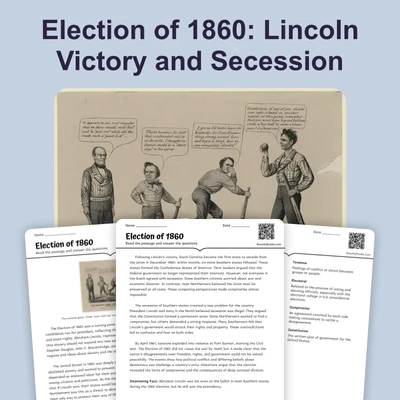
Election of 1860
This passage explores Abraham Lincoln’s election in 1860 and the critical reactions from Southern states, which set the ...
HSS 8.10.4RI.6-8.1RI.6-8.6
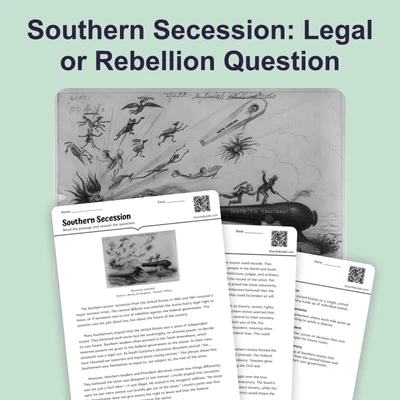
Southern Secession
This passage explores the significant moment in U.S. history when seven Southern states seceded from the Union after Abr...
HSS 8.10.4RI.6-8.1RI.6-8.2
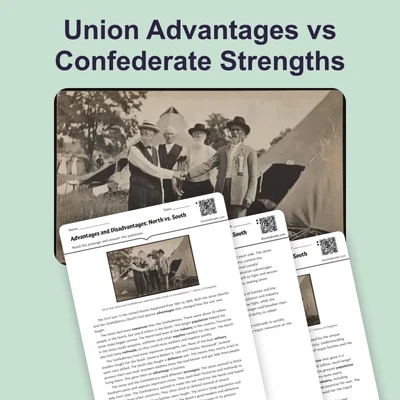
Advantages and Disadvantages: North vs. South
This history reading passage examines the contrasting strengths of the Union and Confederacy during the U.S. Civil War. ...
HSS 8.10.5RI.6-8.1RI.6-8.3
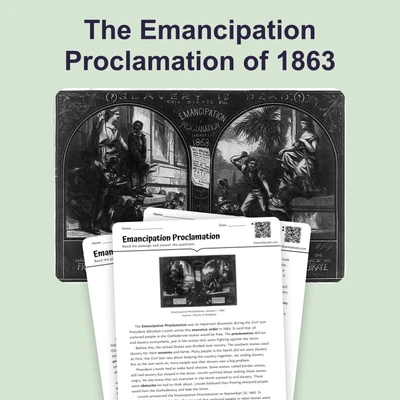
Emancipation Proclamation
This U.S. history passage explores the Emancipation Proclamation of 1863, an executive order issued by President Abraham...
HSS 8.10.6RI.6-8.1RI.6-8.3
Women's Roles in Civil War
This reading passage explores the critical roles women played during the U.S. Civil War, highlighting how they managed f...
HSS 8.10.7RI.6-8.1RI.6-8.2
Surrender at Appomattox
This reading passage explores the historic surrender at Appomattox Court House in April 1865, which marked the conclusio...