Little Rock Nine 1957
Interactive passage with audio narration, comprehension questions, and printable PDF.
What's included
Little Rock Nine 1957 preview and details
About this printable Little Rock Nine 1957 reading passage (Grades 6-8)
Sample passage and quiz from Little Rock Nine 1957
Reading passage and comprehension quiz preview
Little Rock Nine 1957
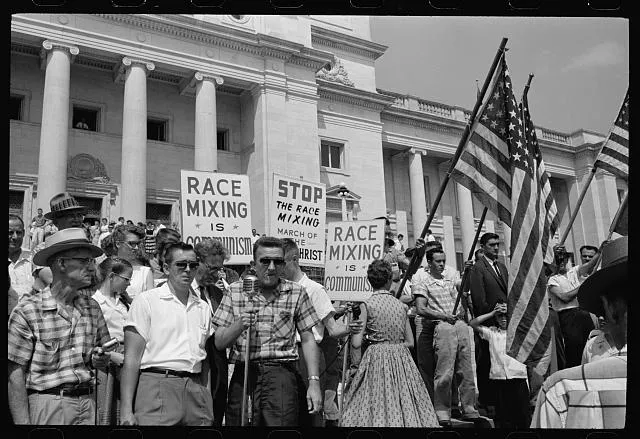
Source: Library of Congress - Bledsoe, John T.
In 1957, the city of Little Rock, Arkansas, became a national focus in the Civil Rights Movement. The United States Supreme Court had ruled in the case of Brown v. Board of Education (1954) that public school segregation was unconstitutional. However, many Southern communities resisted the idea of integration, which meant allowing students of different races to attend the same schools. Central High School in Little Rock became the site of a major conflict over this change.
The Little Rock Nine were nine Black students selected to integrate Central High School in September 1957. These students faced tremendous resistance from both local citizens and state officials. On the first day, the governor of Arkansas ordered the state National Guard to block the students from entering the school. Angry crowds gathered outside, shouting threats and insults, demonstrating how deeply some people opposed integration.
President Dwight D. Eisenhower saw that the local and state authorities were ignoring federal law. He decided that federal intervention was necessary to uphold the Constitution. He sent the 101st Airborne Division of the U.S. Army to Little Rock and placed the Arkansas National Guard under federal control. With the protection of federal troops, the Little Rock Nine were finally able to enter Central High School safely.
The students’ experience inside the school was also challenging. They endured daily harassment from some classmates and faced a hostile environment. Despite this, they showed remarkable courage and determination. The Little Rock Nine understood that their actions would have consequences not only for themselves, but also for the future of equal education in America.
The crisis in Little Rock revealed the limits of legal decisions without strong enforcement. It also demonstrated the power of individuals to bring about change through personal sacrifice and persistence. The events in Little Rock influenced future civil rights struggles and reminded the nation that true progress required both laws and the courage to enforce them.
Although the integration of Central High School did not end segregation overnight, it marked a turning point in the Civil Rights Movement. The actions of the Little Rock Nine and federal intervention sent a clear message that the federal government would protect the rights of all citizens.
Interesting Fact: One of the Little Rock Nine, Ernest Green, became the first Black student to graduate from Central High School in 1958, a year after the crisis.
Comprehension quiz (8 questions)
1. What year did the Little Rock Nine integrate?
2. Which school did the Little Rock Nine attend?
3. Who sent federal troops to Little Rock?
4. Why was federal intervention needed?
5. What did the Little Rock Nine face inside the school?
6. How did the Little Rock Nine impact history?
7. Segregation means students of all races mix.
8. What is 'federal intervention'?
Common Core standards for Little Rock Nine 1957
Explain events, procedures, ideas, or concepts in a historical, scientific, or technical text, including what happened and why, based on specific information in the text.
Determine the meaning of general academic and domain-specific words or phrases in a text relevant to a grade 4 topic or subject area.
Write informative/explanatory texts to examine a topic and convey ideas and information clearly.
Perfect for the way you teach
- Build comprehension skills
- Auto-graded quiz
- Differentiated reading
- Read together at home
- Improve fluency
- Quiet reading time
- Reading curriculum support
- Independent practice
- Track Lexile growth