Louisiana Purchase 1803
Interactive passage with audio narration, comprehension questions, and printable PDF.
By completing this purchase you agree to our Terms of Use and Privacy Policy. Your subscription renews automatically until you cancel. You can cancel anytime from your account settings. All sales are final and non-refundable. Digital content is available for download in your account immediately upon purchase.
What's included
Louisiana Purchase 1803 preview and details
About this printable Louisiana Purchase 1803 reading passage (Grades 6-8)
Sample passage and quiz from Louisiana Purchase 1803
Reading passage and comprehension quiz preview
Louisiana Purchase 1803
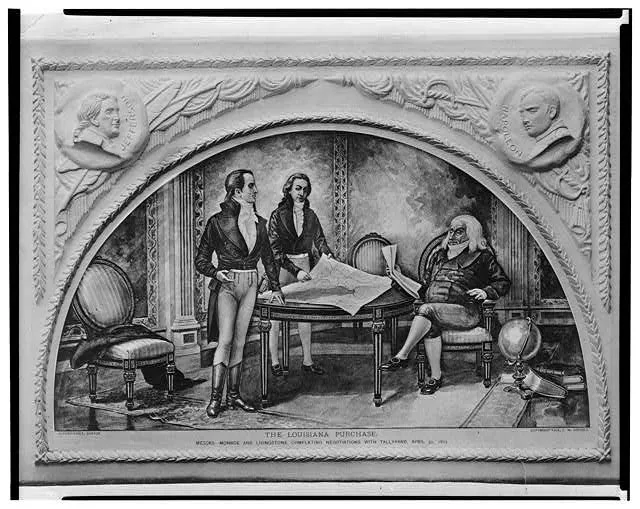
"The Louisiana Purchase. Messr. Monroe and Livingstone completing negotiations with Talleyrand, April 30, 1803" / Library of Congress.
In 1803, the United States made one of the most significant expansions in its history with the Louisiana Purchase. President Thomas Jefferson led the effort to buy a huge area of land from France, doubling the size of the nation. This acquisition was not only important for the country’s growth but also sparked debates about the limits of presidential power and the future of American democracy.
The Louisiana Territory stretched from the Mississippi River to the Rocky Mountains, covering about 828,000 square miles. Before the purchase, France controlled this territory, but French leader Napoleon Bonaparte wanted to sell the land to raise money for wars in Europe. The United States, eager to secure control of the important port city of New Orleans and ensure access to the Mississippi River, saw this as an opportunity.
President Jefferson sent envoys to France to negotiate the terms. At first, the American representatives were only supposed to buy New Orleans and its surroundings. However, Napoleon offered to sell the entire Louisiana Territory for $15 million. This sudden offer created both excitement and uncertainty. The U.S. government had to quickly decide whether it had the authority to make such a large purchase.
The Constitution did not clearly state whether a president could buy new land. Jefferson, who usually favored a strict interpretation of the Constitution, struggled with this decision. In the end, he believed the benefits of the purchase outweighed the risks. Congress approved the deal, and the United States gained vast new lands for settlement and agriculture.
However, the Louisiana Purchase also brought challenges. The United States now had to govern and explore a much larger area. Questions arose about the rights of Native Americans living in the region and the spread of slavery into new territories. The government sent the Lewis and Clark expedition to map and study the new land, hoping to learn more about its resources and inhabitants.
The Louisiana Purchase changed the future of the United States in many ways. It allowed the nation to grow westward, encouraged migration, and set the stage for future conflicts and compromises. The decision showed how leaders must balance the nation's needs with the rules of government.
Interesting Fact: The Louisiana Purchase cost about four cents per acre, making it one of the greatest land bargains in history.
Comprehension quiz (8 questions)
1. Who was president during the Louisiana Purchase?
2. How much did the Louisiana Purchase cost?
3. Which country sold the Louisiana Territory?
4. What did the U.S. originally want to buy?
5. Why did Napoleon sell the Louisiana Territory?
6. What was a result of the purchase?
7. The Constitution clearly allowed land purchases.
8. What does 'territory' mean?
Common Core standards for Louisiana Purchase 1803
Explain events, procedures, ideas, or concepts in a historical, scientific, or technical text, including what happened and why, based on specific information in the text.
Determine the meaning of general academic and domain-specific words or phrases in a text relevant to a grade 4 topic or subject area.
Write informative/explanatory texts to examine a topic and convey ideas and information clearly.
Perfect for the way you teach
- Build comprehension skills
- Auto-graded quiz
- Differentiated reading
- Read together at home
- Improve fluency
- Quiet reading time
- Reading curriculum support
- Independent practice
- Track Lexile growth