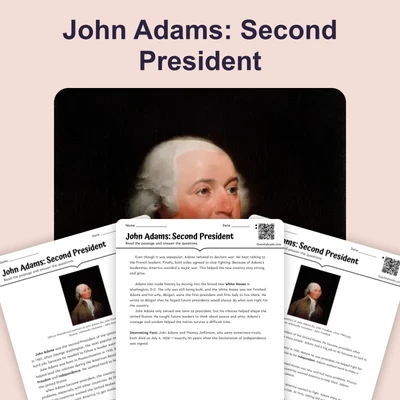
This learning resource is available in interactive and printable formats. The interactive worksheet can be played online and assigned to students. The Printable PDF version can be downloaded and printed for completion by hand.
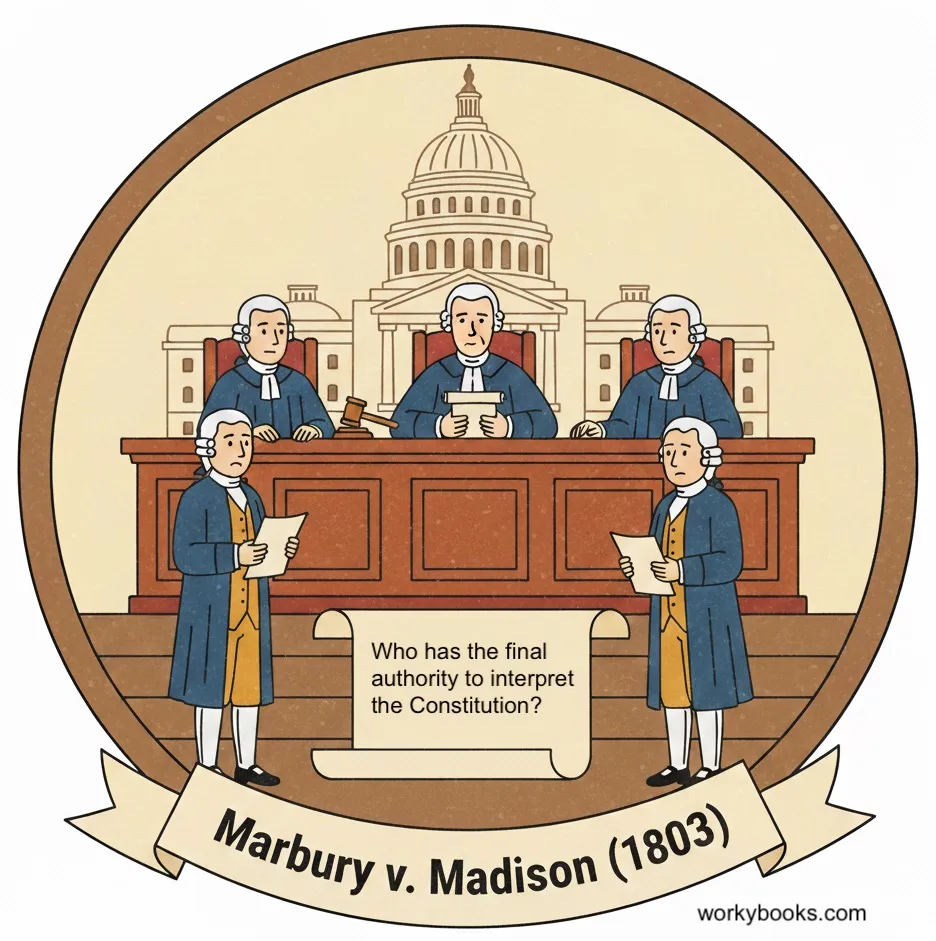
This passage examines the landmark Supreme Court case Marbury v Madison (1803) and its enormous impact on the United States government. The passage introduces the background of the case, the conflict between the branches of government, and explains how Chief Justice John Marshall’s decision established the principle of judicial review. Students will learn how the case empowered the judiciary to declare laws unconstitutional, strengthening the checks and balances system in the US Constitution. The passage is written for upper elementary and middle school students, and it integrates key academic vocabulary such as 'judicial review,' 'unconstitutional,' 'precedent,' and 'separation of powers.' Activities include a glossary, comprehension questions, writing prompts, graphic organizers, timeline, and both a Spanish translation and a simplified version for language support. This resource supports HSS 8.2.6, 8.3.6, and CCSS.RI.6-8.1, RI.6-8.6. Read aloud audio and Spanish versions are available to ensure accessibility and student engagement.
CONTENT PREVIEW
Expand content preview
The Marbury v Madison decision has shaped many later cases and remains a foundation of American government.
In 1803, the United States Supreme Court decided a case called Marbury v Madison that would forever change the role of American courts. At the heart of the case was the principle of judicial review, which is the power of courts to decide whether laws and actions are constitutional. This case established that the Supreme Court could declare laws passed by Congress to be unconstitutional, making it one of the most important decisions in U.S. history.
The conflict began when President John Adams, right before leaving office, appointed several new judges, including William Marbury. These appointments were part of a political struggle between the outgoing Federalists and the incoming Democratic-Republicans led by Thomas Jefferson. However, when Jefferson became president, his Secretary of State, James Madison, refused to deliver some of the official papers, known as commissions, to these new judges. Marbury sued Madison, seeking a legal order called a writ of mandamus to force Madison to give him his commission.
This dispute raised serious questions about the balance of power among the branches of government. The Constitution created three branches—the legislative, executive, and judicial—each with its own responsibilities. But it was not clear how conflicts between them should be resolved. The Supreme Court now had to decide whether it had the authority to order the executive branch to act, and whether the law giving it that power was itself constitutional.
Chief Justice John Marshall wrote the Court’s opinion. He faced a complex problem: if the Court sided with Marbury, it risked being ignored by the executive branch, which would weaken the Court’s authority. If it sided with Madison, it might appear to support the president’s refusal to follow the law. Marshall’s solution was both careful and creative. The Court decided that Marbury did have a right to his commission, but the law that gave the Supreme Court the power to issue a writ of mandamus in this situation—the Judiciary Act of 1789—actually went beyond what the Constitution allowed. Therefore, the Court ruled that part of the law was unconstitutional and could not be enforced.
This decision set an important precedent. By striking down a law passed by Congress, the Supreme Court established itself as the final interpreter of the Constitution. This strengthened the judiciary’s role in the American system of checks and balances. From that point forward, the courts could ensure that no law or government action could violate the Constitution.
Marbury v Madison did not make the Supreme Court more powerful than the other branches, but it did give the judiciary a clear way to protect the Constitution. Over time, judicial review has been used in many other cases to shape American law and protect individual rights. The case also demonstrated how the Constitution allows for adaptation and interpretation, helping the United States government remain strong and fair.
Interesting Fact: The words “judicial review” do not actually appear in the U.S. Constitution, but Marbury v Madison made this principle a permanent feature of American government.
Who was Chief Justice in Marbury v Madison?
John MarshallJames MadisonThomas JeffersonWilliam Marbury
What year was Marbury v Madison decided?
1803178918121791
Which law was declared unconstitutional?
Judiciary Act of 1789Bill of RightsDeclaration of IndependenceArticles of Confederation
Why did Marbury sue Madison?
To get his commissionTo change the ConstitutionTo become PresidentTo stop a new law
What power did the case establish?
Judicial reviewVeto powerImpeachmentTaxation
How did the decision affect checks and balances?
Strengthened the judiciaryWeakened the presidentEnded CongressCreated new states
Marbury v Madison gave courts judicial review.
TrueFalse
What does 'unconstitutional' mean?
Not allowed by the ConstitutionWritten by CongressSupported by the presidentCreated by the Supreme Court
Perfect For:
👩🏫 Teachers
• Reading comprehension practice
• Auto-graded assessments
• Literacy skill development
👨👩👧👦 Parents
• Reading practice at home
• Comprehension improvement
• Educational reading time
🏠 Homeschoolers
• Reading curriculum support
• Independent reading practice
• Progress monitoring
Reading Features:
📖
Reading Passage
Engaging fiction or nonfiction text
❓
Comprehension Quiz
Auto-graded questions
📊
Instant Feedback
Immediate results and scoring
📄
Printable Version
Download for offline reading
🔊
Read Aloud
Voice-over with word highlighting
Reviews & Ratings
No reviews yet. Be the first to share your experience!
Related Content
Native American Tribes Across America
This engaging history reading passage introduces students to Native American tribes across America, focusing on their da...
D2.HIS.1.3-5D2.HIS.2.3-5RI.4.1RI.4.2
Teepees: Homes on the Great Plains
This engaging history reading passage introduces students to teepees, the unique homes of Native American tribes on the ...
D2.HIS.2.3-5D2.HIS.14.3-5RI.4.1RI.4.2RI.4.4
Traditional Native American Clothing
This engaging history passage explores traditional Native American clothing and how it reflected the environment, values...
D2.HIS.2.3-5D2.HIS.3.3-5RI.4.3RI.4.4
The Iroquois Confederacy: A System of Peace
This engaging U.S. History reading passage introduces students to the Iroquois Confederacy, a powerful alliance of Nativ...
D2.HIS.2.3-5D2.HIS.3.3-5RI.4.3RI.4.4
The Cherokee Nation: History and Culture
This reading passage explores the rich history and culture of the Cherokee Nation, one of the largest Native American tr...
D2.HIS.2.3-5D2.HIS.14.3-5RI.4.3RI.4.4RI.4.10
The Sioux: Warriors and Tribal Leaders
This history reading passage explores the Sioux Nation, focusing on their roles as warriors and tribal leaders. Students...
D2.HIS.1.3-5D2.HIS.2.3-5RI.4.1RI.4.3
Native American Respect for Nature
This engaging history reading passage explores Native American respect for nature, emphasizing the close relationship be...
D2.HIS.2.3-5D2.HIS.3.3-5RI.4.3RI.4.4
Jamestown: The First Permanent English Colony
This engaging history passage explores the founding of Jamestown, the first permanent English colony in America. Aligned...
D2.HIS.1.3-5D2.HIS.2.3-5RI.4.3RI.4.4
Pocahontas and the Powhatan People
This engaging reading passage explores the life of Pocahontas and the Powhatan people and their important role in early ...
D2.HIS.1.3-5D2.HIS.2.3-5RI.4.1RI.4.3
Colonial Children: School and Chores
This reading passage explores the daily lives of colonial children, focusing on their experiences at school and their ma...
D2.HIS.2.3-5D2.HIS.3.3-5RI.4.1RI.4.2RI.4.4
Colonial Clothing and Homemade Goods
This engaging U.S. history passage explores the daily life of early American colonists with a focus on colonial clothing...
D2.HIS.2.3-5RI.4.3RI.4.4
Colonial Jobs: Blacksmiths, Bakers, and Craftsmen
This engaging history reading passage explores the vital roles of blacksmiths, bakers, and craftsmen in colonial America...
D2.HIS.2.3-5D2.HIS.3.3-5RI.4.3RI.4.4
Colonial Towns and Village Life
This engaging history reading passage explores the daily life, work, and unity found in colonial towns and villages. Ali...
D2.HIS.1.3-5D2.HIS.2.3-5RI.4.3RI.4.4
Colonial Trade with England and Africa
This history reading passage explores colonial trade between the American colonies, England, and Africa, focusing on the...
D2.HIS.2.3-5D2.HIS.14.3-5RI.4.3RI.4.4
Benjamin Franklin: Printer, Inventor, and Leader
This history reading passage explores the life and achievements of Benjamin Franklin, one of America's most important ea...
D2.HIS.2.3-5D2.HIS.3.3-5RI.4.1RI.4.3
George Washington Leads the Army
This engaging history reading passage explores how George Washington bravely led the Continental Army during the America...
D2.HIS.1.3-5D2.HIS.2.3-5RI.4.3RI.4.4
Women and Children During the Revolutionary War
This reading passage explores the important roles women and children played during the Revolutionary War. Students will ...
D2.HIS.2.3-5RI.4.3RI.5.3
African Americans Fight for Freedom
This educational passage explores the brave and inspiring story of how African Americans fought for freedom in the Unite...
D2.HIS.2.3-5D2.HIS.3.3-5RI.4.3RI.4.4
The Battle of Yorktown Ends War
This engaging U.S. history reading passage explores the Battle of Yorktown, a key event that ended the American Revoluti...
D2.HIS.1.3-5D2.HIS.2.3-5RI.4.1RI.4.3
Loyalists vs. Patriots: Divided Families
This engaging U.S. history reading passage explores the division between Loyalists and Patriots during the American Revo...