Mayflower Compact: Early American Democracy Document
Interactive passage with audio narration, comprehension questions, and printable PDF.
What's included
Mayflower Compact: Early American Democracy Document preview and details
About this printable Mayflower Compact: Early American Democracy Document reading passage (Grades 6-8)
Sample passage and quiz from Mayflower Compact: Early American Democracy Document
Reading passage and comprehension quiz preview
Mayflower Compact Democracy
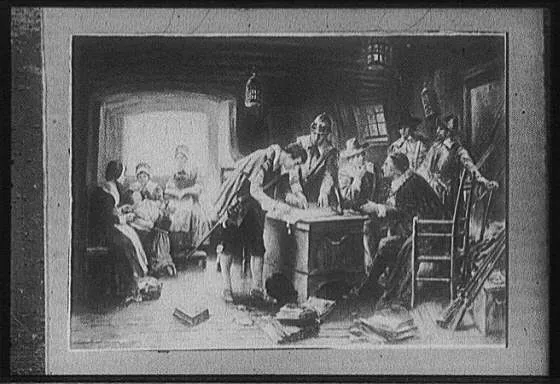
Source: Wikimedia Commons
The Mayflower Compact was the first written agreement for self-government in what would become the United States. In November 1620, over one hundred English colonists, known as the Pilgrims, arrived at Cape Cod aboard the Mayflower. Their original goal was to settle near the Hudson River, but a storm forced them hundreds of miles north. This unexpected change led to disagreement and uncertainty. Some passengers, not bound by the Pilgrims' religious goals, argued that the original charter did not apply in this new place. This created a serious problem: who would be in charge?
To solve this conflict, the adult male passengers wrote and signed the Mayflower Compact. This document was a compact, or formal agreement, to create laws and govern themselves as a group. The signers promised to make decisions based on the consent of the governed, meaning everyone would have a voice. The Compact established a basic framework for government, with rules for order and cooperation. No single person would have absolute power. Instead, authority would come from the community's agreement.
This act was significant because it represented a new approach to government in the colonies. Unlike monarchies in Europe, where a king or queen held all power, the Mayflower Compact was an early example of democracy. It set a precedent for future colonial governments that would be based on consent and shared responsibility. This principle of ruling by the will of the people would eventually influence the creation of the U.S. Constitution more than a century later.
However, the Compact was not a perfect solution. Only adult males signed it, leaving women, children, and servants without a direct say. Still, it provided a model for later documents and practices. The idea that government should be based on the agreement and participation of the people became a powerful tradition in America.
After signing the Compact, the Pilgrims faced a harsh winter and many hardships. Yet, the agreement helped them maintain order and unity as they built their settlement in Plymouth. The Compact's legacy can be seen in later American documents, such as the Fundamental Orders of Connecticut and, eventually, the U.S. Constitution.
By creating the Mayflower Compact, the Pilgrims addressed immediate challenges and shaped the foundations of American democracy. Their decision to rule by consent rather than force set a lasting example for generations to come.
Interesting Fact: The original Mayflower Compact document has been lost, but its words were recorded by early colonial leaders and survive in several copies.
Comprehension quiz (8 questions)
1. What was the Mayflower Compact?
2. Why did the Pilgrims create the Compact?
3. Who signed the Mayflower Compact?
4. What did the Compact set as a precedent?
5. How was the Compact different from European monarchies?
6. What was one limitation of the Compact?
7. The Mayflower Compact was signed in 1620. True or false?
8. What does 'consent' mean in the passage?
Common Core standards for Mayflower Compact: Early American Democracy Document
Explain events, procedures, ideas, or concepts in a historical, scientific, or technical text, including what happened and why, based on specific information in the text.
Determine the meaning of general academic and domain-specific words or phrases in a text relevant to a grade 4 topic or subject area.
Write informative/explanatory texts to examine a topic and convey ideas and information clearly.
Perfect for the way you teach
- Build comprehension skills
- Auto-graded quiz
- Differentiated reading
- Read together at home
- Improve fluency
- Quiet reading time
- Reading curriculum support
- Independent practice
- Track Lexile growth