Mendez v. Westminster
Interactive passage with audio narration, comprehension questions, and printable PDF.
By completing this purchase you agree to our Terms of Use and Privacy Policy. Your subscription renews automatically until you cancel. You can cancel anytime from your account settings. All sales are final and non-refundable. Digital content is available for download in your account immediately upon purchase.
What's included
Part of this bundle

Mendez v. Westminster preview and details
About this printable Mendez v. Westminster reading passage (Grades 3-5)
Sample passage and quiz from Mendez v. Westminster
Reading passage and comprehension quiz preview
Mendez v. Westminster
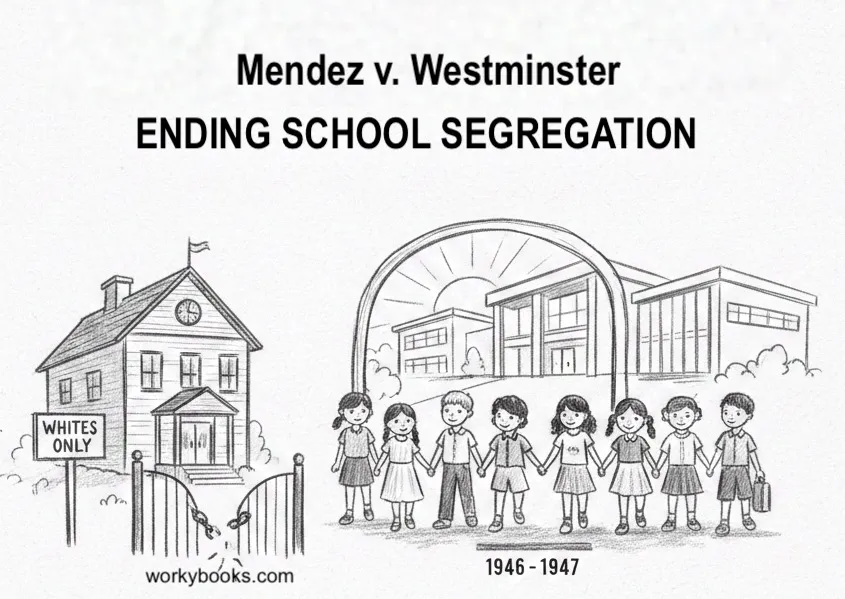
Mendez v. Westminster was a major court case in 1947 that changed schools in California. In the 1940s, many schools in California kept Mexican American children in separate schools from white children. These schools were often old and did not have as many resources. Mexican American families wanted their children to have a better education. They wanted their children to go to the same schools as everyone else.
Gonzalo Mendez and his wife, Felicitas, were Mexican American parents living in Orange County, California. When they tried to enroll their daughter, Sylvia, in the local school, she was told she could not attend because she was Mexican American. The Mendez family believed this was unfair and illegal. With the help of other families, they decided to fight for their children's rights.
The Mendez family and four other families sued four school districts in federal court. They argued that separating children by their background was wrong. The court agreed with the Mendez family. In 1947, the judge ruled that it was illegal to keep Mexican American children out of white schools. The schools had to accept all children, no matter their background. This was a big step for equal education in California.
The case of Mendez v. Westminster was important for the entire country. It showed that people could make a difference if they stood up for what was right. The victory helped inspire other civil rights cases, including Brown v. Board of Education in 1954. Brown v. Board ended school segregation across the United States.
Today, the story of Mendez v. Westminster reminds us that everyone deserves a fair chance to learn. The bravery of the Mendez family helped open doors for many students who came after them.
Segregation means keeping groups of people apart. Desegregation is the process of bringing those groups together. A lawsuit is when someone takes a problem to court. Ruling is the decision made by a judge. Inspire means to encourage others to act. Rights are freedoms or things people are allowed to have or do. Resources are things like books and supplies that help people learn.
Interesting Fact: Sylvia Mendez, the daughter in the case, later received the Presidential Medal of Freedom for her work in civil rights.
Comprehension quiz (8 questions)
1. Who was Sylvia Mendez?
2. What year was the case decided?
3. Where did Mendez v. Westminster happen?
4. Why did the Mendez family go to court?
5. How did the judge rule?
6. What did Mendez v. Westminster inspire?
7. School segregation ended in the U.S. in 1954. True or false?
8. What does 'resources' mean?
Common Core standards for Mendez v. Westminster
Explain events, procedures, ideas, or concepts in a historical, scientific, or technical text, including what happened and why, based on specific information in the text.
Determine the meaning of general academic and domain-specific words or phrases in a text relevant to a grade 4 topic or subject area.
Write informative/explanatory texts to examine a topic and convey ideas and information clearly.
Perfect for the way you teach
- Build comprehension skills
- Auto-graded quiz
- Differentiated reading
- Read together at home
- Improve fluency
- Quiet reading time
- Reading curriculum support
- Independent practice
- Track Lexile growth