Mexican Americans After 1848
Interactive passage with audio narration, comprehension questions, and printable PDF.
By completing this purchase you agree to our Terms of Use and Privacy Policy. Your subscription renews automatically until you cancel. You can cancel anytime from your account settings. All sales are final and non-refundable. Digital content is available for download in your account immediately upon purchase.
What's included
Mexican Americans After 1848 preview and details
About this printable Mexican Americans After 1848 reading passage (Grades 6-8)
Sample passage and quiz from Mexican Americans After 1848
Reading passage and comprehension quiz preview
Mexican Americans After 1848
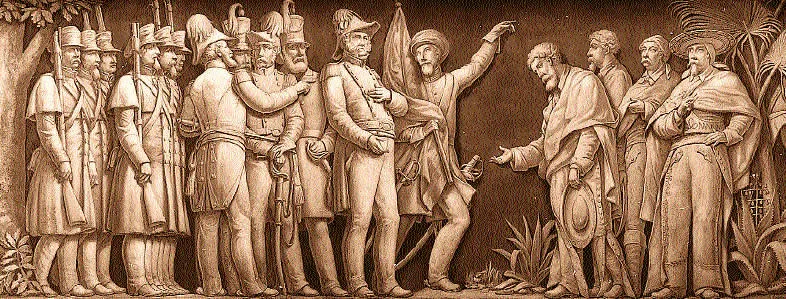
Source: Wikimedia Commons -Architect of the Capitol
The year 1848 marked a turning point for people of Mexican descent living in the American Southwest. After the Mexican-American War ended, the Treaty of Guadalupe Hidalgo transferred vast territories, including present-day California, Arizona, New Mexico, and Texas, from Mexico to the United States. This change meant that tens of thousands of Mexican citizens suddenly found themselves living under a new government, with new laws and expectations.
The treaty promised that the former Mexican citizens would be granted U.S. citizenship and that their property rights would be protected. However, the reality was much more complicated. Many Mexican Americans struggled to prove ownership of their land. American courts often required documents that were difficult to obtain or did not recognize traditional forms of land ownership. As a result, many families lost their homes, farms, and ranches, even though the treaty had guaranteed their rights.
In addition to losing property, Mexican Americans faced widespread discrimination. New laws and social attitudes treated them as outsiders, even though many had lived in the region for generations. They encountered unequal treatment in schools, jobs, and the legal system. Despite these obstacles, Mexican Americans found ways to adapt and resist. Some became leaders in their communities, advocating for equal treatment and justice. Others worked together to support each other through difficult times.
Despite these challenges, Mexican Americans made lasting contributions to the culture and economy of the Southwest. They shared their traditions, foods, music, and language, which became important parts of the region's identity. Their skills in farming, ranching, and business helped the economy grow. Over time, Mexican American communities built schools, churches, and businesses that reflected their heritage and values.
The experience of Mexican Americans after 1848 reveals the complexities of assimilation and identity in American history. While some adapted to new customs and language, many also preserved their traditions, creating a blend of cultures that is still visible today. Their story is a reminder that the promises written in treaties or laws do not always match what happens in people's lives. It also shows the importance of resilience and community in overcoming injustice.
Today, the legacy of Mexican Americans after 1848 can be seen throughout the United States, especially in the Southwest. Their history demonstrates the challenges faced by minority groups and the ways they have shaped the nation. By examining this period, we learn about the ongoing struggle for equality, the value of cultural diversity, and the power of communities to survive and thrive in the face of adversity.
Interesting Fact: The Treaty of Guadalupe Hidalgo more than doubled the size of the United States and affected the lives of around 80,000 Mexican citizens who suddenly became Americans almost overnight.
Comprehension quiz (8 questions)
1. When was the Treaty of Guadalupe Hidalgo signed?
2. Which states were affected by the treaty?
3. How many Mexican citizens became Americans?
4. Why did many Mexican Americans lose land?
5. What was one result of discrimination?
6. How did Mexican Americans help the Southwest?
7. The treaty protected all property rights. True or False?
8. What does 'assimilation' mean?
Common Core standards for Mexican Americans After 1848
Explain events, procedures, ideas, or concepts in a historical, scientific, or technical text, including what happened and why, based on specific information in the text.
Determine the meaning of general academic and domain-specific words or phrases in a text relevant to a grade 4 topic or subject area.
Write informative/explanatory texts to examine a topic and convey ideas and information clearly.
Perfect for the way you teach
- Build comprehension skills
- Auto-graded quiz
- Differentiated reading
- Read together at home
- Improve fluency
- Quiet reading time
- Reading curriculum support
- Independent practice
- Track Lexile growth